Transcription of SCHEME OF EXAMINATION
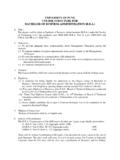
1 SCHEME OF EXAMINATION & syllabi of bachelor OF business administration for First to Sixth Semester ( 2005 2006 Academic Session) GURU GOBIND SINGH INDRAPRASTHA UNIVERSITY KASHMERE GATE, DELHI-110 006 SCHEME OF EXAMINATIONS bachelor OF business administration PROGRAMME First Semester EXAMINATION Code No. Paper L T/P Credits BBA 101 Principles of Management 4 - 4 BBA 103 business Economics-I 4 - 4 BBA 105 business Mathematics 4 - 4 BBA 107 Computer Fundamentals 4 - 4 BBA 109 Financial Accounting 4 - 4 BBA 111 Personality Development & Communication Skills-I 4 - 4 PRACTICAL BBA 113 Computer Lab 0 4 2 Total 24 4 26 bachelor OF business administration PROGRAMME Second Semester EXAMINATION Code No. Paper L T/P Credits BBA 102 business Organization 4 - 4 BBA 104 business Economics-II 4 - 4 BBA 106 Quantitative Techniques & Operations Research in Management 4 - 4 BBA 108 Data Base Management System 4 - 4 BBA 110 Cost Accounting 4 - 4 BBA 112 Personality Development & Communication Skills-II 3 - 3 PRACTICAL BBA 114 DBMS Lab 0 06 3 Total 23 06 26 bachelor OF business administration PROGRAMME Third Semester EXAMINATION Code No.
2 Paper L T/P Credits BBA 201 Organizational Behaviour 4 - 4 BBA 203 Indian Economy 4 - 4 BBA 205 Marketing Management 4 - 4 BBA 207 Computer Applications-I 4 - 4 BBA 209 Management Accounting 4 - 4 BBA 211 Personality Development & Communication Skills-III (Minor Project Report) - - 6 PRACTICAL BBA 213 Computer Application Lab-I 0 4 2 Total 20 4 28 bachelor OF business administration PROGRAMME Fourth Semester EXAMINATION Code No. Paper L T/P Credits BBA 202 Human Resource Management 4 - 4 BBA 204 business Environment 4 - 4 BBA 206 Marketing Research 4 - 4 BBA 208 Computer Application-II 4 - 4 BBA 210 business Laws 4 - 4 BBA 212 Taxation Laws 4 - 4 PRACTICAL BBA 214 Computer Applications Lab-II - 4 2 Total 24 4 26 Note: At the end of the Fourth Semester all the students shall have to undergo Summer Trainee for Eight Weeks. bachelor OF business administration PROGRAMME Fifth Semester EXAMINATION Code No.
3 Paper L T/P Credits BBA 301 Values & Ethics in business 4 - 4 BBA 303 Marketing Management-II 4 - 4 BBA 305 Production & Operations Management 4 - 4 BBA 307 Management Information System 4 - 4 BBA 309 Financial Management 4 - 4 BBA 311 Summer Training Report & Viva Voce - - 6 PRACTICAL BBA 313 Computer Applications Lab - 4 2 Total 20 4 28 bachelor OF business administration PROGRAMME Sixth Semester EXAMINATION Code No. Paper L T/P Credits BBA 302 business Policy & Strategy 4 - 4 BBA 304 Project Planning & Evaluation 4 - 4 BBA 306 Entrepreneurship Development 4 - 4 BBA 308 International business Management 4 - 4 BBA 310 Project Report and Viva-Voce - - 6 BBA 312 Environmental Science 4 - 4 Total 20 - 26 NOTES: I. MINOR PROJECT Prior to the beginning of the End Semester EXAMINATION of the Second Semester the subjects on which each student shall be pursuing his / her Minor Project in relation to a business firm during Summer Vacation and the respective internal supervisors shall be finalized by the concerned Principal / Director of the Institute wherein BBA Programme is being run.
4 After completion of the assigned Project a Project Report in respect of the same shall be submitted to the concerned Director/Principal within two weeks of the commencement of the Third Semester. The Minor Project shall carry 100 marks , marks equivalent to one course and it shall be pursued by every student under the supervision of one internal supervisor to be appointed by the Principal / Director of the Institute from among the Faculty Members handling the various BBA courses. It shall be evaluated jointly by the Internal Supervisor and the External Examiner. The Internal Supervisor shall award marks out of 50 and the External Examiner shall award marks out of 50. The External Examiner shall be appointed by the University. II. SUMMER TRAINING PROJECT Each student shall undergo practical training of eight weeks during the vacations after fourth semester in an approved business / industrial / service organization and submit at least two copies of the Summer Training Report to the Director / Principal of the Institution within two weeks of the commencement of the Fifth Semester.
5 The Summer Training Report shall Carry 100 marks. It shall be evaluated for 50 marks by an External Examiner to be appointed by the University and for the rest of the 50 marks by an Internal Board of Examiners to be appointed by the Director / Principal of the Institution. This internal Board of Examiners shall comprise of a minimum of two Internal Faculty Members. III. FINAL YEAR PROJECT REPORT During the sixth semester each student shall undertake a project to be pursued by him / her under the supervision of an Internal Supervisor to be appointed by the Director / Principal. Both the subject and the name of the Supervisor will be approved by the Director / Principal of the Institution. The Project Report in duplicate along with one soft copy in a floppy will be submitted at least four weeks prior to the commencement of the End Term EXAMINATION of the Sixth Semester.
6 Project Report shall carry 100 marks. These shall be evaluated by an External Examiner appointed by the University for 50 marks and for the rest of the 50 marks by an Internal Board of Examiners to be appointed by the Director / Principal of the Institution. This internal Board of Examiners shall comprise of a minimum of two Internal Faculty Members. MAXIMUM & MINIMUM CREDITS OF THE PROGRAM The total number of the credits of the BBA Programmes is 160. Each student shall be required to appear for examinations in all courses. However, for the award of the degree a student should secure at least 150 credits. BBA GGS Indraprastha University BBA 101: Principles of Management L-4 T/P-0 Credits-4 Objectives: The course aims at providing fundamental knowledge and exposure to the concepts, theories and practices in the field of management.
7 Course contents: Unit I lectures:- 14 Introduction: Concept, nature, process and significance of management; Managerial levels, skills, functions and roles; Management Vs. administration ; Coordination as essence of management; Development of management thought: classical, neo-classical, behavioral, systems and contingency approaches. Unit II lectures:- 14 Planning: Nature, scope and objectives of planning; Types of plans; Planning process; business forecasting; MBO; Concept, types, process and techniques of decision-making; Bounded Rationality. Organising: Concept, nature, process and significance; Principles of an organization; Span of Control; Departmentation; Types of an organization; Authority-Responsibility; Delegation and Decentralization; Formal and Informal Organization.
8 Unit III lectures:- 14 Staffing: Concept, Nature and Importance of Staffing. Motivating and Leading: Nature and Importance of motivation; Types of motivation; Theories of motivation-Maslow, Herzberg, X, Y and Z; Leadership meaning and importance; Traits of a leader; Leadership Styles Likert s Systems of Management, Tannenbaum & Schmidt Model and Managerial Grid. Unit IV lectures:-6 Controlling: Nature and Scope of control; Types of Control; Control process; Control techniques traditional and modern; Effective Control System. Text Books 1. Stoner, Freeman and Gilbert Jr.; Management, Prentice Hall of India, New Delhi, 2003. 2. Gupta, ; Management Concepts and Practices, Sultan Chand and Sons, New Delhi, 2003.
9 Reference Books O Donnel and Weirich- Management ,Tata McGraw Hill Publishing Company,New Delhi,2001. Principles&Pracitices of Management , Sun India Publication. and , Principles&Pracitices of Management ,2nd edition,Tata McGrawHill. BBA GGS Indraprastha University BBA 103: business Economics-I L-4 T-0 Credit-4 Objectives: The objective of this subject is to give understanding of the basic concepts and issues in business economics and their application in business decisions. Course Contents: Unit I lectures:-6 Introduction to business Economics and Fundamental concepts Nature, Scope, Definitions of business Economics, Difference Between business Economic and Economics, Contribution and Application of business Economics to business . Micro Vs. Macro Economics.
10 Opportunity Costs, Time Value of Money, Marginalism, Incrementalism, Market forces and Equilibrium, Risk, Return and Profits. Unit II lectures:-18 Consumer Behaviour and Demand Analysis Cardinal Utility Approach: Diminishing Marginal Utility, Law of Equi-Marginal Utility. Ordinal Utility Approach: Indifference Curves, Marginal Rate of Substitution, Budget Line and Consumer Equilibrium. Theory of Demand, Law of Demand, Movement along Vs. Shift in Demand Curve, Concept of Measurement of Elasticity of Demand, Factors Affecting Elasticity of Demand, Income Elasticity of Demand, Cross Elasticity of Demand, Advertising Elasticity of Demand and Expectation Elasticity of Demand. Demand Forecasting: Need, Objectives and Methods (Brief) Unit III lectures:-6 Theory of Production Meaning and Concept of Production, Factors of Production and production function.