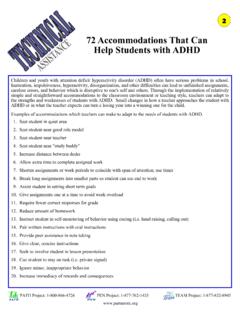
Transcription of School-based Interventions for Students with ADHD
1 School-based Interventions for Students with ADHDG eorge J. DuPaul, Psychology ProgramLehigh UniversityBethlehem PASeptember 20152 Agenda Brief overview of treatment for adhd Overview of School-based Interventions Principles underlying School-based Interventions Behavioral classroom strategies Academic support Home-school communication Self-regulation strategies Integrating medication & School-based intervention Guiding principles for School-based intervention Wrap-up & discussion3 Most Common Interventions for Children with adhd Psychotropic Medication ( , CNS stimulants such as methylphenidate) Home-based contingency management (behavioral parent training) School-based contingency management Interventions ( , token reinforcement) Academic tutoring Daily report card or school-home notesSchool-Based Interventions for Students with adhd Behavioral classroom strategies Academic support Home-school communication Self-regulation strategies4 DuPaul & Stoner (2014)5 School-based Interventions .
2 Core Principles Balanced treatment plan Use multiple mediators (not just reliance on classroom teacher) Consider behavioral function Link intervention design to assessment data6 Balance between Proactive and Reactive Strategies Proactive strategies involve doing something beforebehavior occurs to reduce probability of problems occurring Reactive strategies involve doing something afterbehavior occurs to either reduce or increase probability of future occurrence Too often rely solely on reactive strategies Need to increase focus on being preventive and proactive Intervention plan should always include both proactive & reactive procedures (emphasis on positive)7 School-based Interventions for adhd Manipulating Antecedents (Proactive) Post Rules Instructional Modifications Workload Adjustment ( accommodation ) Providing Choices Peer Tutoring8 School-based Interventions for adhd (cont.)
3 Manipulating Consequences (Reactive) Token Reinforcement Verbal Reprimands Response Cost Time Out from Positive Reinforcement Self-Management9 Possible Mediators for School-based Interventions Teacher-mediated Instructional strategies; Token reinforcement Parent-mediated Parent tutoring; Home-based reinforcement Peer-mediated Classwidepeer tutoring Computer-assisted Drill-and-practice Self-mediated Self-monitoring; Self-management10 Possible Functions of adhd Behavior Avoid/escape effortful tasks Obtain peer attention Obtain teacher attention Obtain tangible object Sensory stimulation11 Link Interventions to Behavioral Function Avoid/escape effortful tasks Increase stimulation value of task and/or provide brief attention breaks Obtain peer attention Provide peer attention following appropriate behavior ( , peer tutoring) Obtain teacher attention Provide attention following appropriate behavior while ignoring inappropriate behavior (or time out from positive reinforcement)
4 12 TEACHING TECHNIQUES TO PREVENT BEHAVIOR PROBLEMS Remind Students of rules Maintain eye contact with Students Remind Students about expected behaviors Circulate thru classroom to monitor/provide feedback Use nonverbal cues to redirect Maintain brisk pace of instruction Insure understanding of activities Manage transitions in well-organized manner Communicate expectations about use of class timeSee Paine et al. (1983)13 TOKEN REINFORCEMENT Establish behavioral or academic goals Choose several target situations Break situation (task) into smaller units Tokens (points, stickers) provided immediately Tokens turned in for privileges at end of day Could also incorporate response cost, if necessarySTUDENT CONTRACT Specify several short-term objectives Identify possible contingencies Positive for reaching goal Aversive for rule violations Determine time period for meeting goals Include both short and long-term payoffs Agreement by both student and teacher (counselor)
5 To follow through Periodic revisions of contract as necessaryAcademic Support Explicit instruction in academic skills Peer tutoring Computer-assisted instruction1516 CLASSWIDE PEER TUTORING Divide classroom into pairs Provide academic scripts Take turns tutoring Immediate feedback & error correction Teacher monitors progress & provides bonus points Points tallied & progress charted Pairs change weekly17 CWPT Effects on adhd (DuPaul et al., 1998) 18 ch. w/ adhd & 10 comparison Students (1st to 5th grade gen. ed.) CWPT increased active engagement w/ reduction of off-task behavior 50% of adhd improved academically Positive effects for comparison peers High rates of student and teacher satisfaction18 COMPONENTS OF EFFECTIVE HOME-SCHOOL COMMUNICATION PROGRAM Daily/weekly goals specified in a positive manner Both academic and behavioral goals included Small number of goals at a time Quantitative feedback about performance Feedback provided by subject or class period Communication is made on a regular basis (either daily or weekly) Home-based contingencies tied to performance (both short-term and long-term)Barkley & Murphy (2006)Daily Report Card ExampleBehaviors to be rated.
6 1234567 Class participationClasswork performanceFollows class rulesGets along well w/othersQuality of HWTeacher s initialsComments on backClass Periods/SubjectsHOME-SCHOOL PROGRAM (cont.) Parental cooperation solicited prior to implementation Student input into goals and contingencies Goals/procedures modified as necessary Associated with reduction in rule violations and greater academic productivity (see Owens et al., 2012) More information: PROGRAM (cont.) Probability of positive txresponse higher for younger children (K-3) who have never repeated a grade (Owens, 2013) Largest improvement obtained in 1stmonth (ES = .78) with gradual reduction in incremental benefit over time (Owens, 2013) Thus, program should be tried for at least one month before discontinuingSelf-Regulation Strategies for adhd Self-monitoring Self-evaluation & self-reinforcement2223 Self-monitoring of organizational skills Adolescents with adhd typically have difficulties in class prep.
7 And HW For some Students , problems related to poor attention to detail and low motivation to complete mundane tasks Possible Students can be trained to monitor own behaviors ( , being ready for class)24 Self-monitoring of org. skills: Controlled case study (Gureasko,DuPaul, & White, 2006) Three 7th grade Students with adhd All had significant problems being prepared for class Checklist of preparatory behaviors developed with teachers (% steps) Training in self-monitoring (4 days) Self-monitoring followed by fading Gains in organizational skills maintained without treatment Replicated with additional 6 middle school Students and extended effects to homework performance (Gureasko-Moore et al.)
8 , 2007)25 SELF-EVALUATION PROGRAM Initially incorporates external and internal evaluation but works toward complete self-monitoring and evaluation Teacher and student independently grade student performance regarding behavior and academics for specified work period Established performance criteria Points earned for performance Bonus points for matching ratings Penalitiesfor inflated ratings Points turned in for school based or home based privileges26 Sample Self-Evaluation Criteria 5 = Excellent Followed all rules for entire interval; Work 100% correct 4 = Very Good Minor infraction of rules; Work at least 90% correct 3 = Average No serious rule offenses; Work at least 80% correct 2 = Below Average Broke rules to some degree: Work 60 to 80% correct 1 = Poor Broke rules almost entire period; Work 0 to 60% correct 0 = Unacceptable Broke rules entire period; No work completed27 SELF-EVALUATION (cont.
9 Gradual weaning from external ratings Longer work periods to be rated Periodic, random matching challenges Eventual reliance on self-ratings only Factors to consider: Practical constraints Drift of student ratings Prepare student using external system28 Integrating Interventions Research indicates that combined medication and behavioral intervention is optimal for many children with adhd Possible reduction in dosage of complementary treatments Examples: MTA study; classroom intervention study (Fabianoet al., 2007)29 Frequency of classroom Rule Violations (Fabiano et al., 2007) mg/kgMedicationFrequencyNo BMODLow BMODHigh BMOD30 Percentage of Seatwork Completed (Fabiano et al.)
10 , 2007)31 Interventions for Students with adhd : Guiding Principles Stimulant medication is single most effective treatment for reducing adhd symptoms Psychosocial (behavioral) treatments at home & school address impairments in functioning Intervention design linked directly to assessment data ( , functional behavioral assessment) School-based Interventions associated with moderate to large effects on academic & behavioral outcomes Academic Interventions for academic outcomes Behavioral, self-regulation, and academic Interventions for behavioral outcomes Multiple mediators beyond classroom teacher should be involved32 Guiding Principles for Intervention (cont.) Intervening as early as possible is important, especially in key functioning areas ( , reading) All behavior serves a purpose; intervention should lead to functionally equivalent behavior Aim for balance between proactive and reactive strategies Typically no single intervention is sufficient; multi-component and multi-setting intervention is presumed more effective Whenever possible, School-based Interventions should be tried before medication and/or educational accommodationsQuestions and Discussion33 References Barkley, R.