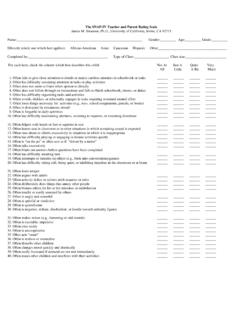
Transcription of Scoring Instructions for the SNAP-IV-C Rating Scale
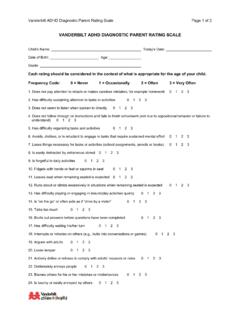
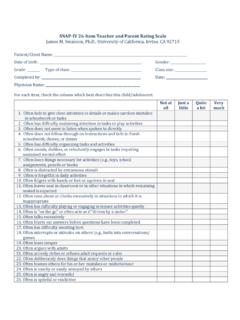
1 Scoring Instructions for the SNAP-IV-C Rating ScaleThe SNAP-IV Rating Scale is a revision of the Swanson, Nolan and pelham (SNAP) Questionnaire (Swanson et al, 1983). The items from the DSM-IV(1994) criteria for Attention-Deficit/Hyperactivity Disorder (ADHD) are included for the two subsets of symptoms: inattention (items #1-#9) and hyperactivity/impulsivity (items #11-#19). Also, items are included from the DSM-IV criteria for Oppositional Defiant Disorder (items #21-#28) since it often is present inchildren with ADHD. Items have been added to summarize the Inattention domain (#10) and the Hyperactivity/Impulsivity domain (#20) of ADHD. Two otheritems were added: an item from DSM-III-R (#29) that was not included in the DSM-IV list for ODD, and an item to summarize the ODD domain (#30).In addition to the DSM-IV items for ADHD and ODD, the SNAP-IV contains items from the Conners Index Questionnaire (Conners, 1968) and the IOWAC onners Questionnaire (Loney and Milich, 1985).
2 The IOWA was developed using divergent validity to separate items which measure inattention/overactivity (I/O items #4, #8, #11, #31, #32) from those items which measure aggression/defiance (A/D items #21, #23, #29, #34, #35). The Conners Index (items #4, #8,#11, #21, #32, #33, #36, #37, #38, #39) was developed by selecting the items which loaded highest on the multiple factors of the Conners Questionnaire, and thusrepresents a general index of childhood SNAP-IV is based on a 0 to 3 Rating Scale : Not at All = 0, Just A Little = 1, Quite A Bit = 2, and Very Much = 3. Subscale scores on the SNAP-IV arecalculated by summing the scores on the items in the subset and dividing by the number of items in the subset. The score for any subset is expressed as the AverageRating-Per-Item, as shown for ratings on the ADHD-Inattentive (ADHD-I) subset: Not At Just A Quite Very Item All Little A Bit Much Score1. Makes careless mistakes ____ ____ __X_ ____ 22.
3 Can t pay attention____ ____ ____ __X_ 33. Doesn t listen____ ____ ____ __X_ 34. Fails to finish work____ ____ __X_ ____ 25. Disorganized____ __X_ ____ ____ 1 ADHD-In Total = 18, Average = 18/9 = Can t concentrate____ ____ ____ __X_ 37. Loses things____ __X_ ____ ____ 18. Distractible____ ____ ____ __X_ 39. Forgetful__X_ ____ ____ _____ 0A Scoring template for the DSM-IV subtypes of ADHD (In and H/Im), for ODD; for the dimensions of the CLAM (I/O and A/D); and for the ConnersIndex are presented below:ADHD-In ADHD-H/Im ODD I/OA/D Conners Index# 1 _____ #11 _____ #21 _____ # 4 _____ #21 _____ # 4 _____# 2 _____ #12 _____ #22 _____ # 8 _____ #23 _____ # 8 _____# 3 _____ #13 _____ #23 _____ #11 _____ #29 _____ #11 _____# 4 _____ #14 _____ #24 _____ #31 _____ #34 _____ #21 _____# 5 _____ #15 _____ #25 _____ #32 _____ #35 _____ #32 _____# 6 _____ #16 _____ #26 _____ #33 _____# 7 _____ #17 _____ #27 _____ #36 _____# 8 _____ #18 _____ #28 _____ #37 _____# 9 _____
4 #19 _____ #38 _____ #39 _____ Total In = _____ H/Im = _____ ODD = _____ I/O = _____ A/D = _____ CI = _____ Average = _____ = _____ = _____ = _____ = _____ = _____C = _____ = _____TeacherParentTentative 5% Cutoffs:ADHD-In items on page 2 of the SNAP-IV Rating Scale are from other DSM-IV disorders which may overlap with or masquerade as symptoms of ADHD. Insome cases, these may be comorbid disorders, but in other cases the presence of one or more of these disorders may be sufficient to exclude a diagnosis of SNAP-IV is not designed to be used in the formal process of diagnosing these non-ADHD disorders, but if symptoms on page 2 of the SNAP-IV receive a high( Quite A Bit or Very Much ) Rating , then an assessment of the implicated non-ADHD disorders may be DSM-IV Manual should be consulted to follow-up with an evaluation of these non-ADHD disorders.
5 The DSM Codes and the page numbers in theDSM Manual are specified below to help in the assessment of possible conditions which may exclude or qualify a diagnosis of ADHD. A referral to a psychiatristor a clinical psychologist may be required.#41-#45 Conduct Disorder(DSM , p. 85)#46 Intermittent Explosive Disorder(DSM , p. 609)#47 Tourette s Disorder(DSM , p. 103)#48 Stereotypic Movement Disorder(DSM , p. 121)#49-#50 Obsessive-Compulsive Disorder(DSM , p. 417)#51-#56 Generalized Anxiety Disorder(DSM , p. 432)#57 Narcolepsy(DSM 347, p. 562)#58 Histrionic Personality Disorder(DSM , p. 655)#59 Narcissistic Personality Disorder(DSM , p. 658)#60 Borderline Personality Disorder(DSM , p. 650)#61-#65 Manic Episode(DSM , p. 328)#66-#73 Major Depressive Episode(DSM , p. 320)#74-#76 Dysthymic Disorder(DSM , p. 345)#77-#78 Posttraumatic Stress Disorder(DSM , p. 424)#79-#80 Adjustment Disorder(DSM 309, p.)
6 623)Finally, the SNAP-IV includes the 10 items of the Swanson, Kotkin, Agler, Mylnn, and pelham (SKAMP) Rating Scale . These items are classroommanifestations of inattention, hyperactivity, and impulsivity ( , getting started, staying on task, interactions with others, completing work, and shifting activi-ties). The SKAMP may be used to estimate severity of impairment in the is important to note that many disorders may produce impairment in the classroom setting, not just ADHD. Therefore, this Rating Scale is presented lastto the possible exclusion conditions (on page 2 of the SNAP-IV) will be considered in addition to the inclusion criteria for ADHD (on page 1 of the SNAP-IV).Both should be considered before interpreting the SKAMP measure of classroom impairment or attributing high ratings on the SKAMP to #81 _____#87 _____#82 _____#88 _____#83 _____#89 _____#84 _____#90 _____#85 _____#86 _____ Total = _____ = _____ Avg.
7 = _____ = _____Orienting (#81,#86) = _____Attention to Other (#87,#88) = _____Maintaining (#82,#83) = _____Attention to Rules (#89,#90) = _____Directing (#84,#85) = _____