Transcription of SDS 32 - Refrigerants
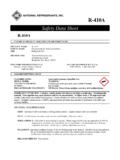
1 R-32 Safety Data Sheet R-32 1. CHEMICAL PRODUCT AND COMPANY IDENTIFICATION PRODUCT NAME: R-32 OTHER NAME: 1,1- Difluoromethane USE: Refrigerant Gas DISTRIBUTOR: National Refrigerants , Inc. 661 Kenyon Avenue Bridgeton, New Jersey 08302 FOR MORE INFORMATION CALL: IN CASE OF EMERGENCY CALL: (Monday-Friday, 8:00am-5:00pm) CHEMTREC: 1-800-424-9300 1-800-262-0012 2. HAZARDS IDENTIFICATION CLASSIFICATION: Flammable Gas, Gas under pressure, Compressed Gas SIGNAL WORD: DANGER HAZARD STATEMENT(S): Extremely flammable gas, Contains gas under pressure, may explode if heated SYMBOL(S): Flames, Gas Cylinder PRECAUTIONARY STATEMENT(S): Prevention: Keep away from heat, sparks, open flame, and hot surfaces.
2 No Smoking Response: Leaking gas fire: Do not extinguish unless leak can be stopped immediately. Eliminate all ignition sources if safe to do so. Storage: Protect from sunlight, store in a well ventilated place. EMERGENCY OVERVIEW: Flammable gas. Liquid under high pressure. POTENTIAL HEALTH EFFECTS: Efrfects of Overexposure: Eye Contact Eye Contact with the rapidly evaporation liquid my cause frostbite. Skin Contact Skin contact with the rapidly evaporation liquid may cause frostbite. Frostbite effects are a change in color of the skin to R-32 _____ SDS: R-32 Page 2 of 8 Current Issue Date: May, 2018 grey or white, followed by blistering.
3 Inhalation Vapor is heavier than air and can cause suffocation by reducing oxygen available for breathing. Inhalation of high vapor concentration may cause dizziness, disorientation, incoordination, narcosis, nausea or vomiting, leading to unconsciousness, cardiac irregularities, or death. Ingestion Not an expected route of exposure. OTHER EFFECTS OF OVEREXPOSURE: None Expected. 3. COMPOSITION / INFORMATION ON INGREDIENTS INGREDIENT NAME CAS NUMBER WEIGHT % 1,1-Difluoromethane 75-10-5 100 COMMON NAME and SYNONYMS R-32; HCFC-32 There are no impurities or stabilizers that contribute to the classification of the material identified in Section 2 4.
4 FIRST AID MEASURES SKIN: Immediately wash with plenty of warm water (do not rub). Thaw affected area with water. Remove contaminated clothing. Caution: clothing may adhere to the skin in case of freeze burns. If symptoms (irritation or blistering) develop, get medical attention. EYES: Immediately flush with plenty of water. After initial flushing, remove any contact lenses and continue flushing for at least 15 minutes. Hold eyelids open during flushing. Have eyes examined and treated by medical personnel. INHALATION: Move victim to fresh air. Keep warm and at rest. If breathing is labored, give oxygen.
5 If only breathing has stopped, give artificial respiration with a pocket mask equipped with a on-way valve to prevent exposure to product or body fluids. If breathing has stopped and there is no pulse, give cardiopulmonary resuscitation (CPR). Get immediate medical attention. INGESTION: Highly unlikely, but should this occur, freeze burns will result. Do not induce vomiting unless instructed to do so by a physician. ADVICE TO PHYSICIAN: Symptomatic and supportive therapy, as indicated. Administration of epinephrine or similar sympathomimetic drugs should be with special caution and only in situations of emergency life support as cardiac arrhythmias may result R-32 _____ SDS: R-32 Page 3 of 8 Current Issue Date: May, 2018 5.
6 FIRE FIGHTING MEASURES FLAMMABLE PROPERTIES FLASH POINT: Not applicable AUTOIGNITION TEMPERATURE: Not available UPPER FLAME LIMIT: 31% (% v/v) LOWER FLAME LIMIT: 14% (% v/v) HAZARDOUS REACTIONS: Reacts with finely divided metals such as aluminum, zinc, magnesium, and alloys containing more the 2% magnesium. Can react violently if in contact with alkali metals and alkaline earth metals such as sodium, potassium, or barium. During a fire the product can form toxic and corrosive gases such as hydrogen fluoride. EXTINGUISHING MEDIA: Suitable extinguishing medium is dry powder. Allow escaping gas to urn under controlled conditions.
7 Extinguish only if escape of gas can be rapidly stopped as it may form a flammable vapor cloud. FIRE AND EXPLOSION HAZARDS: Flammable liquefied gas. Container may burst under intense heat. Ruptured cylinders may rocket or fragment. Heavy vapor may suffocate. Certain mixtures of HFC-32 and chlorine may be flammable under some conditions. FIRE FIGHTING PROCEDURES: Water spray should be used to cool containers. FIRE FIGHTING PROTECTIVE EQUIPMENT: Use self-contained breathing apparatus with a full-face piece and special protective clothing. 6. ACCIDENTAL RELEASE MEASURES This product is a flammable, liquefied gas, which exits the container at temperatures capable of causing freeze burns (frostbite).
8 Contents under pressure. Ruptured cylinder may rocket or fragment. Precautions should take into account the severity of the leak or spill. Move unprotected personnel upwind of leaking container. Remove ignition sources and ventilate the spill area. Use recommended personal protection and shut off the leak, if without risk. If possible, elevate leak position to highest point of container (should leak gas, not liquid). Water should never be put on leak nor should cylinder be immersed. If possible, dike and contain spillage. Prevent liquid from entering sewers sumps, or pit areas since vapor is heavier than air and can create a suffocation atmosphere.
9 Capture material for recycle or destruction if suitable equipment is available. Notify applicable government authority if release is reportable or could adversely affect the environment. R-32 _____ SDS: R-32 Page 4 of 8 Current Issue Date: May, 2018 7. HANDLING AND STORAGE HANDLING: Wear appropriate personal protective equipment. A safety shower and eyewash station should be nearby and ready for use. This product is a flammable, liquefied gas, which exits the container at temperatures capable of causing freeze burns (frostbite). Ensure personnel are trained in handling and storing cylinders.
10 Secure containers at all times. Keep containers closed when not in use. Ensure there is adequate ventilation or use proper respiratory protection in poorly ventilated or confined areas. Avoid causing and inhaling high concentration or vapor. Atmospheric levels should be controlled to below the occupational exposure limit and kept as low as practicable. Prevent liquid or vapor from entering sumps or sewers since vapor is heavier than air and may form suffocating atmospheres. Do not put mixtures of HFC-32 with air or oxygen under pressure; do not use such mixtures for leak or pressure not heat containers.