Transcription of SEA 157SA - SEA Marine Communications …
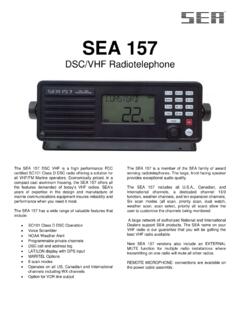
1 SEA 157 SAVHF/FM DSC Class A Marine RadioThe new SEA 157SA VHF/FM DSC Marine Radios are compliant to ITU and IMO standards for DSC Class A GMDSS radios. These new VHF transceivers are built on the widely accepted and proven model 157 platform and award winning DSP technology. Several advanced communication capabilities and new feature sets enhance operator safety and efficiency for individual vessel and fleet operators. These features meet the demanding technical performances and operational requirements of today s professional Maritime Operators and fleet new features include a high-resolution display; transmitter/receiver bandwidth covers all USA/Int l channels and selective private channel access (with FCC license), Public Coast Station calling operations, dedicated DSC receiver/controller (Channel 70), plus software expandable user/operator interfaces and operator setup functions.
2 These radios can be programmed to support Fleet Management operations such as automatic position broadcasting and external PC applications for asset tracking, text and data messaging and command and control functions. Critical functions can be programmed in advance as set and forget radio operations. * Note; certain features require an external PC Application. The 157SA /R (Remote) features SEABUSS interconnection with unique Remote Control capability. With all the new features, 157S models remain easy to operate and to program. Professional and Commercial SEA 157S model versions are in production and available for SEA 157SA radio features include.
3 (* certain features require an external PC App)Channel 70 and Working Channel DSC capability Selective ID and Group CallingDistress Call Management Missed Call LogDual Watch and Priority Scan VDR Output Working Channel SecurityExcellentAudio Quality Extensive Calling & ID Directories Encryption Automatic Position Reporting * Text & Short
4 Messaging Options *I/O ports for PC & GPSText Message and Data options* ..designed for Professional Operators, Commercial Fleets and Public Safety SEA COM CORPORATION7030 - , Mountlake Terrace, Washington 98043, Fax: subject to change without notice or obligation. 157SA (7/11) 2009 SEA Printed in the Range:155 to 163 MHzNumber of Channels: Marine US, Canada &International 10 NOAA weather channelsOptional Part 90 @ kHz *Input Voltage:12 VDC +30% - 10% ( ) negative ground Current Drain:Standby ATransmit (25W) (1W)FCC ID:YIBSEA157 SFCC Type Certifications:Includes Part 80 and Part 90 Warranty:Two Year - LimitedModels and Order Numbers:SEA157SA for standard radioSEA157SA/R for Remote versionNavigation Interface:RS-232 Serial I/O & NMEA 0183 Clock:Date and time of day, battery backedCalling Formats.
5 All formats per , ITU-R & IMO for GMDSS Class A,Extended DSC, GMSK Option,CTCSS optionDSC OPERATIONITU Recommendations:Current ITU R. 493 and 541 IMO (17) and (19)Memory:Nonvolatile memory for unit DSC ID,Emergency Calls, frequently called DSC ID numbers, Call Groups, Coast Stations by ID and Missed calls. RECEIVERF requency Range:155 to 163 MHzSensitivity:Less than .3uV for 12dB SINADLess than .4uV for 20dB quietingSelectivity:At least 80dB at 25 KHz85dB at 50 KHz or greaterIM Ratio:At least 80dBSpurious andImage Rejection:At least 80dBAudio Output:4W, less than 10% distortion across4 OhmsVDR and Audio Line RMS on 600 Ohm Balanced or Unbalanced TX and RX line out TRANSMITTERF requency Range:155 to 163 MHzModulation types:25 kHz and kHz Voice/DataFrequency Stability:Exceeds @-30 to +60 CPower Output:25W.
6 1W into 50 OhmsAudio Response:6dB per octave pre-emphasis300 to 3000 HzAudio Distortion:Less than 10%Spurious andHarmonic Radiation:At least 60dB below rated carrierDimensionsin. (mm)Weight;SEA 157S3 lbs ( kg)SEA 157SA Specifications