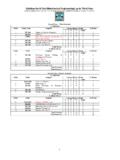
Transcription of Section 1: Engineering Mathematics
1 CE civil Engineering Section 1: Engineering Mathematics Linear Algebra: Matrix algebra; Systems of linear equations; Eigen values and Eigen vectors. Calculus: Functions of single variable; Limit, continuity and differentiability; Mean value theorems, local maxima and minima, Taylor and Maclaurin series; Evaluation of definite and indefinite integrals, application of definite integral to obtain area and volume; Partial derivatives; Total derivative; Gradient, Divergence and Curl, Vector identities, Directional derivatives, Line, Surface and Volume integrals, Stokes, Gauss and Green s theorems.
2 Ordinary Differential Equation (ODE): First order (linear and non-linear) equations; higher order linear equations with constant coefficients; Euler-Cauchy equations; Laplace transform and its application in solving linear ODEs; initial and boundary value problems. Partial Differential Equation (PDE): Fourier series; separation of variables; solutions of one-dimensional diffusion equation; first and second order one-dimensional wave equation and two-dimensional Laplace equation.
3 Probability and Statistics: Definitions of probability and sampling theorems; Conditional probability; Discrete Random variables: Poisson and Binomial distributions; Continuous random variables: normal and exponential distributions; Descriptive statistics - Mean, median, mode and standard deviation; Hypothesis testing. Numerical Methods: Accuracy and precision; error analysis. Numerical solutions of linear and non-linear algebraic equations; Least square approximation, Newton s and Lagrange polynomials, numerical differentiation, Integration by trapezoidal and Simpson s rule, single and multi-step methods for first order differential equations.
4 Section 2: Structural Engineering Engineering Mechanics: System of forces, free-body diagrams, equilibrium equations; Internal forces in structures; Friction and its applications; Kinematics of point mass and rigid body; Centre of mass; Euler s equations of motion; Impulse-momentum; Energy methods; Principles of virtual work. Solid Mechanics: Bending moment and shear force in statically determinate beams; Simple stress and strain relationships; Theories of failures; Simple bending theory, flexural and shear stresses, shear centre; Uniform torsion, buckling of column, combined and direct bending stresses.
5 Structural Analysis: Statically determinate and indeterminate structures by force/ energy methods; Method of superposition; Analysis of trusses, arches, beams, cables and frames; Displacement methods: Slope deflection and moment distribution methods; Influence lines; Stiffness and flexibility methods of structural analysis. Construction Materials and Management: Construction Materials: Structural steel - composition, material properties and behaviour; Concrete - constituents, mix design, short-term and long-term properties; Bricks and mortar; Timber; Bitumen.
6 Construction Management: Types of construction projects; Tendering and construction contracts; Rate analysis and standard specifications; Cost estimation; Project planning and network analysis - PERT and CPM. Concrete Structures: Working stress, Limit state and Ultimate load design concepts; Design of beams, slabs, columns; Bond and development length; Prestressed concrete; Analysis of beam sections at transfer and service loads. Steel Structures: Working stress and Limit state design concepts; Design of tension and compression members, beams and beam- columns, column bases; Connections - simple and eccentric, beam-column connections, plate girders and trusses; Plastic analysis of beams and frames.
7 Section 3: Geotechnical Engineering Soil Mechanics: Origin of soils, soil structure and fabric; Three-phase system and phase relationships, index properties; Unified and Indian standard soil classification system; Permeability - one dimensional flow, Darcy s law; Seepage through soils - two-dimensional flow, flow nets, uplift pressure, piping; Principle of effective stress, capillarity, seepage force and quicksand condition; Compaction in laboratory and field conditions; One-dimensional consolidation, time rate of consolidation; Mohr s circle, stress paths, effective and total shear strength parameters, characteristics of clays and sand.
8 Foundation Engineering : Sub-surface investigations - scope, drilling bore holes, sampling, plate load test, standard penetration and cone penetration tests; Earth pressure theories - Rankine and Coulomb; Stability of slopes - finite and infinite slopes, method of slices and Bishop s method; Stress distribution in soils - Boussinesq s and Westergaard s theories, pressure bulbs; Shallow foundations - Terzaghi s and Meyerhoff s bearing capacity theories, effect of water table; Combined footing and raft foundation; Contact pressure; Settlement analysis in sands and clays; Deep foundations - types of piles, dynamic and static formulae, load capacity of piles in sands and clays, pile load test, negative skin friction.
9 Section 4: Water Resources Engineering Fluid Mechanics: Properties of fluids, fluid statics; Continuity, momentum, energy and corresponding equations; Potential flow, applications of momentum and energy equations; Laminar and turbulent flow; Flow in pipes, pipe networks; Concept of boundary layer and its growth. Hydraulics: Forces on immersed bodies; Flow measurement in channels and pipes; Dimensional analysis and hydraulic similitude; Kinematics of flow, velocity triangles; Basics of hydraulic machines, specific speed of pumps and turbines.
10 Channel Hydraulics - Energy-depth relationships, specific energy, critical flow, slope profile, hydraulic jump, uniform flow and gradually varied flow Hydrology: Hydrologic cycle, precipitation, evaporation, evapo-transpiration, watershed, infiltration, unit hydrographs, hydrograph analysis, flood estimation and routing, reservoir capacity, reservoir and channel routing, surface run-off models, ground water hydrology - steady state well hydraulics and aquifers; Application of Darcy s law.