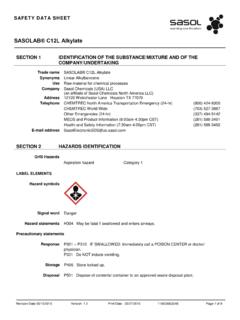
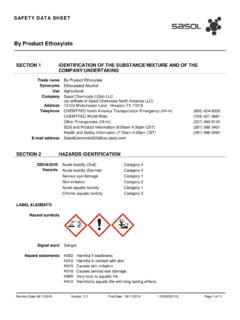
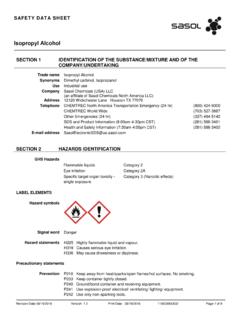
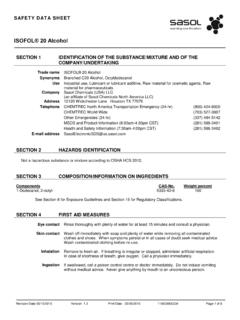
Transcription of SECTION 1 IDENTIFICATION OF THE …
1 ISOFOL 12 Alcohol Revision Date 05/15/2015 Version Print Date 05/26/2015 110000000320 Page 1 of 9 S AFET Y D AT A SH EET SECTION 1 IDENTIFICATION OF THE substance /MIXTURE AND OF THE COMPANY/UNDERTAKING Trade name ISOFOL 12 Alcohol Synonyms Branched alcohol; Butyloctanol; 1-Octanol, 2-butyl- Use Industrial use, Industrial & Institutional cleaning, Personal care Company Sasol Chemicals (USA) LLC (an affiliate of Sasol Chemicals North America LLC) Address 12120 Wickchester Lane Houston TX 77079 Telephone CHEMTREC North America Transportation Emergency (24-hr) (800) 424-9300 CHEMTREC World Wide (703) 527-3887 Other Emergencies (24-hr) (337) 494-5142 MSDS and Product Information (8:00am-4:30pm CST) (281) 588-3491 Health and Safety Information (7:30am-4:00pm CST) (281) 588-3492 E-mail address SECTION 2 HAZARDS IDENTIFICATION GHS Hazards Acute aquatic toxicity Category 1 Chronic aquatic toxicity Category 2 Hazard symbols Signal word Warning Hazard statements H400 Very toxic to aquatic life.
2 H411 Toxic to aquatic life with long lasting effects. Precautionary statements Prevention P273 Avoid release to the environment. Response P391 Collect spillage. Disposal P501 Dispose of contents/ container to an approved waste disposal plant. LABEL ELEMENTS ISOFOL 12 Alcohol Revision Date 05/15/2015 Version Print Date 05/26/2015 110000000320 Page 2 of 9 S AFET Y D AT A SH EET SECTION 3 COMPOSITION/INFORMATION ON INGREDIENTS Components CAS-No. Weight percent 1-Octanol, 2-butyl- 3913-02-8 >97 See SECTION 8 for Exposure Guidelines and SECTION 15 for Regulatory Classifications. SECTION 4 FIRST AID MEASURES Eye contact Rinse thoroughly with plenty of water for at least 15 minutes and consult a physician. Skin contact Wash off immediately with soap and plenty of water while removing all contaminated clothes and shoes. When symptoms persist or in all cases of doubt seek medical advice. Wash contaminated clothing before re-use.
3 Inhalation Remove to fresh air. If breathing is irregular or stopped, administer artificial respiration. In case of shortness of breath, give oxygen. Call a physician immediately. Ingestion If swallowed, call a poison control centre or doctor immediately. Do not induce vomiting without medical advice. Never give anything by mouth to an unconscious person. SECTION 5 FIREFIGHTING MEASURES FLAMMABLE PROPERTIES Fire/explosion NFPA Class IIIB combustible liquid. Suitable extinguishing media Water spray, Alcohol-resistant foam, Dry chemical, Carbon dioxide (CO2) Protective equipment and precautions for firefighters Wear self-contained breathing apparatus and protective suit. Further information Keep containers and surroundings cool with water spray. SECTION 6 ACCIDENTAL RELEASE MEASURES Methods and materials for containment and cleaning up Evacuate personnel to safe areas. Remove all sources of ignition. Material can create slippery conditions.
4 Contain spillage, and then collect with non-combustible absorbent material, ( sand, earth, diatomaceous earth, vermiculite) and place in container for disposal according to local / national regulations (see SECTION 13). Do not flush into surface water or sanitary sewer system. Spill precautions Material can create slippery conditions. Do not flush into surface water or sanitary sewer system. ISOFOL 12 Alcohol Revision Date 05/15/2015 Version Print Date 05/26/2015 110000000320 Page 3 of 9 S AFET Y D AT A SH EET SECTION 7 HANDLING AND STORAGE Safe handling advice Ensure all equipment is electrically grounded before beginning transfer operations. Storage/Transport pressure Ambient Load/Unload temperature 10 - 30 F above the melting point. SECTION 8 EXPOSURE CONTROLS/PERSONAL PROTECTION ENGINEERING MEASURES Ensure adequate ventilation, especially in confined areas. PERSONAL PROTECTIVE EQUIPMENT Eyes Wear as appropriate: Goggles, Face-shield Skin Wear suitable protective clothing, gloves and eye/face protection.
5 Inhalation Respiratory protection is normally not required except in emergencies or when conditions cause excessive airborne levels of mists or vapors. Use NIOSH approved respiratory protection. EXPOSURE GUIDELINES Contains no substances with occupational exposure limit values. SECTION 9 PHYSICAL AND CHEMICAL PROPERTIES Appearance liquid; Colour colourless Form liquid Odour sweet Odour Threshold no data available Flash point approximately 120 C, 248 F; DIN 51758; Flammability Upper explosion limit: no data available Lower explosion limit: no data available Boiling point/boiling range approximately 243 C, 469 F; Melting point/range < -30 C, < -22 F; ISOFOL 12 Alcohol Revision Date 05/15/2015 Version Print Date 05/26/2015 110000000320 Page 4 of 9 S AFET Y D AT A SH EET Auto-ignition temperature approximately 255 C, 491 F; Decomposition temperature no data available; Flammability (solid, gas) no data available Vapour pressure hPa @ 38 C, 100 F; Vapour density no data available Density approximately g/cm3 @ 20 C, 68 F; Specific gravity no data available Water solubility @ 23 C, 73 F; ASTM E 1148; insoluble Viscosity cSt @ 40 C, 104 F.
6 Viscosity, dynamic approximately 23 @ 20 C, 68 F; pH no data available Evaporation rate no data available Partition coefficient: n-octanol/water log Pow: ; @ 23 C, 73 F; OECD Test Guideline 117; SECTION 10 STABILITY AND REACTIVITY Reactivity Stable under recommended storage conditions. Chemical stability No decomposition if stored and applied as directed. Conditions to avoid Keep away from heat and sources of ignition. Hazardous decomposition products Combustion products include carbon dioxide, carbon monoxide and possibly other unidentified organic compounds. Materials to avoid Can react with strong oxidizers, inorganic acids, and halogens. Hazardous polymerisation None. SECTION 11 TOXICOLOGICAL INFORMATION Acute dermal toxicity LD50 rabbit: > 2 mL/kg Test substance : 2-Butyloctan-1-ol ISOFOL 12 Alcohol Revision Date 05/15/2015 Version Print Date 05/26/2015 110000000320 Page 5 of 9 S AFET Y D AT A SH EET Acute inhalation toxicity no data available Acute oral toxicity LD50 rat: > 5,000 mg/kg; OECD Test Guideline 401 Test substance : 2-Butyloctan-1-ol Skin corrosion/irritation Primary irritation (rabbit): (Max.)
7 Score is ) Eye damage/irritation Primary irritation (rabbit): (Max. score is 110.) Irritation was completely gone by day 3, the last day of observation. Respiratory or skin sensitization no data available Germ cell mutagenicity Genotoxicity in vitro: no data available Genotoxicity in vivo: no data available Assessment Mutagenicity: no data available Reproductive toxicity Reproductive toxicity: no data available Assessment Reproductive toxicity: no data available Teratogenicity: no data available Assessment teratogenicity: no data available STOT - single exposure no data available STOT - repeated exposure rat; Oral; 90-day; OECD Test Guideline 408 NOAEL: mg/kg Test substance : 2-Butyloctan-1-ol Based on available data, the classification criteria are not met. Aspiration toxicity no data available Carcinogenicity Assessment carcinogenicity: Contains no ingredient listed as a carcinogen ISOFOL 12 Alcohol Revision Date 05/15/2015 Version Print Date 05/26/2015 110000000320 Page 6 of 9 S AFET Y D AT A SH EET SECTION 12 ECOLOGICAL INFORMATION Aquatic toxicity Very toxic to aquatic life.
8 Toxic to aquatic life with long lasting effects. Toxicity to fish LD50 (Oncorhynchus mykiss (rainbow trout)) 96 hours: > - 1 mg/l; semi-static test; OECD Test Guideline 203 Test substance : 2-Butyloctan-1-ol Toxicity to aquatic invertebrates EC50 (Daphnia magna (Water flea)) 48 hours: > - 1 mg/l; OECD Test Guideline 202 Test substance : 2-Butyloctan-1-ol Toxicity to algae ErC50 (Pseudokirchneriella subcapitata (green algae)) 72 hours: > 1 - 10 mg/l; OECD Test Guideline 201 Test substance : 2-Butyloctan-1-ol Chronic toxicity to fish no data available Chronic toxicity to aquatic invertebrates NOEC (Daphnia magna (Water flea)) 21 d: mg/l; semi-static test; OECD Test Guideline 211 Test substance : 1-Dodecanol (literature value) Biodegradation Readily biodegradable. OECD Test Guideline 310 (28 d): > 60 % Test substance : 2-Butyloctan-1-ol Bioaccumulation no data available Mobility in soil no data available Other adverse effects no data available SECTION 13 DISPOSAL CONSIDERATIONS Waste Code Any unused product or empty containers may be disposed of as non-hazardous in accordance with state and federal requirements.
9 Re-evaluation of the product may be required by the user at the time of disposal, since the product uses, transformations, mixtures , contamination, and spillage may change the classification. If the resulting material is determined to be hazardous, please dispose in accordance with state and federal (40 CFR 262) hazardous waste regulations. Disposal methods Dispose of only in accordance with local, state, and federal regulations. ISOFOL 12 Alcohol Revision Date 05/15/2015 Version Print Date 05/26/2015 110000000320 Page 7 of 9 S AFET Y D AT A SH EET Empty containers. Empty containers retain product residue (liquid and/or vapor) and can be dangerous. DO NOT PRESSURIZE, CUT, WELD, BRAZE, SOLDER, DRILL, GRIND, OR EXPOSE SUCH CONTAINERS TO HEAT, FLAME, SPARKS, STATIC ELECTRICITY, OR OTHER SOURCES OF IGNITION; THEY MAY EXPLODE AND CAUSE INJURY OR DEATH. Empty drums should be completely drained, triple-rinsed, properly bunged and promptly returned to a drum reconditioner, or properly disposed.
10 SECTION 14 TRANSPORT INFORMATION DOT UN 3082, Environmentally hazardous substance , liquid, (2-Butyloctanol), 9, III , Marine pollutant This product is regulated as a hazardous material according to the Department of Transportation only in bulk quantities (greater than 119 gallons per package). IATA UN 3082, Environmentally hazardous substance , liquid, (2-Butyloctanol), 9, III IMDG UN 3082, Environmentally hazardous substance , liquid, , (2-Butyloctanol), 9, III, Marine pollutant Transport in bulk according to Annex II of MARPOL 73/78 and the IBC Code Remarks no data available SECTION 15 REGULATORY INFORMATION FEDERAL REGULATIONS OSHA Hazards (HCS 1994) Non-hazardous substance TSCA Inventory Listing Components CAS-No. 1-Octanol, 2-butyl- 3913-02-8 SARA 302 Status Components CAS-No. Weight percent SARA 302: No chemicals in this material are subject to the reporting requirements of SARA Title III, SECTION 302. SARA 311/312 Classification Non-hazardous substance SARA 313 Chemical Components CAS-No.