Transcription of Section 2: Chain Drives
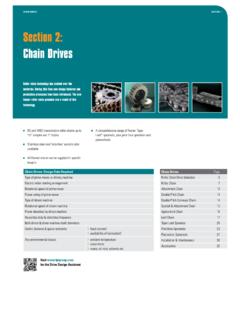
1 Section 2: Chain DrivesSection : 2 Roller Chain technology has evolved over the centuries. During this time new design features and production processes have been introduced. The new Fenner roller Chain products are a result of this DRiVeSchain Drives : Design Data RequiredType of prime mover, or driving machineElectric motor starting arrangementRotational speed of prime moverPower rating of prime moverType of driven machineRotational speed of driven machinePower absorbed by driven machineHours/day duty & start/stop frequencyBoth driven & driver machine shaft diametersCentre distance & space restraints:> fixed centres?
2 > availability of lubrication?Any environmental issues: > ambient temperature> noise limits> water, oil mist, solvents for the Drive Design Assistantchain Drives PageRoller Chain Drive Selection 3 Roller Chain 7 Attachment Chain 13 Double Pitch Chain 14 Double Pitch Conveyor Chain 14 Special & Attachment Chain 15 Agricultural Chain 16 Leaf Chain 17 Taper Lock Sprokets 20 Pilot Bore Sprockets 23 Platewheel Sprockets 27 Installation & Maintenance 30 Accessories 32 BS and ANSI transmission roller chains up to 1 " simplex and 1" triplex Stainless steel and 'lube-free'
3 Variants also available All Fenner chains can be supplied to specific lengths A comprehensive range of Fenner Taper Lock sprockets, plus pilot bore sprockets and platewheelsFenner Advanced Chain technologytHe MARk oF engineeRing excellenceFenner PLUS Lubrication Free ChainHigh Performance Chain > Built-in lubrication> Sintered bushes impregnated with oil> operating speed of up to > Fit and forget reliability> easy Pin extraction feature> enhanced performance in hostile : DRiVe DeSign & MAintenAnce MAnuAl3types of Prime Mover'Soft' Starts'Heavy' StartsElectric Star-delta Shunt woundInternal combustion engines with 4 or more cylinders.
4 All prime movers fitted with centrifugal clutches, dry or fluid Direct-on-line Series and compound combustion engines with less than 4 of Driven MachineHours per day duty10 and underover 10 to 16over 1610 and underover 10 to 16over16light DutyAgitators (uniform density),Belt conveyors (uniformlyloaded). DutyAgitators and mixers (variabledensity). Belt conveyors (notuniformly loaded), Kilns,Laundry machinery,Lineshafts, Machine tools,Printing machinery, Sawmilland woodworking machinery,Screens (rotary). DutyBrick machinery, Bucketelevators, Conveyors (heavyduty), Hoists, Quarry plant,Rubber machinery, Screens(vibrating), Textile a Chain drive to transmit kW from a gearbox running at 80 rev/min and driven by a direct-on-line electric motor, to a uniformly loaded conveyor drive shaft which is required to run at approximately 40 rev/min for 12 hours per day.
5 Gearbox output shaft is 35mm and the conveyor headshaft is 65mm diameter.(a) Service FactorFrom Table 1 the Service Factor is (b) Design Power= x = kW.(c) Chain PitchBy referring to Table 2 (page 4), the intersection of design power and the rev/min of the faster shaft indicates a 16B 1 pitch Chain .(d) Speed Ratio 80 40 = 2:1(e) Sprocket SizeFrom Table 4 (page 6) sprockets of 19 and 38 teeth give a ratio of 2 : 1.(f) Power RatingThe power ratings for 16B Chain are given on page 5. The required power rating from step (b) is kW.
6 For a 19T driver Selection(a) Service FactorFrom Table 1, determine the service factor which is applicable to the drive.(b) Design PowerMultiply the normal running power by the service factor. This gives the Design Power which is used as the basis for selecting the drive.(c) Chain PitchRefer to Table 2 (page 4) and trace to the right along the horizontal axis to the rev/min of the faster shaft. Trace upwards along the vertical axis to the Design Power. At the point of intersection, note the recommended Chain pitch or pitches if there is an overlap.
7 (d) Speed RatioDivide the speed of the faster shaft by the speed of the slower shaft to obtain the speed ratio.(e) Sprocket SizesRefer to Table 4 (page 6) and select driving and driven sprockets to match the Speed Ratio found in step (d). See sprocket pitch recommendations on page 4.(f) Power RatingRefer to the power rating tables (page 5) for the pitch of Chain chosen in step (c). Read down the left hand column to the rotational speed of the faster shaft. On this line read the power rating for the simplex Chain selected. These tables are for 19 tooth sprockets, if a sprocket with a different number of teeth is used, the power rating should be multiplied by the Sprocket Factor from the table at the bottom of page 5.
8 If the power rating figure does not equal or preferably exceed the Design Power, calculated in step (b), either select a larger pitch or a multiple strand (duplex or triplex) strand Chain offers the most economical solution, and should be used where possible. However, for limitations in space, high speed or smooth running requirements a smaller pitch, duplex or triplex drive may be considered.(g) Chain lengthTo find the Chain length in pitches, use the formula = 2C + T + t + KP P 2 CL = Length of Chain in = Centre distance in = Pitch of Chain in = Number of teeth on large = Number of teeth on small = Factor from Table 3 (page 6).
9 The calculated number of pitches should be rounded up to an even, whole number of pitches. If the centre distance cannot be adjusted, to allow for the use of an even number of pitches, it may be necessary to use an offset or cranked link, in which case the Chain power rating will need to be reduced, consult your local Authorised Distributor. Re-calculate the exact centre distance required for the adjusted number of pitches. For recommended centre distance, refer to Table 5 a jockey or tensioning sprocket is used, add an extra 2 pitches.
10 To obtain the Chain length, multiply the number of pitches by the pitch of the of Chain in feet = LP 305tABle 1 SeRVice FActoRSsprocket, running at 80 rev/minute, the power rating for 16B-1 simplex Chain is kW. As this exceeds the required design power the selection is space limitations demand smaller sprocket dimensions, alternative selections would be: use 12B-2 duplex Chain which has a power rating of kW at 80 rev/min or 15 T driving to 30 T on 16 B-1 1" simplex Chain - power rating x = kWg) Chain lengthRecommended centre distance for 16B-1 Chain is 1000 mm (Table 5 below).