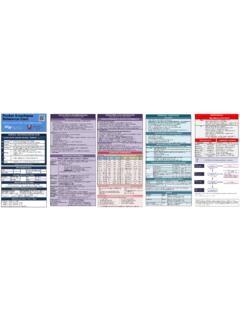
Transcription of Section 4.4 Special warning and precautions for use
1 An agency of the European Union Section : Special warnings and precautions for use Rev. 1 SmPC training presentation Note: for full information refer to the European Commission s Guideline on summary of product characteristics (SmPC) SmPC Advisory Group Index objectives principles Situations leading to a warning or precaution (1/2) Situations leading to a warning or precautions (2/2) information Structure and readability of Section Information not to be included Example of presentation of information on a specific risk throughout the SmPC * Section : Special warnings and precautions for use 2 of Section Section : Special warnings and precautions for use 3 Safety warnings should be clear, compelling and effective Section Index The exact content will be different for each product and for the therapeutic conditions it is intended to treat The objective of Section is to provide information on a specific risk when healthcare professionals have to be warned of this risk or the risk leads to a precaution for use to avoid harm Situations leading to a warning or precaution (1/2) Section .
2 Special warnings and precautions for use 4 Conditions to fulfill before use, measure required by Risk Management Plan, should be described Special population at increased risk Serious adverse reactions for alerting healthcare professionals Measures to identify patients at risk or to prevent noxious conditions Risks associated with starting or stopping the product Specific clinical or laboratory monitoring Section index 2 4 5 6 In general, patient population not studied in the clinical trial should be mentioned in Section and not in Section unless a safety issue can be predicted Situations leading to a warning or precaution (2/2) Section : Special warnings and precautions for use 5 Ethanol content in herbal medicinal products Warnings necessary for excipients or residues Risks associated with incorrect route of administration Warnings necessary with respect to transmissible agents Warnings and precautions for use that are specific to the paediatric population or any subset of the paediatric population (to be identified under a subheading) Specific interference with laboratory tests Section index Structure and readability of Section Section .
3 Special warnings and precautions for use 6 Order of warnings and precautions should be determined by the importance of safety information provided In exceptional cases, especially important safety information may be included in bold type within a box Subheadings are encouraged to facilitate readability Warnings and precautions regarding pregnancy and breast-feeding, ability to drive and use machines and interactions should be dealt with in their respective sections, unless they are of major clinical importance and specific precautionary measures should be described in Section Section index Information not to be included Section : Special warnings and precautions for use 7 Detailed information of adverse reactions with no recommendation Section index Example 1- Special condition Section : Special warnings and precautions for use 8 Active substance X mg film-coated tablets Conditions in which use of product could be acceptable provided Special conditions are fulfilled.
4 To ensure safe and effective use describe specific risk minimisation measures as part of a risk minimisation plan Section LVEF* should be evaluated in all patients prior to initiation of treatment with active substance X to ensure that the patient has a baseline LVEF that is within the institutions normal limits. LVEF should continue to be evaluated during treatment with active substance X to ensure that LVEF does not decline to an unacceptable level (see Section ). Risk Management Plan Summary warning in Section of the SmPC (LVEF should be evaluated in all patients prior to initiation of treatment with active substance X to ensure that the patient has a baseline LVEF that is within the institutions normal limits. LVEF should continue to be evaluated during treatment with active substance X to ensure that LVEF does not decline to an unacceptable level) and information in dose/administration Section *LVEF left ventricular ejection fraction Section index Key principles (1/2) Example 2-serious adverse reaction Section : Special warnings and precautions for use 9 Active substance X 100 mg powder for concentrate for solution for infusion Serious adverse reactions to which health care professionals need to be alerted.
5 The situations in which these may occur and the action that may be required Infections Patients must be monitored closely for infections including tuberculosis before, during and after treatment with active substance X. Because the elimination of active substance X may take up to six months, monitoring should be continued throughout this period. Further treatment with active substance X must not be given if a patient develops a serious infection or sepsis. *LVEF left ventricular ejection fraction Section index Key principles (1/2) Example 3-detect onset of noxious condition Section : Special warnings and precautions for use 10 Active substance X mg hard capsules Detect early onset of noxious condition In case of severe vomiting associated with active substance X treatment, appropriate dose adjustments as recommended in Section must be made.
6 Some cases of severe vomiting were associated with oesophageal rupture (see Section ). Such events appeared to occur particularly after dose increments or high doses of active substance X. Section index Key principles (1/2) Example 4-statement of early symptoms of serious adverse reaction Section : Special warnings and precautions for use 11 Active substance X 5 mg/ml solution for infusion Measures taken to identify patients at risk of noxious conditions/prevent their occurrence and for early detection of onset or worsening of noxious conditions. If there is a need for awareness of signs or symptoms representing early warning of a serious adverse reaction, a statement should be included *LVEF left ventricular ejection fraction Section index In exceptional cases: bold type within a box NEUROLOGICAL ADVERSE EVENTS Severe neurological events have been reported with the use of active substance X.
7 These events have included altered mental states including severe somnolence, central nervous system effects including convulsions, and peripheral neuropathy ranging from numbness and paresthesias to motor weakness and paralysis. There have also been reports of events associated with demyelination, and ascending peripheral neuropathies similar in appearance to Guillain-Barr Syndrome. Full recovery from these events has not always occurred with cessation of active substance X. Therefore, close monitoring for neurological events is strongly recommended, and active substance X must be discontinued at the first sign of neurological events of NCI CTCAE Grade 2 or greater. Key principles (1/2) Example 5-start treatment Section : Special warnings and precautions for use 12 Active substance X 100 mg (10 mg/ml) concentrate for solution for infusion Particular risks associated with starting ( first dose effects) the medicinal product and action required for prevention Severe cytokine release syndrome is characterised by severe dyspnea, often accompanied by bronchospasm and hypoxia, in addition to fever, chills, rigors, urticaria, and angioedema.
8 This syndrome may be associated with some features of tumour lysis syndrome such as hyperuricaemia, hyperkalaemia, hypocalcaemia, hyperphosphaetemia, acute renal failure, elevated lactate dehydrogenase (LDH) and may be associated with acute respiratory failure and death. The acute respiratory failure may be accompanied by events such as pulmonary interstitial infiltration or oedema, visible on a chest x-ray. The syndrome frequently manifests itself within one or two hours of initiating the first infusion. Patients with a history of pulmonary insufficiency or those with pulmonary tumour infiltration may be at greater risk of poor outcome and should be treated with increased caution. Patients who develop severe cytokine release syndrome should have their infusion interrupted immediately (see Section ) and should receive aggressive symptomatic treatment.
9 *LVEF left ventricular ejection fraction Section index Key principles (1/2) Example 6-stop treatment Section : Special warnings and precautions for use 13 Active substance X mg film-coated tablets Particular risks associated with stopping ( rebound, withdrawal effects) the medicinal product and action required for prevention At the end of treatment, discontinuation of active substance X was associated with an increase in irritability, urge to smoke, depression, and/or insomnia in up to 3% of patients. The prescriber should inform the patient accordingly and discuss or consider the need for dose tapering. *LVEF left ventricular ejection fraction Section index Key principles (1/2) Example 7- Special patient group Section : Special warnings and precautions for use 14 Active substance X 500 micromol/ml solution for injection in a pre-filled syringe Special patient groups at increased risk or only group at risk of experiencing product or product class-related adverse reactions (usually serious or common) Renal impairment and liver transplant patients There have been reports of nephrogenic systemic fibrosis (NSF) associated with use of some gadolinium-containing contrast agents in patients with severe renal impairment (GFR <30ml/ ) and those who have had or are undergoing liver transplantation.
10 Therefore active substance X should not be used in these populations (see Section ). Cases of NSF have also been reported in patients with moderate renal impairment (GFR <60ml/ ) with use of gadolinium-containing contrast agents. Active substance X should be used in these patients with caution. Active substance X is dialysable. Haemodialysis shortly after active substance X administration in patients currently receiving haemodialysis may be useful at removing active substance X from the body. There is no evidence to support the initiation of haemodialysis for prevention or treatment of NSF in patients not already undergoing haemodialysis. *LVEF left ventricular ejection fraction Section index Key principles (1/2) Example 8- Special patient group Section : Special warnings and precautions for use 15 Active substance X ml solution for injection, pre-filled syringe Special patient groups at increased risk or only group at risk of experiencing product or product class-related adverse reactions (usually serious or common) Elderly patients The elderly population is at increased risk of bleeding.