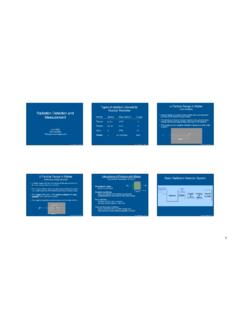
Transcription of Section 5: Radiation Detection & Measurement
1 Section 5: Radiation Detection & Measurement TOPIC Page Radiation Detection & Measurement ..1 Gas-filled Detectors .. 2 Scintillatore & Dosimetry Measurement .. 3 ACTIVITIES Radiation Lab Exercise.
2 5 Inverse Square Law ..[exercise with survey meter to demonstrate the reduction in Radiation with distance from the source] 8 Statistics - The Normal Distribution .. [uses penny flipping to generate and explore a normal distribution in the context of Radiation Measurement ] 9 The North Carolina Chapter of the Health Physics Society Science Teacher's Workshop 1 Radiation Detection and Measurement Because ionizing Radiation cannot be detected by the unaided senses, various types of Detection instruments must be used to evaluate the level of Radiation and/or amount of radioactive material in an area.
3 The proper instrumentation is essential for the accurate Measurement of these quantities. Before selecting the correct instrument, the application must be considered: 1) Type of Radiation and the energy range of the Radiation to be monitored; : alpha or beta particles; gamma rays or X-rays; low energy or high energy 2) The purpose for which the Measurement results will be used, such as: a) Locating contamination b) Evaluating external Radiation hazard ( , checking for adequate shielding) c) Measurement of Radiation absorbed doses, exposure rates, dose equivalents, etc.
4 , from a source or in a specified area d) Quantifying the amount (activity) of radioactive material in a sample e) Nuclide identification Once the Radiation to be measured and the purpose of the Measurement are determined, several factors should be considered in selecting the right instrument for the job: Efficiency For locating contamination and quantifying activity, efficiency of the detector for the Radiation (s) of interest is important. Efficiency CPM/DPM; a detector with 50% efficiency would produce 100 CPM per 200 DPM of activity in the measured sample.
5 Table 1 shows approximate efficiencies of various detectors reported by manufacturers for various nuclides. TABLE 1: Detector Efficiencies for Various Radiation TYPE OF Radiation DETECTOR TYPE EFFICIENCY/NUCLIDE Low Energy Gamma NaI Scintillator 80 - 90% / I-125 Gamma Geiger-Mueller (GM) 5 - 10% Beta Thin End Window GM 10% / C-14 45% /Sr-90 Pancake GM 10% / C-14, S-35 60% / Sr-90 Plastic Scintillator 16-20% / C-14, S-3585-88% / Sr-90 Liquid Scintillator 30-60% / H-3 67-85% / C-14, S-3590-98% / P-32 Instrument Design A wide variety of instrument designs is available.
6 The most commonly used types are described below. 2 Gas-Filled Detectors This design includes ion chambers, gas flow proportional counters, and Geiger-Mueller detectors. These instruments rely on the Detection of ionization in gases by Radiation to provide charge carriers within the gas-filled chamber. These charge carriers (ions) then carry an electric current between the anode and cathode of the detector. The instrument s electronics convert this measured current flow to appropriate units, such as CPM or mR/hr.
7 Figure 1 gives a simplified view of gas-filled detectors. These systems generally consist of a gas-filled chamber containing an electrode, a voltage supply, a resistor, and an ammeter (current flow meter). Although the gas-filled detector chamber shown has a cylindrical geometry, other shapes are available. GAS-FILLED TUBE V R I FIGURE 1: Diagram of Cylindrical Gas-Filled Detector a. Ion Chambers: The simplest and lowest voltage instruments of this type are ionization chambers or ion chambers.
8 These portable instruments usually use regular air at atmospheric pressure as gas in the detector, although some special designs may use other gases. Ion chambers are primarily used to measure Radiation exposure or exposure rate. Ion chambers are rarely found in the research lab. The primary application for this design is the evaluation of external Radiation hazard by Radiation safety personnel. b. Proportional Counters: Proportional counters operate at somewhat higher voltages than ion chambers and employ special gases such as argon-methane mixtures.
9 The name of this detector type is derived from the fact that, although the current flow measured by the meter electronics is greatly amplified by an avalanche effect within the gas-filled chamber, the response nonetheless remains proportional to the initial ionization in the detector. Proportional counters are used in both portable and fixed installations, but they are rarely used in biomedical research labs. c. Geiger-Mueller Detectors: The popularity of Geiger-Mueller (GM) detectors stems from this design s sturdiness, reliability, and low cost.
10 The typical thin-end window GM or pancake GM (PGM) survey meter is adequate for detecting high-energy beta particles and high-energy gamma rays. Some of the radionuclides that may be adequately monitored by use of a GM survey meter are P-32, I-131, Co-57, Tc-99m, Sr-90, Cr-51, and Na-22. While the GM survey meter can detect larger quantities of radioactive material, it is not sensitive enough for smaller amounts of some radionuclides. For example, a thin-end window GM survey meter may detect large amounts of C-14, S-35, or P-33 in a small area, but when the activity is spread over a large area or there is a small quantity of the material in one spot, the survey meter may not detect it.