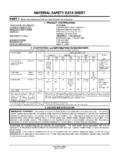
Transcription of Section I - Product and Company Identification
1 MATERIAL SAFETY DATA SHEET (unhardened and hardened asphalt ) for HOT MIX asphalt Section I - Product and Company Identification Material Identity (Trade Names): asphalt (a mixture of 93-97 % aggregate, 4-7% asphalt , and % antistripping agent) Manufacturer's Name: National asphalt Mfg. Telephone Number: 1-703-273-2536 Address: 3400 Old Pickett RoadFairfax, VA 22031 Telephone Number for Information: 1-703-273-2536 Internet Web Site: Preparer: National asphalt Mfg. Corp. Section II - Hazardous Ingredients/Identity Information Hazardous Components (Chemical Identity/Common Names) CAS No.
2 OSHA PEL ACGIH TLV MSHA PEL % (MIXTURE) asphalt (hot liquid) 8052-42-4 Not Listed mg/m3 (Fume) (as benzene-soluble aerosol or equivalent method) 5 mg/m3 (Fume) 4-7% Crystalline silica (Quartz) (contained in aggregate) 14808-60-7 30/(%SiO2 +2) mg/m3 (Total) 10/(%SiO2 +2) mg/m3 (Respirable) mg/m3 (Respirable quartz) 30/(%SiO2+ 3) mg/m3 (Total) 10/(%SiO2 +2) mg/m3 (Respirable) 0-95% Alkyloxylated aliphatic polyamines (contained in antistripping agent)UN 3082 (LD50 rat 4,300 mg/kg) not otherwise classified --------15 mg/m3 (Total) 5 mg/m3 (Respirable) 10 mg/m3 (Inhalable) 3 mg/m3 (Respirable) 10 mg/m3 (Total) 0-95% Section III - Physical/Chemical Characteristics Boiling Point Not Applicable Specific Gravity (H20 = 1) Variable Vapor Pressure (mm Hg) Not Applicable Melting Point N/A Vapor Density (Air = 1) Not Applicable Evaporation Rate (Butyl Acetate = 1) N/A Solubility in Water: N/A.
3 Appearance and Odor: Hardened asphalt is an odorless solid material of varying black to brown color and texture. Unhardened hot asphalt may exhibit characteristic asphalt fume (tar) or petroleum hydrocarbon odor. Section IV - Fire and Explosion Hazard Data Flash Point: > 450o F (liquid asphalt ) Flammable Limits: Not Flammable LEL: N/A UEL: N/A Extinguishing Media: Use foam, dry chemical, or carbon dioxide to fight fire. Special Fire Fighting Procedures: Since fire may produce toxic fumes, wear a self-contained breathing apparatus (SCBA) with a full facepiece operated in the pressure-demand or positive pressure mode.
4 Wear protective clothing and face and eye protection when handling hot asphalt . If feasible, move containers from fire hazard since they may explode in the heat of the fire. Otherwise, use water spray to cool fire-exposed containers. Be aware of runoff from fire control methods. Do not release to sewers or waterways since it may create a fire hazard and cause pollution. Unusual Fire and Explosion Hazards: Hot asphalt is a slight fire hazard when exposed to heat, flame, or fluorine. Vapors may travel to an ignition source and flash back.
5 Section V - Reactivity Data Stability: Stable Conditions to Avoid: Avoid contact of hot asphalt with heat, flame, or fluorine. asphalt cooled in a closed tank can evolve high concentrations of hydrogen sulfide gas, carbon monoxide, and other aliphatic hydrocarbons. Incompatibility (Materials to Avoid): When mixed with naphtha or other volatile solvents, asphalt may readily ignite. Hazardous Decomposition or Byproducts: Thermal oxidative decomposition of asphalt can produce carbon monoxide, various aliphatic hydrocarbons, and hydrogen sulfide.
6 Inhalation of carbon monoxide and hydrogen sulfide produces tissue hypoxia (insufficient oxygen). The various aliphatic hydrocarbons can also produce asphyxia. Hazardous Polymerization: Will Not Occur Conditions to Avoid: Hazardous polymerization cannot occur. Avoid excessive dust/fume generation and contact with incompatible materials listed above. Section VI - Health Hazard Data Route(s) of Entry: Inhalation? Yes Skin? Yes Ingestion? Unlikely Health Hazards: Acute Effects: Inhalation of hot asphalt fumes can cause headache, nausea, eye, and respiratory tract irritation, and nervousness due to formation of hydrogen sulfide gas.
7 Inhalation of hydrogen sulfide gas can cause upper respiratory tract irritation and, if exposure is prolonged at levels above the OSHA PEL, pulmonary edema and even coma or death. Direct skin contact with hot asphalt produces a scald-like lesion. The asphalt tends to adhere to the skin but may come off in blistered areas. Patchy areas of full thickness skin loss are common. Eye exposure to hot asphalt also produces a direct thermal burn. Cutting, grinding, crushing, or drilling hardened asphalt may generate dust containing crystalline silica.
8 Acute effects of exposure to such dust may include: EYE CONTACT: Direct contact with dust may cause irritation by mechanical abrasion. SKIN CONTACT: Direct contact may cause irritation by mechanical abrasion. SKIN ABSORPTION: Not expected to be a significant route of exposure. INGESTION: Expected to be relatively non-toxic. Ingestion of large amounts may cause gastrointestinal irritation and blockage. INHALATION: Dusts may irritate the nose, throat, and respiratory tract by mechanical abrasion. Coughing, sneezing, and shortness of breath may occur following exposures in excess of recommended exposure limits.
9 Use of asphalt for construction purposes is not believed to cause additional acute toxic effects. However, repeated overexposures to very high levels of respirable crystalline silica (quartz, cristobalite, tridymite) for periods as short as six months have caused acute silicosis. Acute silicosis is a rapidly progressive, incurable lung disease that is typically fatal. Symptoms include Section VI -Health Hazard Data (continued) (but are not limited to): shortness of breath, cough, fever, weight loss, and chest pain.
10 Chronic Effects: On prolonged or repeated exposure, asphalt fumes can cause dermatitis, acne-like lesions, mild keratosis ( a skin disease marked by an overgrowth of horny tissue), melanosis, and photosensitization. Chronic inhalation exposure can cause chronic pneumonitis and bronchitis. Cutting, grinding, crushing, or drilling hardened asphalt can produce exposure to dust containing crystalline silica (quartz), which is a cancer hazard if inhaled. Cancer risk depends on level and duration of exposure. Prolonged exposure to crystalline silica can also cause silicosis, a progressive pneumoconiosis (lung disease).