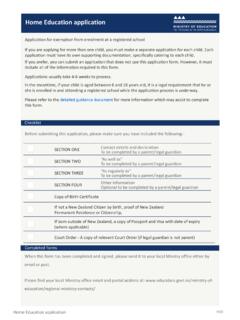
Transcription of Section One – Contact details and declaration Section Two ...
1 Detailed guidance for home education applicants Section One Contact details and declaration Please fill in all parts of this Section , where applicable. Section Two As well as The requirements under this Section are set out in Section 38 of the education and Training Act 2020, which states that an exemption from enrolment at a registered school can only be granted where the Ministry of education is satisfied that the student is to be taught at least as in a registered school".Key requirement (A) Help us to understand your home education philosophy/approach, and how you will meet the requirement to teach as well as a registered school.
2 Detailed guidance In this Section , you will need to describe your overall approach to your child s education . This should include three core components: your philosophy/overall approach, your anticipated curriculum, and how you intend to cater for your child s special education needs (if any). Philosophy/overall approach Many home educators choose to build their approach based on an established education philosophy. Popular philosophies include: Classical School-at-home Montessori Charlotte Mason Unschooling WaldorfOften, home educators choose to familiarise themselves with a few of these approaches, and then combine specific elements from each to suit the needs of their child.
3 If you wish to base your application on a pre-existing philosophy, you will need to become well-acquainted with it. One way to do this is by connecting with a home educator association. There are over a hundred of these associations in New Zealand, often split by region and/or overall philosophy. Most of these are easily identifiable and contactable via a web search. We do not require home educators to specifically teach the New Zealand Curriculum (although you may access this world-le ading curriculum for free if your child is granted an exemption from attendance at school).
4 However, it may be useful to reflect on the curriculum s vision and key competencies, which are summarised in the table below. The New Zealand Curriculum Vision Young people are confident, connected, actively involved, life-long learners. Key Competencies Thinking This competency is about using creative, critical, and metacognitive processes to make sense of information, experiences, and ideas. These processes can help to develop understanding, make decisions, shape actions, or construct knowledge. Students who are competent thinkers and problem-solvers actively seek, use, and create knowledge.
5 Using language, symbols, and text This competency is about working with and making meaning from the codes in which knowledge is expressed. Students who are competent can interpret and use words, numbers, images, movement, metaphor, and technologies in a number of contexts. Managing self This competency is associated with self-motivation, a can-do attitude, and with students seeing themselves as capable learners. It is integral to self-assessment. Students who manage themselves are enterprising, resourceful, reliable, and resilient. They establish personal goals, make plans, manage projects, and set high standards.
6 Relating to others This competency is about interacting effectively with a diverse range of people in a variety of contexts. It includes the ability to listen actively, recognise different points of view, negotiate and share ideas. Participating and contributing This competency is about being actively involved in communities (eg. families, wh nau, and cultural or interest groups). Students who participate and contribute in communities have a sense of belonging and the confidence to participate within new contexts. They understand the importance of balancing rights , roles, and responsibilities and of contributing to the quality and sustainability of social, cultural, physical, and economic environments For more information on the New Zealand Curriculum, please visit: Many home educators choose a philosophy aligned with the M ori world-view.
7 Te Marautanga o Aotearoa is the curriculum written for M ori immersion education . For more information on Te Marautanga o Aotearoa, please visit: Learning areas A home education situation can provide an opportunity for a more flexible approach to learning than that which is available in schools. However, the Ministry must still be satisfied that your child will be taught at least as well as in a registered school. Crucially, your proposed curriculum must: be sufficiently curriculum which is broad will cover several learning areas. Again, although you do not need to craft your approach with reference to the New Zealand Curriculum, it does contain the following list of learning areas which may be a good place to start: English Te Reo M ori Health and physical education Languages Social sciences Science Technology The arts Mathematics and statisticsIt is not enough to simply list the learning areas you intend to teach.
8 You should also provide enough information to help the Ministry gain a general understanding of what will be taught within the area. For example, an English learning area for an 11 or 12 year-old could include content such as: Understanding basic punctuation (eg. full stops, parentheses, brackets)and other written conventions, including spelling rules. Understanding a range of English language techniques (eg. metaphors,similes, onomatopoeia, alliteration, rhyming, personification). Reading a range of written materials, including non-fiction and fiction,and encouraging personal responses to each text.
9 Writing a mixture of creative, formal and opinion pieces, and usingthem to reflect and develop proof-reading skills. Extending vocabulary by focussing on one new word per age-appropriate, Ministry of education recognises that different children and young people have different learning needs. It also recognises that some home education philosophies do not teach some subjects until children have reached a certain age (which may be older than they would be at a registered school). This will be taken into account when you submit your application, but your approach must still be appropriate for the age of your child.
10 One way to assess whether your curriculum is age-appropriate is with reference to school-learners. Often, parents/legal guardians choose to home educate for a portion of their child s period of mandatory education (ie. ages 6- 16). Around 20% of all new home educators return their children tomainstream schooling within one year. When thinking about whether yourcurriculum is age appropriate, you may wish to reflect on whether your child seducation would be comparable to others at a similar age, if s/he was toreturn to a registered strong literacy and numeracy requirement is self-explanatory.