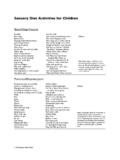
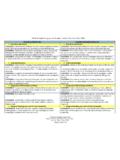
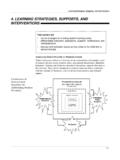
Transcription of SenSory CheCkliSt
1 SenSory ChecklistFrom Raising a SenSory Smart Child, Biel & Peske, 2005 TOUCHTOUCHTOUCHTOUCHTOUCHAVOIDSSEEKSMIXE DNEUTRALB eing touched on some body parts, hugs and cuddles Certain clothing fabrics, seams, tags, waistbands, cuffs, etc. Clothing, shoes, or accessories that are very tight or very loose Getting hands, face, or other body parts messy with paint, glue, sand, food, lotion, etc. Grooming activities such as face and hair washing, brushing, cutting, and nail trimming Taking a bath, shower, or swimming Getting toweled dry Trying new foods Feeling particular food textures and temperatures inside the mouth mushy, smooth, etc.
2 Standing close to other people Walking barefoot PROPRIOCEPTION (BODY SENSE)PROPRIOCEPTION (BODY SENSE)PROPRIOCEPTION (BODY SENSE)PROPRIOCEPTION (BODY SENSE)PROPRIOCEPTION (BODY SENSE)AVOIDSSEEKSMIXEDNEUTRALA ctivities such as roughhousing, jumping, banging, pushing, bouncing, climbing, hanging, and other active play High-risk play (jumps from extreme heights, climbs very high trees, rides bicycle over gravel) Fine motor tasks such as writing, drawing, closing buttons and snaps, attaching pop beads and snap-together building toys Activities requiring physical strength and force Eating crunchy foods (pretzels, dry cereal, etc.)
3 Or chewy foods ( , meat, caramels) Smooth, creamy foods (yogurt, cream cheese, pudding) Having eyes closed or covered 2009, Lindsey Biel, OTR/L VESTIBULAR (MOVEMENT SENSE)VESTIBULAR (MOVEMENT SENSE)VESTIBULAR (MOVEMENT SENSE)VESTIBULAR (MOVEMENT SENSE)VESTIBULAR (MOVEMENT SENSE)AVOIDSSEEKSMIXEDNEUTRALB eing moved passively by another person (rocked or twirling by an adult, pushed in a wagon) Riding equipment that moves through space (swings, teeter-totter, escalators and elevators) Spinning activities (carousels, spinning toys, spinning aroundin circles) Activities that require changes in head position (such as bending over sink) or having head upside down (such as somersaults, hanging from feet)
4 Challenges to balance such as skating, bicycle riding, skiing, and balance beams Climbing and descending stairs, slides, and ladders Being up high, such as at the top of a slide or mountain overlook Less stable ground surfaces such as deep pile carpet, grass, sand, and snow Riding in a car or other form of transportation AUDITORY/LISTENINGAUDITORY/LISTENINGAUDI TORY/LISTENINGAUDITORY/LISTENINGAUDITORY /LISTENINGAVOIDSSEEKSMIXEDNEUTRALH earing loud sounds car horns, sirens, loud music or TV Being in noisy settings such as a crowded restaurant, party, or busy store Watching TV or listening to music at very high or very low volume Speaking or being spoken to amid other sounds or voices Background noise when concentrating on a task (music, dishwasher, fan, etc.)
5 Games with rapid verbal instructions such as Simon Says or Hokey Pokey Back-and-forth, interactive conversations Unfamiliar sounds, silly voices, foreign language Singing alone or with others 2009, Lindsey Biel, OTR/L VISIONVISIONVISIONVISIONVISIONAVOIDSSEEK SMIXEDNEUTRALL earning to read or reading for more than a few minutes Looking at shiny, spinning, or moving objects Activities that require eye-hand coordination such as baseball, catch, stringing beads, writing, and tracing Tasks requiring visual analysis like puzzles, mazes, andhidden pictures Activities that require discriminating between colors, shapes, and sizes Visually busy places such as stores and crowded playgrounds Finding objects such as socks in a drawer or a particular book on a shelf Very bright light or sunshine, or being photographed with a flash Dim lighting, shade, or the dark Action-packed, colorful television.
6 Movies or computer/video games New visual experiences such as looking through a kaleidoscope or colored glass TASTE AND SMELLTASTE AND SMELLTASTE AND SMELLTASTE AND SMELLTASTE AND SMELLS melling unfamiliar scentsAVOIDSSEEKSMIXEDNEUTRALS trong odors such as perfume, gasoline, cleaning products Smelling objects that aren t food such as flowers, plastic items, playdough, and garbage Eating new foods Eating familiar foods Eating strongly flavored foods (very spicy, salty, bitter, sour, or sweet) 2009, Lindsey Biel, OTR/L