Transcription of Sepsis overview - pathways.nice.org.uk
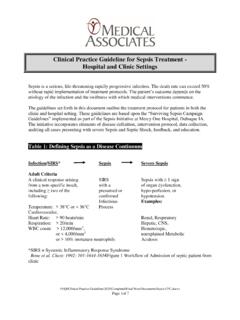
1 Sepsis overview NICE Pathways bring together everything NICE says on a topic in an interactive flowchart. NICE Pathways are interactive and designed to be used online. They are updated regularly as new NICE guidance is published. To view the latest version of this NICE Pathway see: NICE Pathway last updated: 20 April 2021. This document contains a single flowchart and uses numbering to link the boxes to the associated recommendations. Sepsis Page 1 of 12. NICE 2022. All rights reserved. Subject to Notice of rights. Sepsis overview NICE Pathways Sepsis Page 2 of 12. NICE 2022. All rights reserved. Subject to Notice of rights. Sepsis o ovverview NICE Pathways 1 Person with suspected Sepsis No additional information 2 When to suspect Sepsis Think 'could this be Sepsis ?' if a person presents with signs or symptoms that indicate possible infection.
2 Take into account that people with Sepsis may have non-specific, non-localised presentations, for example feeling very unwell, and may not have a high temperature. Pay particular attention to concerns expressed by the person and their family or carers, for example changes from usual behaviour. Assess people who might have Sepsis with extra care if they cannot give a good history (for example, people with English as a second language or people with communication problems). Assess people with any suspected infection to identify: possible source of infection factors that increase risk of Sepsis any indications of clinical concern, such as new onset abnormalities of behaviour, circulation or respiration. Identify factors that increase risk of Sepsis or indications of clinical concern such as new onset abnormalities of behaviour, circulation or respiration when deciding during a remote assessment whether to offer a face-to-face-assessment and if so, on the urgency of face-to-face assessment.
3 Use a structured set of observations to assess people in a face-to-face setting to stratify risk (see evaluate the level of risk for under 5s, children aged 5 to 11 or people aged 12 and over) if Sepsis is suspected. Consider using an early warning score (NEWS2 has been endorsed by NHS England) to assess people with suspected Sepsis in acute hospital settings. Suspect neutropenic Sepsis in patients having anticancer treatment who become unwell. Sepsis Page 3 of 12. NICE 2022. All rights reserved. Subject to Notice of rights. Sepsis o ovverview NICE Pathways Refer patients with suspected neutropenic Sepsis immediately for assessment in secondary or tertiary care. Treat people with neutropenic Sepsis in line with the NICE Pathway on neutropenic Sepsis . This guidance covers recognition, diagnosis and early management of Sepsis for children and adults.
4 The guidance should be used together with algorithms organised by age group and treatment location. MR-proADM test NICE has published a medtech innovation briefing on the MR-proADM test for use with clinical deterioration scores in cases of suspected infection. Quality standards The following quality statement is relevant to this part of the interactive flowchart. Sepsis 1. Assessment 3 People who are most vulnerable to Sepsis Take into account that people in the groups below are at higher risk of developing Sepsis : the very young (under 1 year) and older people (over 75 years) or people who are very frail people who have impaired immune systems because of illness or drugs, including: people being treated for cancer with chemotherapy (suspect neutropenic Sepsis in patients having anticancer treatment who become unwell and treat people with neutropenic Sepsis in line with the NICE Pathway on neutropenic Sepsis ).
5 People who have impaired immune function (for example, people with diabetes, people who have had a splenectomy, or people with sickle cell disease). people taking long-term steroids people receiving taking immunosuppressant drugs to treat non-malignant disorders such as rheumatoid arthritis people who have had surgery, or other invasive procedures, in the last 6 weeks people with any breach of skin integrity (for example, cuts, burns, blisters or skin infections). people who misuse drugs intravenously Sepsis Page 4 of 12. NICE 2022. All rights reserved. Subject to Notice of rights. Sepsis o ovverview NICE Pathways people with indwelling lines or catheters. Ensure people who are at increased risk of Sepsis (for example after surgery) are told before discharge about symptoms that should prompt them to get medical attention and how to get it.
6 Women of childbearing age Take into account that women who are pregnant, have given birth or had a termination of pregnancy or miscarriage in the last 6 weeks, are in a high risk group for Sepsis . In particular, women who: have impaired immune system because of illness or drugs (see face to face assessment [See page 6]). have gestational diabetes or diabetes or other comorbidities needed invasive procedures (for example, caesarean section, forceps delivery, removal of retained products of conception). had prolonged rupture of membranes have or have been in close contact with people with group A streptococcal infection, for example, scarlet fever have continued vaginal bleeding or an offensive vaginal discharge. Neonates Take into account the following risk factors for early-onset neonatal infection: invasive group B streptococcal infection in a previous baby maternal group B streptococcal colonisation, bacteriuria or infection in the current pregnancy prelabour rupture of membranes preterm birth following spontaneous labour (before 37 weeks' gestation).
7 Suspected or confirmed rupture of membranes for more than 18 hours in a preterm birth intrapartum fever higher than 38 C, or confirmed or suspected chorioamnionitis parenteral antibiotic treatment given to the woman for confirmed or suspected invasive bacterial infection (such as septicaemia) at any time during labour, or in the 24-hour periods before and after the birth (this does not refer to intrapartum antibiotic prophylaxis). suspected or confirmed infection in another baby in the case of a multiple pregnancy. See the NICE Pathway on neonatal infection: antibiotics for prevention and treatment. Sepsis Page 5 of 12. NICE 2022. All rights reserved. Subject to Notice of rights. Sepsis o ovverview NICE Pathways 4 Face to face assessment Assessment and examination Assess temperature, heart rate, respiratory rate, blood pressure, level of consciousness and oxygen saturation in young people and adults with suspected Sepsis .
8 Assess temperature, heart rate, respiratory rate, level of consciousness, oxygen saturation and capillary refill time in children under 12 years with suspected Sepsis . Measure blood pressure of children under 5 years if heart rate or capillary refill time is abnormal and facilities to measure blood pressure, including a correctly-sized blood pressure cuff, are available. Measure blood pressure of children aged 5 to 11 years who might have Sepsis if facilities to measure blood pressure, including a correctly-sized cuff, are available. Only measure blood pressure in children under 12 years in community settings if facilities to measure blood pressure, including a correctly-sized cuff, are available and taking a measurement does not cause a delay in assessment or treatment. Measure oxygen saturation in community settings if equipment is available and taking a measurement does not cause a delay in assessment or treatment.
9 Examine people with suspected Sepsis for mottled or ashen appearance, cyanosis of the skin, lips or tongue, non-blanching rash of the skin, any breach of skin integrity (for example, cuts, burns or skin infections) or other rash indicating potential infection. Ask the person, parent or carer about frequency of urination in the past 18 hours. Interpreting findings Temperature Do not use a person's temperature as the sole predictor of Sepsis . Do not rely on fever or hypothermia to rule Sepsis either in or out. Ask the person with suspected Sepsis and their family or carers about any recent fever or rigors. Sepsis Page 6 of 12. NICE 2022. All rights reserved. Subject to Notice of rights. Sepsis o ovverview NICE Pathways Take into account that some groups of people with Sepsis may not develop a raised temperature. These include: people who are older or very frail people having treatment for cancer people severely ill with Sepsis young infants or children.
10 Take into account that a rise in temperature can be a physiological response for example after surgery or trauma. Heart rate Interpret the heart rate of a person with suspected Sepsis in context, taking into account that: baseline heart rate may be lower in young people and adults who are fit baseline heart rate in pregnancy is 10 to 15 beats per minute more than normal older people with an infection may not develop an increased heart rate older people may develop a new arrhythmia in response to infection rather than an increased heart rate heart rate response may be affected by medicines such as beta-blockers. Blood pressure Interpret blood pressure in the context of a person's previous blood pressure, if known. Be aware that the presence of normal blood pressure does not exclude Sepsis in children and young people. Confusion, mental state and cognitive state Interpret a person's mental state in the context of their normal function and treat changes as being significant.