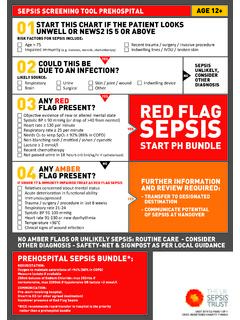
Transcription of Sepsis Screening and Nurse Driven Protocols
1 Sepsis Screening and Nurse Driven ProtocolsCairn Ruhumuliza, MSN, RN CPHQS epsis Coordinator, McLaren Northern Michigan HospitalAmy Sprague, DNP, RN, ACNS-BC, CCRNP atient SafetyManager, Indianapolis VA MedicalCenterFounding Sponsor:Network Sponsors:Lily Popkin, BSN, MSN, RNSepsis Coordinator, LutheranMedicalCenter Nation s leading Sepsis organization, working in all 50 states Focus on: Public awareness Provider education Survivor support AdvocacyIt s About TIMETM, a national you know? option:Amazon link on Sepsis Alliance website Donation range of 4% on total monthly qualifying purchases Amazon Smile program with Sepsis Alliance as your qualifying charity only of qualifying purchases benefit Sepsis Alliance Sepsis Screening and Nurse Driven ProtocolsEmergency Room and InpatientCairn Ruhumuliza MSN RN CPHQLily Popkin MSN RNAmy Sprague DNP RN ACNS-BC CCRNO bjectives Discuss the significance of early detection of and intervention for Sepsis Identify the similarities and differences between Emergency Room and Inpatient screenings and Nurse Driven protocolsEvidence behind ScreeningsCairn
2 Ruhumuliza MSN RN CPHQA pproximately 14 million survive to hospital discharge Half of patients recover 1/3 die during the following year 1/6thhave severe persistent impairments (about 840,000 people)Source: Sepsis Alliance and Global Sepsis AllianceFRAMING THE million cases of Sepsis each year in the #1 cause of death in hospitals #1 driver of readmission to a hospital258,000 deaths annually in US-more than breast cancer, prostate cancer & AIDS combined#1 cost of hospitalization -$24 Billon per yearMore than 80% of Sepsis cases originate in the communityUp to 50% of Sepsis survivors suffer from Post- Sepsis Syndrome (PSS)Globally > 19 million people develop Sepsis annuallyIT IS BELIEVED THESE NUMBERS ARE GROSSLY UNDERREPRESENTED10,000 Deaths/Year in the USSource.
3 Coalition for Sepsis SurvivalSEPSIS IS A LEADING CAUSE OF DEATHEasy to Manage if Recognized Early As the physicians say it happens in hectic fever, that in the beginning of the malady it is easy to cure but difficult to detect, but in the course of time, not having been either detected or treated in the beginning, it becomes easy to detect but difficult to cure Niccol Machiavelli, The Prince, 1532Or in other s tough to identify Sepsis early, but easy to treat. Once Sepsis is advanced, it s easy to identify but hard to treatParamount in the management of patients with Sepsis is the concept that Sepsis is a medical emergencyIdentifying Sepsis The challenges in reliably identifying severe Sepsis on clinical presentation remain the greatest barrier to implementing any guidelines, institutional Protocols or toolkits developed to reduce mortality.
4 Chamberlain, D. J. et al (2015) Identification of the severe Sepsis patient in triage. EMJ. 32(9): Infection Onset of clinical S/S of host response (fever, chills, etc.) Biological response (white blood cells, biomarkers) Presence of signs of infection (dysuria, purulent wounds, chest infiltrates) source specific Proven microbiological invasion (positive cultures) Note: 2004 Survey -86% of physicians indicated that symptoms of Sepsis can easily be misattributed to other conditions. 45% felt they sometimes missed a diagnosis of Sepsis . (Poeze, 2004)Does timing matter for the earliest and most basic elements of Sepsis care?
5 AB administration reduces pathogen burden, modifies host response, could reduce incidence of subsequent organ measurement of lactate could identify heretofore unrecognized are broad variations in identification of Sepsis , even when presented with similar casesSome Key Citations Ferrer (2014) Antibiotic administration and mortality. Almost 18,000 participants (retrospective) Delay of Antibiotic resulted in increased risk of mortality for every hour of delay (1-6 hours) Vincent Liu & Colleagues (2017) Timing of AB and Hospital mortality 9% increase in odds of mortality for each elapsed hour between presentation and AB administration.
6 Antibiotic given within 1sthour had greatest benefit Lynn, 2018 as 3 hour bundle compliance increased, mortality decreased Follow The Logic Early Identification of SepsisEnables Rapid Intervention Halting or slowing progressionLeading to Reduced Mortality Reduced Length of Stay Reduced Morbidity Reduced CostsOutcomesSepsis and septic shock are medical emergencies and we recommend that treatment and resuscitation begin Practice StatementSurviving Sepsis CampaignBest Practice Statements (SSC) Strong but ungraded statements Use defined criteriaCriteria for Best PracticeStatementsIs the statementclear and actionable?
7 Is the messagenecessary?Is the net benefit(or harm) unequivocal?Is the evidence difficultto collect and summarize?Is the rationaleexplicit?Isthe statement better if formally GRADEd?GuyattGH, Sch nemannHJ, DjulbegovicB, et al: ClinEpidemiol2015; 68:597 600 Current and Future Trends for Identification and Management of Sepsis Big data Electronic Medical Records using automated algorithms Machine Learning Predictive Modeling Clinical Support Systems early recognition and stratification Personalized and Precision Medicine New usage of BiomarkersSCREENING FOR Sepsis AND PERFORMANCE IMPROVEMENTWe recommend that hospitals and hospital systems have a performance improvement program for Sepsis including Sepsis Screening for acutely ill, high-risk patients.
8 (BPS)Surviving Sepsis Campaign,2018 Bottom LineTIME IS TISSUE Screening for Sepsis must be part of the nurses daily routine in order to positively influence outcomes If we don t screen, we will miss patients that may have benefited from the interventionsEmergency Room Screenings and Nurse Initiated OrdersLiane Popkin MSN RNGoals for Emergency Room Screening Identify all Sepsis continuum patients before they progress to worsening severe Sepsis and septic shock Patients to receive early intervention to decrease mortality Timely 3 Hour bundle elements With the goal of Door to antibiotics of <1 hour Algorithm2 SIRS?
9 Suspected or Known Infection?YesContinue to MonitorNoNoAre you sure?Continue to MonitorYesConsult ProviderStart BundleCall Sepsis AlertYesNoWhat Does it Look Like?What Does it Look Like?What constitutes a positive screening2 SIRS + Suspected/Known Source of InfectionInterventions 3 Hour Bundle Goal of Door to ABX < 1 Hour Radiology to bedside for a portable chest Nurse Interventions All monitors Heart and BP Set BP to q15min Apply NICOM and trend SVI Accurate Temporal Temperature If you are suspicious it is not correct, get rectal. IV Fluids in Room Prepared to be hung NS or LRGRAB THE GREEN Sepsis WORKSHEETTHIS FOLLOWS THE PATIENTN urse Interventions Ideal situation is to have 2 people in the room.
10 2 IVs Rainbow + 2 Blood Cultures [Draw and Hold] + Lactate SEND ALL LAB WORK WITH ORANGE SHEET CIRCLING Sepsis RN to order ED Sepsis Lactate Panel If patient has Urine Specimen Orderedand patient is unable to cleanly urinateRN to order and obtain Straight Cath UrineI have antibiotics ordered and haven t gotten my second set of blood cultures THE ER CONUNDRUMA lthough best practice is to get both sets of Blood Cultures prior to antibiotics, we understand that there are cases where you may not have both sets prior to antibiotics being this is the case administer antibiotics and work on trying to get the second set right after administration.