Transcription of SESSION 1: SCARCITY & DECISION MAKING
1 SESSION DescriptionScarcity of resources requires individuals, organizations, and governments to make decisions. Students will explore limited resources, opportunity cost, trade-offs, andthe production possibilities curve. In addition, they will experience DECISION MAKING inseveral ways by planning a dance, choosing a college, and buying a Points1. SCARCITY necessitates that a DECISION be made. 2. Productive resources are scarce because there are not enough of them to produce the unlimited amounts of goods and services that society wants. This is the fundamental economic problem (Step 1 of the PACED model) faced by society. 3. The PACED model provides a five-step process for MAKING decisions: P: Identify the problem.
2 Usually, the problem is related to SCARCITY . A: List alternatives the options you will choose from. C: Select criteria the things that are important to you in MAKING the DECISION . E: Evaluatealternatives based on the criteria. D: Make a DECISION . 4. Even though people may face the same problem and alternatives, they may have differ-ent criteria and evaluate the alternatives differently based on those criteria. So, facedwith the same problem, people do not necessarily make the same DECISION . 5. The PACED model is not about finding the correct choice for everybody; it is aboutmaking a careful, well-informed DECISION for Although societies want a large variety of goods, for simplicity s sake, let s assume thatwe have a society that wants only two goods.
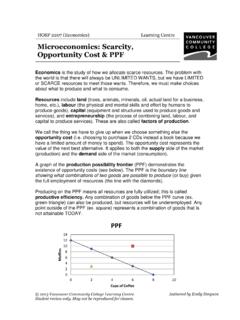
3 A production possibilities curve (PPC)shows the various combinations of these two goods a society can produce given itsavailable productive resources and current technology (methods of converting resourcesinto goods and services); that is, it shows the alternative mixes of goods that are pos-sible to produce at this time. SESSION 1: SCARCITY & DECISION MAKINGT ools for Teaching the Arkansas Economics and Personal Finance Course 2016, Economics Arkansas. Developed in partnership with the Federal Reserve Bank of St. Louis. All rights reserved. Reproduction for classroom use is permitted. All other reproduction is prohibited without written permission from Economics To construct a PPC, first find the all-or-nothing extremes and then ask what is the maximum amount of one good that could be produced given a certain amount of the other good to find the remaining combinations.
4 8. Combinations outside the PPC are not possible to produce at this time, while those inside the PPC are possible but do not require the use of all of society s resources. 9. The opportunity cost of a choice is the most-valued alternative that must be given up (it is real goods and services and/or real activities, not simply money or time) when a DECISION is made. 10. The opportunity cost along a PPC is the amount of one good that must be given up to get more of the other. 11. If all units of a resource are homogeneous (equally productive), the opportunity cost is the same for all units of a good (resulting in a straight-line PPC).
5 12. If units of a resource are heterogeneous (not equally productive), the opportunity cost rises as more of a good is produced (resulting in a bow-shaped PPC). 13. The simple message of the PPC is that there is a trade-off: Getting more of one thing (one good) means getting less of something else (another good). SESSION 1 Tools for Teaching the Arkansas Economics and Personal Finance Course 2016, Economics Arkansas. Developed in partnership with the Federal Reserve Bank of St. Louis. All rights for classroom use is permitted. All other reproduction is prohibited without written permission from Economics 1: Standards and BenchmarksArkansas Economic StandardsStrand:Economic DECISION MakingContent Standard 1: Students will make decisions after considering the marginal costs andmarginal benefits of alternatives.
6 Evaluate the roles of SCARCITY , incentives, trade-offs, and opportunitycosts in DECISION MAKING ( , PACED DECISION MAKING model, cost/benefitanalysis)Common Core State Standards Cite specific textual evidence to support analysis ofprimary and secondary sources, attending to such features as the date and ori-gin of the information. Determine the central ideas or information of a pri-mary or secondary source; provide an accurate summary of how key events orideas develop over the course of the text. Determine the meaning of words and phrases asthey are used in a text, including vocabulary describing political, social, or eco-nomic aspects of history/social science.
7 Initiate and participate effectively in a range of col-laborative discussions (one-on-one, in groups, and teacher-led) with diverse part-ners on grades 9 10 topics, texts, and issues, building on others ideas andexpressing their own clearly and persuasively. Present information, findings, and supporting evi-dence clearly, concisely, and logically such that listeners can follow the line ofreasoning and the organization, development, substance, and style are appropri-ate to purpose, audience, and task. Integrate quantitative or technical analysis ( ,charts, research data) with qualitative analysis in print or digital text.
8 Cite specific textual evidence to support analysisof primary and secondary sources, connecting insights gained from specificdetails to an understanding of the text as a whole. Present information, findings, and supporting evi-dence, conveying a clear and distinct perspective, such that listeners can followthe line of reasoning, alternative or opposing perspectives are addressed, andthe organization, development, substance, and style are appropriate to purpose,audience, and a range of formal and informal tasks. Work with peers to promote civil, democratic discussions and DECISION MAKING , set clear goals and deadlines, and establish individual roles as 1 Tools for Teaching the Arkansas Economics and Personal Finance Course 2016, Economics Arkansas.
9 Developed in partnership with the Federal Reserve Bank of St. Louis. All rights reserved. Reproduction for classroom use is permitted. All other reproduction is prohibited without written permission from Economics Present information, findings, and supporting evi-dence, conveying a clear and distinct perspective, such that listeners can followthe line of reasoning, alternative or opposing perspectives are addressed, andthe organization, development, substance, and style are appropriate to purpose,audience, and a range of formal and informal 1 Tools for Teaching the Arkansas Economics and Personal Finance Course 2016, Economics Arkansas.
10 Developed in partnership with the Federal Reserve Bank of St. Louis. All rights for classroom use is permitted. All other reproduction is prohibited without written permission from Economics 1: Resources1. Video: SCARCITY (Virtual Economics )a. Choose Browse Economic Concepts. b. Choose Fundamental Economics. c. Choose SCARCITY . d. Choose the picture on the Podcast: Economic Lowdown Series (Federal Reserve Bank of St. Louis)a. Episode 1: Opportunity Cost; Video: DECISION MAKING /Cost Benefit Analysis (Virtual Economics )a. Choose Browse Economic Concepts. b. Choose Fundamental Economics. c. Choose DECISION MAKING /Cost Benefit Analysis.