Transcription of Session 11 Lessons for Life: Learning and Transfer
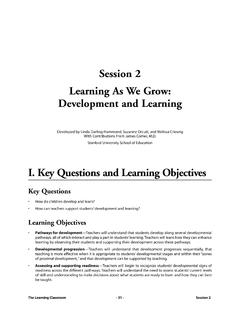
1 Session 11. Lessons for life : Learning and Transfer Developed by Linda Darling-Hammond and Kim Austin With Contributions From Lee Shulman and Daniel Schwartz Stanford University School of Education I. Key Questions and Learning Objectives Key Questions How do people Transfer skills and knowledge from one situation to another? How can we teach for Transfer ? Learning Objectives Conditions for Transfer Teachers will understand what conditions are needed for knowledge and skills learned in one context to be retrieved and applied to a new situation. Teaching for Transfer Teachers will develop ideas about how to facilitate Transfer in their own classrooms and how to build bridges for their students between concepts, activities, and Lessons .
2 The Learning Classroom - 189 - Session 11. II. Session Overview When students go out into the world and encounter new experiences, rarely will they have a manual telling them exactly what to do. They will need to draw on what they have learned before to solve new challenges. How do we teach them to Transfer what they have learned from one situation to another? How can we teach them to use their knowledge in new ways? That is the challenge of Transfer : How can students use what they have learned by applying it to solve new problems? Given the vast array of knowledge needed in life , the teacher's challenge is to determine what is the least amount of material that she can teach really well that will allow students to use that knowledge in the widest possible range of situations.
3 Transfer is the ability to extend what one has learned in one context to new contexts. In some sense, the whole point of school Learning is to be able to Transfer what is learned to a wide variety of contexts outside of school. Yet the ability to Transfer information or ideas is not a given. Quite often, information learned in a specific way, or in a particular context, does not Transfer to another. For example, students may memorize vocabulary words for a quiz, but they cannot use the words in their writing. Students may learn mathematical facts, but they do not know how to apply these concepts when they are confronted with a different kind of problem outside of school.
4 Students may conjugate verbs in a second language, but they cannot remember how to use them correctly in conversation. If the ultimate goal of schooling is to help students Transfer what they have learned in school to the everyday set- tings of home, community, and work, we have much to learn from the nonschool environments where people work. Studies conducted in places like ships, hospital emergency rooms, and dairy farms have found at least three contrasts between schools and everyday settings: 1. School environments place more emphasis on individual work than most other environments, which tend to emphasize collaboration. 2. School work tends to involve more mental work, whereas everyday settings invest more in tools and tech- nologies to solve problems.
5 3. Abstract reasoning is emphasized in school, whereas contextualized reasoning is used more often in everyday settings (Resnick, 1987, cited in Bransford, Brown, & Cocking, 2000, p. 74). The overall implication is that for effective Transfer to take place, Learning should be organized around the kinds of authentic problems and projects that are more often encountered in nonschool settings. However, as we dis- cuss below, overly contextualized reasoning can limit an individual's ability to Transfer . It is thus important to pro- vide opportunities for students to use knowledge in multiple contexts so that they can see how skills or problem-solving strategies can be generalized.
6 All new Learning involves Transfer to some extent; Learning can be transferred from one problem to another, from one class to another, between home and school, and between school and the workplace. Specific Transfer (also called near Transfer ) refers to the application of knowledge to a specific, very similar situation. For example, a stu- dent can add a string of numbers on a worksheet in the classroom and can also add a similar string of numbers in the grocery store. General Transfer (also called far Transfer ) refers to the application of knowledge or general prin- ciples to a more complex, novel situation. An example of general Transfer is a student who understands the principles of the scientific method and applies them to design and conduct an experiment, to critique other experiments, and to test competing hypotheses in an area where she has developed content knowledge.
7 General Transfer is more broadly useful, and it is also more challenging to develop. Researchers have found that a number of factors influence a learner's ability to understand or apply new knowledge: The nature of the initial Learning experience, The contexts for both the initial Learning and the new situation to which it may apply, The ability of learners to see similarities and differences across situations, and Learners' metacognitive abilities to reflect on and monitor their own Learning . Session 11 - 190 - The Learning Classroom II. Session Overview, cont'd. For Transfer to occur, Learning must involve more than simple memorization or applying a fixed set of procedures (Bransford et al.)
8 , 2000, p. 55). Learners must understand a concept or have command of a skill in order to be able to use it themselves. They must know how to apply what they have learned to new situations or problems, and they must know when it applies. To teach for Transfer , teachers must ask, What is it about what I am teaching now that will be of value, of use, and a source of understanding for my students at some point in the future, when they are in a situation that is not identical to the one they're in now? Continually asking not just, Where are my stu- dents in the curriculum now? , but also Where might this Learning be going? is fundamental to teaching for Transfer .
9 The Nature of the Initial Learning Experience An important point about Transfer is that the initial knowledge that is intended for Transfer needs to be well- grounded. One factor that influences initial Learning is whether students have learned something so that they understand it or whether they have simply memorized facts or procedures. Learning with understanding includes grappling with principles and ideas, and structuring facts around these organizing ideas. For example, a student may memorize the properties of veins and arteries, but not understand why these features are important. In How People Learn, John Bransford and colleagues illustrate the difference between knowing that arteries are elastic in order to recognize the fact on a test, as opposed to understanding that arteries are elastic and are thicker than veins because they must withstand the force of blood pumping in surges (Bransford et al.)
10 , 2000). This latter under- standing allows learners confronted with the challenge of creating an artificial artery to figure out that there are alternative ways of solving the problem of variable pressure. Students who possess this deeper understanding of the original material how and why arteries work as they do are better equipped to Transfer this initial knowl- edge to a new situation and grapple with this more complex problem. Another factor that influences initial Learning is the time students are given to explore ideas, offer predictions, process information, and make sense of new tasks and situations. Ideas cannot just be mentioned; they must be examined and pondered in order to be understood.