Transcription of SG34:17 - NASC
1 NASC1 of 24SG34:17 Guidance on Protection of the Public January 20171. INTRODUCTIONL egislation, including the Construction (Design and Management) Regulations (CDM 2015) and Management of Health and Safety Regulations (MHSW 1999), outlines that clients, main contractors, designers, users ( other contractors on site who will use the scaffold ) and scaffold contractors have a duty to consider and control the risks to the general public as early as possible, at the enquiry stage, planning stage ( planning, pavement license, traffic management, segregation, hoarding, lighting, signage, etc)
2 And throughout the life of each general public will not be aware of the hazards associated with scaffolding activities making them more vulnerable to the possibility of injury; therefore adequate planning involving all parties is essential for the safe erection, use, alteration, maintenance and dismantling of scaffold structures in close proximity to the general public and others who may be affected by scaffolding NASC guidance document has been produced to give an overview of the planning required and the range of precautions that need to be considered to eliminate the risk of harm (including that of controlling the risk of falling material and transport accidents).
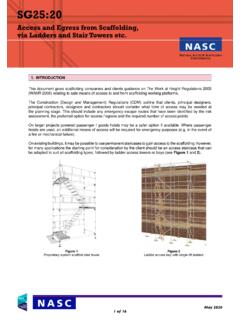
3 11 Many of the pictorials in this guidance document have been taken from existing NASC Guidance, such as TG20:13. Please note that the TG20:13 illustration on the front page has been amended to show the provision of a single guardrail to control access and footfall under the scaffold , because of the risk of tripping over the baulk timber. Where guardrails are required (in consultation with the local authority issuing the Highway Licence) there may be a requirement for suitable breaks in the handrail and baulk ( for escape route or for access) at intervals dependant on the length of the of 24 For further information regarding protecting the public from construction work, please also refer to current health and safety legislation, British and European Standards and Guidance information in the reference WHERE INTERFACE WITH THE PUBLIC CAN OCCURI nterface with the general public can occur in many different environments whilst carrying out scaffolding operations , including for example: On a public pavement or road.
4 At a premises or location that is visited or accessed by the public; At schools and residential and care homes; At a domestic household for a private project will need to be risk assessed on its own merits and this document provides guidance on protecting the general public and others. Please see example below from TG20 of a pavement lift , which pictorially documents typical safety requirements. A pavement lift allows members of the public after erection to walk under the first lift of scaffolding on a public pavement. Free passage is achieved by omitting the ledger bracing below the first lift and by increasing the first lift height to provide sufficient headroom, with additional ties or plan braces fitted to stabilise the scaffold .
5 The pavement lift may be supplanted with safety features such as lighting, protective boarding or foam padding around the uprights etc).It is vitally important that, from the time of the initial scaffolding enquiry the scaffold contractor makes all parties aware of the hazards and risks as well as the control measures that will be required to ensure safe erection, use, alteration, maintenance and dismantling of the of 243. OVERVIEW OF TYPICAL HAZARDS, RISKS AND CONTROL MEASURESThe client, main contractor, designer, users ( other contractors on site who will use the scaffold , such as bricklayers), scaffold contractor and other interested bodies (including the local authority where necessary) should consider the hazards, risks and control measures required for the , the main phases are: scaffold erection; The scaffold in use (after handover) by operatives working for the main contractor and other contractors.
6 scaffold alterations carried out by the scaffold contractor after initial handover; scaffold dismantle , the main scaffolding hazards and risks involving the public are: Transport (risk of scaffolding vehicles injuring pedestrians); Work at height during scaffolding operations (with risk of falling scaffold tubes, boards and fittings); Work at height during building works (other trades working on completed scaffold with risk of their materials falling bricks); Pedestrians (risk of personal injury walking into scaffolding structures).
7 Typically, the main control measures are: Client and main contractor control measures ( hoarding, site segregation, pedestrian and vehicle segregation); Methodical scaffold erection/dismantle operations (promoted and driven by CISRS courses); Exclusion zones (sometimes with lookouts); Out of hours working; Protection gantries; Pavement scaffolds; Protection fans; System protection fans/nets installed and raise progressively with the rising scaffold and progressively lowered with the dismantled scaffold ;2 Note: scaffold contractors carrying out scaffolding operations on domestic properties may be the only contractor on site and therefore under CDM 2015 take on the duties of the main contractor/designer (as another contractor a roofer will subsequently work on site afterwards).
8 For domestic properties and clients, the NASC consider that the scaffold contractor s Risk Assessment/Method Statement (RAMS) incorporates the required elements of the CDM Construction Health & Safety Plan ( induction, design, health & safety, security, first aid and welfare arrangements as per SG18) and no further paperwork (aside from a site visitors book for longer term projects) is required for compliance with of 24 Brickguards; and Sheeting and SPECIALISED CONTROL MEASURESDBS (Disclosure and Barring Service), formerly CRB3 Additional control measures may be required of scaffold contractors when working on schools, residential and care homes.
9 There may be a requirement when working for local authorities to comply with the Safeguarding Vulnerable Groups Act 2006 as well as compliance with DBS, which was formerly the Criminal Records Bureau (CRB).Tethering Other control measures sometimes required for adverse weather conditions ( very gusty weather) and/or for very high risk overhead projects (such as suspended/hanging scaffolds in built up city centres), may include, subject to a risk assessment, Tethered tools and Tethered tube, boards, fittings etc. Please see section 7.
10 Tethering for more : Tethering of material should not be considered as a first option as it is labour intensive, introduces elements of complacency, and requires very high levels of supervision and there are often better ways to eliminate the risk of falling CLIENT, MAIN CONTRACTOR AND DESIGNER CONSIDERATIONSThe client, main contractor and designer should consider whether the risk to the public is high, medium and low and the required control measures that must put in place ( physical protection methods such as protection fans, pavement lifts.)