Transcription of Shakespeare Critical Anthology: Tragedy
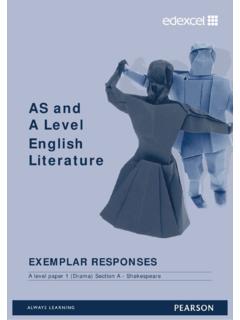
1 Shakespeare Critical Anthology: TragedyAS and A Level English LiteratureThe Pearson Edexcel AS and A level English Literature Shakespeare Critical Anthology can be used to prepare for Component 1 of your assessmentFor more information about Edexcel or BTEC qualifications from Pearson, visit or is a registered trademark of Pearson Education LimitedPearson Education Limited. Registered in England and Wales No. 872828 Registered Office: Edinburgh Gate, Harlow, Essex CM20 2JE VAT Reg No GB 278 537121 PearsonEdexcel GCEE nglish LiteratureComponent 1a: DramaShakespeare Critical Anthology: TragedyFor use with: A level English Literature (9ET0) Component 1a Drama ( Shakespeare )Published by Pearson Education Limited, a company incorporated in England and Wales, having its registered office at Edinburgh Gate, Harlow, Essex, CM20 2JE. Registered company number: 872828 Edexcel is a registered trade mark of Edexcel Limited Pearson Education Limited 2014 First published 201417 16 15 1410 9 8 7 6 5 4 3 2 1 British Library Cataloguing in Publication DataA catalogue record for this book is available from the British LibraryISBN 9781446913499 Copyright noticeAll rights reserved.
2 No part of this publication may be reproduced in any form or by any means (including photocopying or storing it in any medium by electronic means and whether or not transiently or incidentally to some other use of this publication) without the written permission of the copyright owner, except in accordance with the provisions of the Copyright, Designs and Patents Act 1988 or under the terms of a licence issued by the Copyright Licensing Agency, Saffron House, 6 10 Kirby Street, London, EC1N 8TS ( ). Applications for the copyright owner s written permission should be addressed to the in Slovakia by NeografiaCover images: Background: : Theepatheep Kawinpathawee; Masks: : InnervisionArtAcknowledgementsWe are grateful to the following for permission to reproduce copyright material:Section A: Tragedy1 David Scott Kastan, A rarity most beloved : Shakespeare and the Idea of Tragedy , in A Companion to Shakespeare s Works Vol I, Blackwell 20032 A. D. Nuttall, Aristotle and After , in Why Does Tragedy Give Pleasure?
3 , OUP 19963 A. C. Bradley, The Substance of Shakespearean Tragedy , in Shakespearean Tragedy , Penguin 19914 Maynard Mack, What Happens in Shakespearean Tragedy , in Everybody s Shakespeare : Reflections Chiefly on the Tragedies, University of Nebraska Press 1993 Section B: Antony and Cleopatra1 Howard Jacobson, Antony and Cleopatra: Gentle Madam, No , in Shakespeare s Magnanimity, OUP 19872 Emrys Jones, Introduction , in Antony and Cleopatra, Penguin 19773 Tony Tanner, in Prefaces to Shakespeare , Harvard University Press 1993 Section C: Hamlet1 John Kerrigan, in Revenge Tragedy : Aeschylus to Armageddon, Clarendon 19962 Janet Adelman, Man and Wife Is One Flesh: Hamlet and the Confrontation with the Maternal Body , in Suffocating Mothers, Routledge 19923 William Hazlitt, Hamlet in Characters of Shakespeare s Plays, OUP 1916 Section D: King Lear1 Carol Rutter, Eel Pie and Ugly Sisters in King Lear , in Lear from Study to Stage, Associated University Presses 19972 Frank Kermode, King Lear , in Shakespeare s Language, Allen Lane 20003 Fintan O Toole, King Lear: Zero Hour in Shakespeare Is Hard, But So Is Life, Granta 2002 Section E: Othello1 E.
4 A. J. Honigmann, Introduction , in othello , Arden 3rd Series 20012 F. R. Leavis, Diabolical Intellect and the Noble Hero , in Scrutiny, December 19373 Ania Loomba, othello and the Radical Question , in Shakespeare , Race, and Colonialism, OUP 1998 Every effort has been made to contact copyright holders to obtain their permission for the use of copyright material. Pearson Education will, if notified, be happy to rectify any errors or omissions and include any such rectifications in future 4 Section A: Tragedy1 Shakespearean Tragedy 62 The pleasure of Tragedy 83 The Shakespearean tragic hero 104 Tragedy and madness 12 Section B: Antony and Cleopatra1 Antony s suicide 142 Antony and Cleopatra: the play s structure 163 Time and timelessness in Antony and Cleopatra 18 Section C: Hamlet1 Memory and remembrance in Hamlet 202 Hamlet: Avenging his father or saving his mother?
5 223 The complexity of Hamlet 24 Section D: King Lear1 Language and female power in King Lear 262 Ways of speaking in King Lear 283 The morality of King Lear 31 Section E: Othello1 othello : The portrayal of Iago 332 The character of othello 353 othello , race and society 37 IntroductionAt the heart of Edexcel s A level Literature specification is the literary text. Teachers and academics tell us that, above all, A level should encourage you to read and re-read your literary texts and to know them well. They also want students to read widely, deeply and independently to secure informed views about these texts. Reading critically means not just having opinions, but seeing that other readers might think collection of Critical passages is designed to extend and illuminate your reading of your set Shakespeare play. It results from our extensive research to understand what teachers and university English departments really believe are the most important skills and knowledge for students of literature at A level.
6 The Critical views contained here will offer you a range of perspectives on Tragedy , as well as three specific passages on your chosen Shakespeare play. In total you will have seven passages that are relevant to your A level Shakespeare text (Component 1 Drama).The texts have been selected to give you a taste of high-quality writing by literary critics about a text that you should know well. They have been chosen by academics at one of the leading university English departments in the country, University College London, led by Professor John Mullan. Teachers may wish to supplement them with other passages of criticism that they think are illuminating, but this is not essential. We hope that your own Critical writing style will be enriched by reading, and sometimes grappling with, these tightly crafted pieces by skilled literary thinkers. The arguments posed will enable you to consider the views of others and form, and perhaps re-assess, your own readings of your studied Shakespeare how might you use literary criticism within A level Literature?
7 This will vary from student to student, depending on your developing skills in the subject. There is no expectation for you to pepper your own responses to Shakespeare with quotations from this anthology, or to ensure that a set percentage of your essay references this material. The intention is that your own responses to Shakespeare s writing will be enriched by considering the range of viewpoints offered here. Think of reading this criticism as rather like having a conversation; we offer each of these perspectives not as the answer to reading Shakespeare , but merely as another reading of the text for you to engage with. You may find that some of the critics do not seem to agree with each Edexcel Shakespeare Critical Anthology45 All of the points below are valuable ways of using the extended reading offered in this collection during class discussion, in personal essays, or ultimately in your examination responses: Understand the interpretation being put forward about the literary text(s).
8 Compare the critic s position with your own reading of the text (or indeed that of another critic or a member of your class). Identify any points of connection or difference. Agree with the point made. Identify further evidence in Shakespeare s text to extend it. Disagree with the critic s position. Identify evidence in Shakespeare s text that might support your opposing argument. Refine the critic s position. Identify one element that you can support and another that you would prefer to refine and qualify with evidence from the text. Select particular quotations that support or contrast with your own reading of the text to strengthen your discussion or literary that, for all today s students, with ready access to the internet, the issue of plagiarism is an important one. You can, and should, draw on both the literary text and your wider reading to craft your own arguments. However, once you use others words, or specific ideas, you must acknowledge them by use of a footnote or bracketed reference within your text.
9 While Shakespeare borrowed many of his stories from other writers, academic essay-writing must be your own!UCLP rofessor John Mullan, Professor Helen Hackett and Professor Ren WeisPearsonKaty Lewis, Esther Menon6If any theoretical pressures existed to shape Shakespeare s understanding of Tragedy they came more from medieval articulations of the genre than classical ones. Chaucer was seemingly the first to use the English word Tragedy , in a gloss in his translation (ca. 1380) of Boethius s De Consolatione Philosophiae: Tragedye is to seyn a dite of a prosperite for a tyme that endeth in wrecchidnesse. The felt need for a gloss suggests that Tragedy was then an unfamiliar concept in English, but quickly the idea of Tragedy as the fall from prosperity to wretchedness became commonplace. Chaucer s definition is perhaps so limited as to seem obvious and unhelpful, especially in our hypertheoretical age, but in its very simplicity it calls attention to Tragedy s power, marking it as universal and inexplicable.
10 It defines the inescapable trajectory of the tragic action but not its cause, and in its reticence about who or what is responsible for the dire change of fortune it speaks Tragedy s fearful Chaucer s definitional reserve finds its most powerful analogue in the agonizing silences of Shakespeare s tragedies. Why should a dog, a horse, a rat have life / And thou no breath at all? ( 8), King Lear cries, holding his broken child. No answer is forthcoming, though it lies in the incalculable murderousness of the world. And directly questioning that world produces no more satisfying responses. Is there any cause in nature that makes these hard hearts? ( 5).Section A: Tragedy1 Shakespearean tragedyKastan sees Shakespeare s tragedies as intense treatments of age-old questions about whether the causes of suffering lie in human weakness, divine retribution, or arbitrary fate. He asserts that the absence of clear answers to these questions is central to Shakespearean Tragedy .