Transcription of Silver-Copper-Phosphorus Alloys Safety Data Sheet
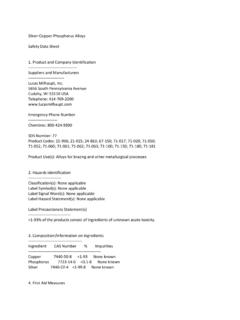
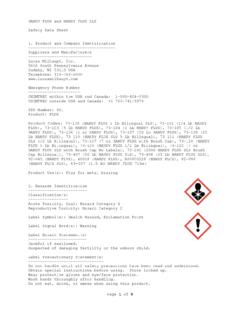
1 Page 1 of 7 Silver-Copper-Phosphorus Alloys Safety data Sheet 1. Product and Company Identification ------------------------------------- Manufacturer ------------ Lucas-Milhaupt, Inc. 5656 South Pennsylvania Avenue Cudahy, WI 53110 USA Telephone: 414-769-6000 Emergency Phone Number ---------------------- CHEMTREC : within USA or Canada 1-800-424-9300 CHEMTREC : outside USA or Canada 1-704-741-5970 SDS Number: 77 Product: AG-CU-P Product Codes: 28704 (SIL-FOS 10), 71-100 (SIL-FOS 10), 34286 (SIL-FOS 5M), 26310 (SIL-FOS 1), 27953 (SIL-FOS 1), 2774 (SIL-FOS 2), 71-020 (SIL-FOS 2), 34649 (SIL-FOS 2F), 28134 (SIL-FOS 2M), 35502 (SIL-FOS 2M), 71-017 (SIL-FOS 2M), 35503 (SIL-FOS 5), 25841 (SIL-FOS 5), 7054 (SIL-FOS 5)), 71-050 (SIL-FOS 5), 28118 (SIL-FOS 5F), 71-052 (SIL-FOS 5F), 17152 (HANDY-FLO 6), 71-062 (HANDY-FLO 6), 17244 (HANDY-FLO 6), 35542 (SIL-FOS 6i), 71-063 (SIL-FOS 6i), 28126 (SIL-FOS 6), 71-060 (SIL-FOS 6), 29538 (SIL-FOS 15),7153 (SIL-FOS 15), 71-150 (SIL-FOS 15), 26047 (SIL-FOS 15), 35528 (SIL-FOS 15), 35544 (SIL-FOS 15LP), 19422 (SIL-FOS 18W), 31138 (SIL-FOS 18M), 35207 (SIL-FOS 18M),71-181 (SIL-FOS 18M)
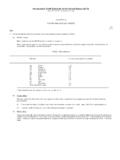
2 , 35216 (SIL-FOS 18), 71-180 (SIL-FOS 18) Product Use(s): Alloys for brazing and other metallurgical processes 2. Hazards Identification ------------------------- Classification(s): None applicable Label Symbol(s): None applicable Label Signal Word(s): None applicable Label Hazard Statement(s): None applicable Label Precautionary Statement(s) -------------------------------- The acute toxicities of 74-94% of the product s ingredients are unknown. 3. Composition/Information on Ingredients ---------------------------------------- - Ingredient CAS Number % Impurities ---------------------------------------- ------------ copper 7440-50-8 74-94 None known phosphorus 7723-14-0 2-8 None known silver 7440-22-4 <1-19 None known Page 2 of 7 4.
3 First Aid Measures --------------------- Eye --- Flush affected areas with water for at least fifteen minutes. Seek medical assistance if necessary. Skin ---- Remove contaminated clothing. Wash affected area with large quantities of water for at least five minutes. Seek medical attention if necessary. Launder or dry-clean clothing before reuse. Ingestion --------- If subject is conscious, induce vomiting. If unconscious or convulsive, seek immediate medical assistance. Do not give anything by mouth to an unconscious or convulsive person. Inhalation ---------- If signs and symptoms of toxicity are observed, remove subject from area, administer oxygen, and seek medical attention.
4 Keep the subject warm and at rest. Perform artificial respiration if breathing has stopped. Note to Physician or Poison Control Center ---------------------------------------- -- None of the components are acutely toxic by ingestion, nor are they absorbed through the skin. Long-term chronic exposure may cause argyria. 5. Fire Fighting Measures ------------------------- Fire and Explosion Hazards -------------------------- These products are non-flammable and non-explosive. If present in a fire or explosion, they may emit fumes of the constituent metals and/or phosphorus pentoxide. Extinguishing Media ------------------- Use dry chemical. Do not use water. Fire Fighting Instructions -------------------------- If fighting a fire in which these products are present, wear a self-contained breathing apparatus with full facepiece operated in pressure-demand or other positive pressure mode.
5 6. Accidental Release Measures ------------------------------ Methods and Materials --------------------- If a finely-divided form of product is spilled, clean up spillage so as to minimize dispersion of dust. Either wet sweeping or vacuuming using HEPA filtration is recommended. Personal Precautions -------------------- Avoid contact with skin, eyes, and mucous membranes. Page 3 of 7 Environmental Precautions ------------------------- Prevent spills from entering sewers or contaminating soil. 7. Handling and Storage ----------------------- Handling Precautions -------------------- No special handling precautions are required. Work and Hygiene Practices -------------------------- To prevent ingestion following use of the product, wash hands and face before eating, drinking, applying cosmetics, or using tobacco.
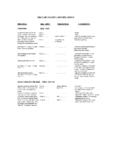
6 Remove contaminated clothing or protective equipment before entering eating/drinking areas. Storage Precautions ------------------- Do not store in proximity to incompatible materials (see Section #10). 8. Exposure Controls and Personal Protection ---------------------------------------- ---- Ingredients - Exposure Limits ----------------------------- copper ACGIH TLVs: mg/m3 TWA (fume); 1 mg/m3 TWA (dusts and mists) OSHA PELs: mg/m3 TWA (fume); 1 mg/m3 TWA (dusts and mists) phosphorus No applicable ACGIH TLV(s) No applicable OSHA PEL(s) silver ACGIH TLV: mg/m3 TWA (metal) OSHA PEL: mg/m3 TWA Ingredients Biological Limits ------------------------------- copper No ACGIH BEI(s) or other biological limit(s) phosphorus No ACGIH BEI(s) or other biological limit(s) silver No ACGIH BEI(s) or other biological limit(s) Engineering Controls -------------------- Use dilution or local exhaust ventilation adequate to maintain concentrations of all components and their byproducts to within their applicable standards.
7 Eye/Face Protection ------------------- Wear eye protection adequate to prevent eye contact with the product and injury if the product is used with a flame. Plastic-frame spectacles with side shields are recommended. Skin Protection --------------- Wear protective gloves and clothing to prevent skin injuries if the product is used with a flame. Avoid flammable fabrics. Respiratory Protection ---------------------- If an exposure level to a component(s) exceeds an applicable standard, use a NIOSH-approved respirator having a configuration (facepiece, filter media, Page 4 of 7 assigned protection factor, etc.) effective for the concentration of the component(s) generated. For guidance on selection and use of respirators, consult American National Standard (ANSI, New York, NY 10036, USA).
8 9. Physical and Chemical Properties ----------------------------------- Appearance: Yellow-white metals, various forms Odor: none Odor threshold: not applicable pH: not applicable Melting Point: approx. 1, Freezing point: not applicable Boiling point/boiling range: not determined Flash Point: not applicable Evaporation Rate: not applicable Flammability Class: not applicable Lower Explosive Limit: not applicable Upper Explosive Limit: not applicable Vapor pressure: not applicable Vapor density: not applicable Relative density (H2O): Solubility (H2O): insoluble Oil-water partition coefficient: not applicable Autoignition Point: not applicable Decomposition temperature: not applicable Viscosity: not applicable 10.
9 Stability and Reactivity ---------------------------- Reactivity: none reasonably foreseeable Stability: stable Hazardous Polymerization: will not occur Risk of Dangerous Reactions: silver and copper can form unstable acetylides in contact with acetylene gas. Incompatible Materials ---------------------- Strong oxidizers; ammonia; azides; nitric acid; ethylene imine; sulfuric acid; chlorine trifluoride; inorganic and organic peroxides; peroxyformic acid; oxalic acid; bromates, chlorates, and iodates of alkali and alkali earth metals; tartaric acid; 1-bromo-2-propyne; permonosulfuric acid; alkaline hydroxides. Hazardous Decomposition Products -------------------------------- Heating to elevated temperatures may liberate fumes of the constituent metals and/or phosphorus pentoxide.
10 10. Toxicological Information ----------------------------- Ingredients - Toxicological data -------------------------------- copper LD50: No data available LC50: No data available phosphorus LD50: >15,000 mg/kg (oral/rat) LC50: 4,300 mg/m3 for 1 hr (rat) silver LD50: >2,000 mg/kg (oral/rat) LC50: No data available Page 5 of 7 Primary Routes(s) of Entry -------------------------- Ingestion; inhalation. Eye Hazards ----------- Eye contact with these products in finely-divided forms may cause irritation, conjunctivitis, ulceration of the cornea, and/or argyria, a permanent gray discoloration of the eyes, skin, mucous membranes, and respiratory tract.