Transcription of Solid waste disposal
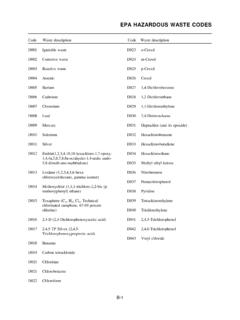
1 waste disposal Information Sheet Current criteria for the classification of waste including Industrial and Commercial waste (Listed) and waste Soil Issued March 2010 EPA 889/10: This information sheet provides the current criteria for the classification of waste as they appear on EPA licences, including Industrial and Commercial waste (Listed) and waste Soil. These are applied at waste depots to define disposal criteria, and to form part of the criteria to assess risks and determinations made for materials proposed for reuse as waste Derived Fill1. The concentrations of chemical substances that define chemical criteria for Intermediate and Low-level contaminated waste will apply until the draft publication Guideline for Solid waste : criteria for assessmclassification and disposal of waste ent, 2 is finalised.
2 The criteria for waste Fill however, will remain as defined in the Environment Protection Regulations 2009, as reflected in this Information Sheet. Intermediate and Low-level Contaminated waste Criteria Landfill licenses may contain additional notations for minimum suites of chemicals for analysis of specific wastes for disposal . Table 1 Criteria for the classification of waste Intermediate Low-level contaminated Chemical Substance Concentration in mg/kg (dry weight) Maximum leachate concentrations in mg/L Method of analysis 1997 Concentration in mg/kg (dry weight)) Maximum leachate concentrations in mg/L Method of analysis 1997 Aldrin + dieldrin (total)
3 <2 # <50 Arsenic <200 5 <750 5 Barium 100 Benzo(a)pyrene <2 # <5 Beryllium <40 1 <150 1 Cadmium <30 <60
4 Chlordane <2 # <50 1 Refer to < waste_derived_fill> 2 Refer to < >. Current criteria for classification of waste 2 Intermediate Low-level contaminated Chemical Substance Concentration in mg/kg (dry weight) Maximum leachate concentrations in mg/L Method of analysis 1997 Concentration in mg/kg (dry weight)) Maximum leachate concentrations in mg/L Method of analysis 1997 Chromium Total 20 Chromium (III) <12% # <30% # Chromium (VI)
5 <200 5 <750 5 Cobalt <170 # <1,000 # Copper <2,000 10 <7,500 10 Cyanides (total) <1,000 10 <3,500 10 DDT <2 # <50 Heptachlor <2 # <50 Iron 100 Lead <1.
6 200 5 <5,000 5 Manganese <6,000 50 <10,000 50 Mercury <30 <110 Methyl Mercury <20 # <75 # Nickel <600 2 <3.
7 000 2 Phenolic compounds (total) <17,000 # <50,000 Polychlorinated biphenyls (PCBs) <2 # <50 # Polycyclic aromatic hydrocarbons (PAH) (total) <40 # <200 # Silver 5 Total Petroleum Hydrocarbons (TPH) C6-C9 <100 # <1,000 # TPH > C9 <1,000 # <10,000 # Zinc <14,000 250 <50.
8 000 250 Method of analysis 1997 Benzene <5 # <15 1 Ethylbenzene <100 # <1,000 30 Tetrachloroethylene <14 # < Current criteria for classification of waste Intermediate Low-level contaminated Chemical Substance Concentration in mg/kg (dry weight) Maximum leachate concentrations in mg/L Method of analysis 1997 Concentration in mg/kg (dry weight))
9 Maximum leachate concentrations in mg/L Method of analysis 1997 Toluene <50 # <500 Xylene (total) <180 # <1,800 50 Notes: 1 The assessment of the chemical analysis carried out on samples of the waste may include scientifically valid statistical analysis (for total concentrations mg/kg) to justify classification of the waste in accordance with the values listed in this table. 2 # indicates that leachate testing for that chemical substance is not required provided that the concentration of that chemical substance in mg/kg (dry weight) does not exceed the value specified for that category of waste .
10 3 < = less than . waste Fill (as defined in Part 1 the Environment Protection Regulations 2009) waste fill means waste consisting of clay, concrete, rock, sand, soil or other inert mineralogical matter in pieces not exceeding 100 millimetres in length and containing chemical substances in concentrations (calculated in a manner determined by the Authority) less than the concentrations for those substances set out in the following table (but does not include waste consisting of or containing asbestos or bitumen): Table 2 waste fill chemical criteria waste fill criteria3 Chemical substance Maximum total dry weight chemical concentrations (mg/kg) Chemical substance Maximum total dry weight chemical concentrations (mg/kg) Aldrin/Dieldrin (total) 2 Ethylbenzene Arsenic 20 Heptachlor