Transcription of Solving Equations—Quick Reference - Algebra-Class.com
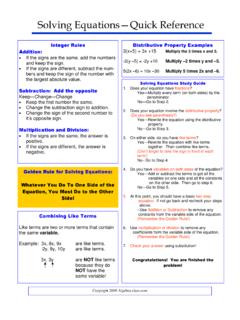
1 Copyright 2009 Solving Equations Quick Reference Integer Rules Addition: If the signs are the same, add the numbers and keep the sign. If the signs are different, subtract the num-bers and keep the sign of the number with the largest absolute value. Subtraction: Add the opposite Keep Change Change Keep the first number the same. Change the subtraction sign to addition. Change the sign of the second number to it s opposite sign. Multiplication and Division: If the signs are the same, the answer is positive. If the signs are different, the answer is negative. Golden Rule for Solving Equations: Whatever You Do To One Side of the Equation, You Must Do to the Other Side! Combining Like Terms Like terms are two or more terms that contain the same variable. Example: 3x, 8x, 9x are like terms. 2y, 9y, 10y are like terms. 3x, 3y are NOT like terms because they do NOT have the same variable! Distributive Property Examples 3(x+5) = 3x +15 Multiply the 3 times x and 5.
2 -2(y 5) = -2y +10 Multiply 2 times y and 5. 5(2x 6) = 10x 30 Multiply 5 times 2x and 6. Solving Equations Study Guide 1. Does your equation have fractions? Yes Multiply every term (on both sides) by the denominator. No Go to Step 2. 2. Does your equation involve the distributive property? (Do you see parenthesis?) Yes Rewrite the equation using the distributive property. No Go to Step 3. 3. On either side, do you have like terms? Yes Rewrite the equation with like terms together. Then combine like terms. (Don t forget to take the sign in front of each term!) No Go to Step 4. 4. Do you have variables on both sides of the equation? Yes Add or subtract the terms to get all the variables on one side and all the constants on the other side. Then go to step 6. No Go to Step 5. 5. At this point, you should have a basic two-step equation.
3 If not go back and recheck your steps above. - Use Addition or Subtraction to remove any constants from the variable side of the equation. (Remember the Golden Rule!) 6. Use multiplication or division to remove any coefficients form the variable side of the equation. (Remember the Golden Rule!) 7. Check your answer using substitution! Congratulations! You are finished the problem! Copyright 2009 Graphing Equations Quick Reference Slope= rise run Calculate the slope by choosing two points on the line. Count the rise (how far up or down to get to the next point?) This is the numerator. Count the run (how far left or right to get to the next point?) This is the denominator. Write the slope as a fraction. Slope = 3/5 ** Read the graph from left to right. If the line is falling, then the slope is negative. If the line is rising, the slope is positive. **When counting the rise and run, if you count down or left, then the number is negative.
4 If you count up or right, the number is positive. Slope Intercept Form y = mx +b Slope Y-intercept Graphing Using Slope Intercept Form 1. Identify the slope and y-intercept in the equation. y = 3x -2 Slope Y-intercept 2. Plot the y-intercept on the graph. 3. From the y-intercept, count the rise and run for the slope. Plot the second point. 4. Draw a line through your two points. Copyright 2009 Writing Equations Quick Reference If you know the slope (or rate) and the y-intercept (or constant), then you can easily write an equation in slope intercept form. Example: If you have a slope of 3 and y-intercept of -4, the equation can be written as: y = 3x - 4 slope y-intercept Slope Intercept Form y = mx +b Slope Y-intercept Writing Equations Given Slope and a Point If you are given slope and a point, then you are given m, x, and y for the equation y = mx + b.
5 You must have slope (m) and the y-intercept (b) in order to write an equation. Step 1: Substitute m, x, y into the equation and solve for b. Step 2: Use m and b to write your equation in slope intercept form. Example: Write an equation for the line that has a slope of 2 and passes through the point (3,1). m = 2, x = 3 y = 1 y = mx + b 1 = 2(3) + b Substitute for m, x, and y. 1 = 6 +b Simplify (2 3 =6) 1-6 = 6-6- +b Subtract 6 from both sides. -5 = b Simplify (1-6= -5) y = 2x -5 Write your equation. Standard Form Ax + By = C The trick with standard form is that A, B, and C must be integers AND A must be a positive integer! Examples: -3x + 2y = 9 Incorrect! -3 must be positive (multiply all terms by -1) 3x 2y = -9 Correct! A, B, & C are integers and A is a positive integer. Writing an Equation Given Two Points If you are given two points and asked to write an equation, you will have to find the slope and the y-intercept!
6 Step 1: Find the slope using: y2 y1 x2 x1 Step 2: Use the slope (from step 1) and one of the points to find the y-intercept. Step 3: Write your equation using the slope (step 1) and y-intercept (step 2). Example: Write an equation for the line that passes through (1,6) (3,-4). Step 1: -4 6 = -10 = -5 Slope = -5 3 1 2 Step 2: y = mx +b m = -5 (1,6) y = mx + b 6 = -5(1) +b 6 = -5 +b Simplify: -5(1)= -5. 6 +5= -5 +5+b Add 5 to BOTH sides. 11 = b Simplify (6+5=11). Y-intercept = 11 Step 3: y = -5x+ 11 Copyright 2009 Systems of Equations Quick Reference Graphing Systems of Equations Two linear equations form a system of equations. You can solve a system of equations using one of three methods: 1. Graphing 2. Substitution Method 3. Linear Combinations Method Substitution Method Solve the following system of equations: x 2y = -10 y= 3x x 2y = -10 x 2(3x) = -10 Since we know y = 3x, substitute 3x for y into the first equation.
7 X 6x = -10 Simplify: Multiply 2(3x) = 6x. -5x = -10 Simplify: x 6x = -5x -5x = -10 -5 -5 Solve for x by dividing both sides by -5. x= 2 The x coordinate is 2. y = 3x y = 3(2) y = 6 Since we know that x = 2, we can substitute 2 for x into y = 3x. Solution: (2, 6) The solution! The solution to a system of equations is the point of intersection. The ordered pair that is the point of intersection represents the solution that satisfies BOTH equations. If two lines are parallel to each other, then there is no solution. The lines will never intersect. If two lines lay one on top of another then there are infinite solutions. Every point on the line is a solution. Linear Combinations (Addition Method) Solve the following system of equations: 3x+2y = 10 2x +5y = 3 -2(3x + 2y = 10) 3(2x + 5y = 3) Create opposite terms. I m creating opposite x terms. -6x 4y = -20 6x + 15 y = 9 11y = -11 Multiply to create opposite terms.
8 Then add the like terms. 11y = -11 11 11 Solve for y by dividing both sides by 11. y = -1 The y coordinate is -1 2x + 5y = 3 2x +5(-1) = 3 Substitute -1 for y into one of the equations. 2x 5 = 3 2x -5 + 5 = 3 + 5 2x = 8 2 2 x = 4 Solve for x! The solution (4, -1) Copyright 2009 Inequalities Quick Reference Graphing Inequalities in One Variable Inequality Symbols < Less Than Less Than OR Equal To > Greater Than Greater Than or Equal To Graphing Inequalities in Two Variables Graph for: y > -1/2x + 1 1. Graph y = -1/2x + 1, but dot the line since the symbol is >. The points on the line are not solutions. 2. Pick a point such as (0,0) and substitute it into the inequality. (0,0) is not a solution, therefore, shade the side of the line that does not contain (0,0). Special Rule - Just for Inequalities Whenever you multiply or divide by a negative number, you MUST reverse the sign. Example -3x < 9 -3x < 9 -3 -3 x > -3 Systems of Inequalities Graph each inequality as shown above.
9 ONLY the area that is shaded by BOTH inequalities is the solution set (orange section) Reverse the sign Divide by a negative 3 Copyright 2012 Functions Quick Reference Identifying Functions using the Vertical Line Test If a graph represents a function, that graph will only intersect with a vertical line one time. Function Notation can be written as: f(x) = 3x+2 this translates to: f of x equals 3x+2 g(x) = 3x-1 this translates to: g of x equals 3x 1 Evaluating Functions Quadratic Functions Quadratic Functions will have a squared term A quadratic function will result in a parabola when graphed. When vertical lines are drawn through this graph, each vertical line touches the graph only one time. This graph represents a function. When vertical lines are drawn through this graph, each vertical line touches the graph more than once. This graph does not represent a function. **If the lead coefficient is positive, then the parabola will open up.
10 Example: 3x2 + 2x 5 (3 is positive) **If the lead coefficient is negative, then the parabola will open down. Example: -2x2 +2x -5 (2 is negative) Vertex Formula Given the function: f(x) = ax2 + bx + c Vertex Formula: (The opposite of b divided by 2 times a) Linear Functions Function notation can be confusing, but once you can identify the x and y coordinate, you can think of your typical ordered pair. Copyright 2012 Exponents and Monomials Quick Reference Multiplying Powers with the Same Base Power of a Product Property Multiplying Monomials Example Zero Exponents LAWS of EXPONENTS Power of a Power Property Power of Quotient Property Property: To find the power of a quotient, raise the numerator to the power, and the denominator to the power. Then divide. Simplifying Monomials Example Copyright 2012 Polynomials Quick Reference What is the Degree of a Polynomial? What is a Polynomial?