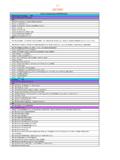
Transcription of Sonography Principles and Instrumentation Examination ...
1 1 | P a g e Version: Sonography Principles and Instrumentation Examination content outline ( outline Summary) # Domain Subdomain Percentage 1 Clinical Safety, Patient Care, and Quality Assurance Patient Care 10% Quality Assurance New Technologies 2 Physical Principles Physical Principles 15% 3 Ultrasound Transducers Transducers 16% 4 Imaging Principles and Instrumentation Instrumentation 28% 5 Doppler Imaging Concepts Hemodynamics 31% (Detailed outline ) 1. Clinical Safety, Patient Care, and Quality Assurance 10% Knowledge and/or Skills of Safety Issues in a Medical Environment Clinical Safety Apply generally accepted infection control precautions and disinfectant techniques Apply generally-accepted.
2 Infection control precautions and disinfectant techniques Knowledge of sterile technique Modify output power following ALARA Principles Knowledge of bioeffects and ALARA Identify potential bioeffects Modify the exam based on the displayed mechanical index Modify the exam based on the displayed thermal index Knowledge of mechanical index and thermal index Apply ergonomic techniques throughout the workday Ability to perform appropriate patient care Ability to communicate with the patient and physician Knowledge of when and how to communicate through a patient representative Ability to acquire information from other imaging findings ( , computed tomography, magnetic resonance imaging, x-ray, etc.)
3 Knowledge of parameters for measuring image accuracy Knowledge of gold standards ( , sensitivity and specificity standards) Knowledge of parameters for transducer element integrity tests Knowledge of damage that contributes to degradation of image Apply ergonomic techniques throughout the workday Modify output power following ALARA principle Identify potential bioeffects Patient Care Demonstrate appropriate patient care and communication skills Analyze clinical history and prior imaging studies Quality Assurance Apply concepts for conducting performance tests with Doppler flow phantoms and tissue-mimicking phantoms Apply concepts for evaluation of statistical
4 Parameters New Technologies Identify tissue Doppler 2 | P a g e Version: New Technologies cont. Evaluate applicable uses of ultrasound contrast agents Knowledge of Doppler flow phantoms and tissue-mimicking phantoms Apply concepts related to elastography imaging Knowledge of tissue Doppler Knowledge of ultrasound hybrid imaging Evaluate applicable uses of ultrasound contrast agents Apply concepts related to elastography imaging Identify ultrasound hybrid imaging, , fusion imaging 2. Physical Principles 15% Knowledge and/or Skills of Physical Principles Physical Principles Modify the exam based on gray-scale artifacts Ability to distinguish gray-scale artifacts and reflectors Knowledge of the interaction between sound and matter ( , attenuation, reflection, refraction)
5 Ability to integrate concepts related to all types of resolution Knowledge of axial resolution Knowledge of lateral resolution Knowledge of temporal resolution Knowledge of elevational resolution Knowledge of duty factor Knowledge of frame rate Differentiate the various interactions of sound and matter Modify technique based on knowledge of reflectors Integrate concepts related to optimization of axial resolution Integrate concepts related to optimization of lateral resolution Integrate concepts related to optimization of temporal resolution Integrate concepts related to optimization of elevational resolution Apply concepts related to duty factor 3.
6 Ultrasound Transducers 16% Knowledge and/or Skills of Ultrasound Transducers Transducers Select a specific transducer type based on the area being scanned Ability to select the appropriate transducer frequency for a given situation Knowledge of transducers, use and limitation Ability to evaluate transducer integrity Knowledge of damage that contributes to degradation of image Knowledge of curvilinear transducers Knowledge of linear transducers Knowledge of sector transducers (phased array) Knowledge of endocavity transducers Knowledge of two-dimensional array transducers Knowledge of transducer components Knowledge of nonimaging transducers Knowledge of array transducers Evaluate and adjust transducer frequency based on the area being scanned Evaluate transducer integrity Apply concepts related to the use of curvilinear array transducers Apply concepts related to the use of linear array transducers Apply concepts related to the use of sector transducers (phased array)
7 Apply concepts related to the use of endocavity transducers Apply concepts related to the use of two-dimensional array transducers Distinguish components of the transducer 3 | P a g e Version: Apply concepts related to the use of nonimaging transducers Apply concepts related to the use of array transducers 4. Imaging Principles and Instrumentation 28% Knowledge and/or Skills of Imaging Principles and Instrumentation Instrumentation Demonstrate ability to perform accurate measurements Knowledge of Instrumentation and controls Knowledge of two-dimensional measurements Ability to recognize and measure anatomic structures Knowledge of imaging depth Knowledge of overall gain Knowledge of focusing Knowledge of two-dimensional real-time, gray-scale imaging (B-mode)
8 Knowledge of time gain compensation Knowledge of zoom Knowledge of M-mode imaging Knowledge of harmonic imaging Knowledge of dynamic range Knowledge of edge enhancement Knowledge of persistence Knowledge of frequency compounding Knowledge of extended field of view Knowledge of compound imaging Knowledge of coded excitation Knowledge of three-dimensional/four-dimensional imaging Knowledge of storage systems and devices Knowledge of appropriate documentation of findings Apply concepts related to imaging depth Apply concepts related to overall gain Apply concepts related to focusing Apply concepts related to gray scale Apply concepts related to time gain compensation Apply concepts related to zoom Apply concepts related to M-mode Apply concepts related to harmonic imaging Apply concepts related to dynamic range, compression Apply concepts related to edge enhancement Apply concepts related to persistence Apply concepts related to frequency compounding Apply concepts related to extended field of view.
9 Panoramic imaging Apply concepts related to spatial compounding Apply concepts related to coded excitation Apply concepts related to the use of three-dimensional/four-dimensional imaging Apply concepts related to imaging systems and storage 4 | P a g e Version: 5. Doppler Imaging Concepts 31% Knowledge and/or Skills of Doppler Imaging Concepts Hemodynamics Obtain measurements of blood flow velocities Knowledge of proper measurement of blood flow velocities Knowledge of pulsed wave Doppler Application of proper Doppler scale adjustment (spectral and color) Knowledge of pulse repetition frequency (spectral and color) Knowledge of spectral Doppler gain Knowledge of spectral Doppler waveforms Knowledge of wall filter applications (spectral and color)
10 Apply concepts related to pulse repetition frequency Apply concepts related to wall filter Apply concepts related to pulsed wave Doppler Evaluate spectral Doppler waveforms Hemodynamics cont. Apply concepts related to continuous wave Doppler Knowledge of continuous wave Doppler Knowledge of Doppler controls and Instrumentation (spectral and color) Knowledge of spectral Doppler angle to flow Knowledge of Doppler artifacts (spectral and color) Knowledge of Doppler reject (spectral and color) Application of proper sample size (volume) adjustment (spectral and color)