Transcription of Special Immigrant Juvenile Status: The Basics
1 1 Special Immigrant Juvenile status : The BasicsKristen Jackson, Senior Staff Attorney, Public Counsel, LARachel Prandini, Unaccompanied Minor Law FellowImmigrant Legal Resource Center, San FranciscoHayley Upshaw, Senior Staff Attorney, Legal Services for Children, San FranciscoSIJS Basics : Overview Special Immigrant Juvenile status (SIJS)provides legal protection for certain undocumented Immigrant youth who have been abused, abandoned, or neglected, by allowing them to legalize their immigration status and become lawful permanent residents2 Special Immigrant Juvenile status Created in 1990 after advocacy by Santa Clara child welfare agency Creates pathway to permanent residency Depends on findings by a state court to establish eligibility 2 Special Immigrant Juvenile status Statutory Authority.
2 8 1101(a)(27)(J) and 8 Note: the regulations have not been updated since important changes in the law made in 2008. Proposed regulations are pending and not expected until late 2016 See alsoCalifornia Code of Civil Procedure 155 Clarifies which Superior Courts have jurisdiction to make SIJS findings and mandates that courts make these findings where evidence has been presented to establish eligibilitySpecial Immigrant Juvenile status Eligibility RequirementsA youth may be eligible for SIJS if he/she:1. Is under 21 years of age2.
3 Is unmarried3. Has been declared dependent upon a Juvenile court located in the United States or whom such a court has legally committed to or placed under the custody of an agency or department of a State, or an individual or entity appointed by a State or Juvenile court located in the United StatesSpecial Immigrant Juvenile status Eligibility RequirementsThe court must make two findings:4. Reunification with one or both of the child s parents is not viable due to abuse, neglect, or abandonment, or a similar basis found under State law5.
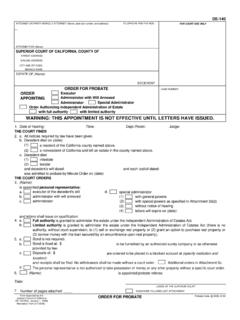
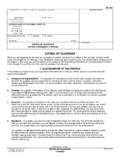
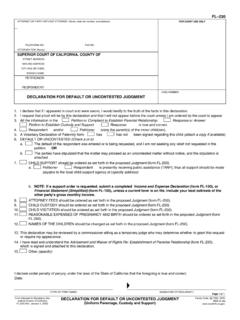
4 It would not be in the child s best interest to be returned to the child s or parent s previous country of nationality or country of last habitual residence3 The Path to a SIJS Visa & Legal Permanent Residence1. Juvenile Court a. Guardianship/Dependency/Delinquency/Fami ly Petitionb. Petition for SIJS eligibility findings (form GC 220, FL 356, JV 356) SIJS Predicate order on formFL 357/GC 224/JV 357 2. Application to USCIS for Special Immigrant Juvenile Status3. Application to USCIS or Immigration Court for Permanent Residency7 What Is a Juvenile Court?
5 The term Juvenile court is defined as a court located in the United States having jurisdiction under State law to make judicial determinations about the custody and care of juveniles. 8 (a).What Is a Juvenile Court? In California, this includes, but is not limited to, the Juvenile , probate, and family court divisions California Code of Civil Procedure 155 v. Superior Court, 207 Cal. App. 4th 621 (2012) (Superior Courts are divided into departments as a matter of convenience; but the subject matter jurisdiction of the Superior Court is vested as a whole, so any superior court making a determination about the custody and care of a Juvenile qualifies as a Juvenile court as defined by the SIJS statute)
6 4 Custody Determination Declared dependent upon a Juvenile court located in the United States Dependency Or whom such a court has legally committed to or placed under the custody of an agency or department of a State Delinquency Or an individual or entity appointed by a State or Juvenile court located in the United States Probate and familyReunification Not Viable with One orBoth Parents Change to the SIJS law that was made by the Trafficking Victims Protection Reauthorization Act of 2008 Under the current statute, children who live with one parent but have been abused, abandoned, or neglected by the other parent can be eligible for SIJSR eunification Not Viable with One orBoth Parents In re Israel O.
7 , 233 Cal. App. 4th 279 (2015) (finding that a child may be eligible for SIJS even if a safe and suitable parental home in the United States is available) Eddie E. v. Superior Court, 234 Cal. App. 4th 319 (2015) (finding that the plain language of the [revised] SIJS statute means that a child can satisfy the second SIJS finding by showing an inability to reunify with one parent due to abuse, abandonment, neglect, or a similar basis)5 Best Interests Court looks to state law on best interest factors Welfare and Institutions Code 202; Probate Code 1514.
8 Family Code 3011 Best interest determination may, and often is, based on facts beyond abuse, abandonment, or neglect Court may consider country conditions, family members or lack of them in home country, child s safety, Interests In determining whether it would be in the child s best interests to be returned to his or her parent s home country, the court must look at the evidencepresented and cannot speculate about what might be in the child s best interests or make determinations based on policy considerations.
9 See Leslie H. v. Superior Court,224 Cal. App. 4th 340 (2014) (finding that the lower court erred in denying the request for SIJS findings for a delinquent youth based on policy considerations and that ample, uncontroverted evidence was presented to satisfy the statutory criteria)Maintaining Juvenile Court Jurisdiction General rule: Child must remain under Juvenile court jurisdiction until the adjustment of status application is approved unless such jurisdiction is terminated based on age 6 Maintaining Juvenile Court Jurisdiction Background.
10 Regulations (now outdated) interpreting statute require that the child remain under Juvenile court jurisdiction until adjustment of status is approved 8 CFR (c)(5) requires child to continue to be dependent upon the Juvenile court and eligible for long term foster care, such declaration, dependency, or eligibility not having been vacated, terminated, or otherwise ended 8 CFR (a)(3)(iv)(C) provides for automatic revocation of SIJS if the dependency on the Juvenile court is terminated before adjustment of status is approvedMaintaining Juvenile Court Jurisdiction Perez OlanoStipulation (2015), Case No.