Transcription of Specimen Label - CDMS
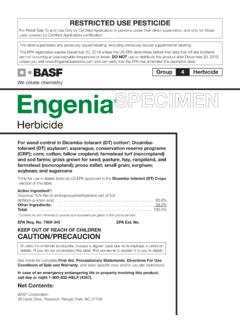
1 Specimen Label Trademark of The Dow Chemical Company ( Dow ) or an affiliated company of Dow A herbicide for control of annual grasses and broadleaf weeds in field corn, field seed corn, field silage corn, and yellow popcorn. Group15274 HERBICIDES Active Ingredients: acetochlor: 2-chloro-N-ethoxymethyl-N- (2-ethyl6-methylphenyl)acetamide 31 0% mesotrione: 2-[4-(methylsulfonyl)- 1,3-cyclohexanedione 3 3% clopyralid MEA salt: 3,6-dichloropyridinecarboxylic acid, monoethanolamine salt 2 7%Other Ingredients.]
2 63 0%Total 100 0% Contains 336 grams/liter or 2 8 pounds/gallon acetochlor, 36 grams/liter or 0 30 pounds/gallon mesotrione, and 22 4 grams/liter or 0 19 pounds/gallon clopyralid, acid equivalent (3,6-dichloropyridinecarboxylic acid) Not for Sale, Sale Into, Distribution and/or Use in Nassau and Suffolk Counties of New York State. Precautionary Statements Hazards to Humans and Domestic Animals EPA Reg No 62719-693 CAUTION Harmful If Swallowed or Absorbed Through Skin Causes Moderate Eye Irritation Prolonged or Frequently Repeated Skin Contact May Cause Allergic Reactions in Some Individuals Avoid contact with skin, eyes or clothing.
3 Wash thoroughly with soap and water after handling and before eating, drinking, chewing gum, using tobacco or using the toilet. Remove and wash contaminated clothing before reuse. Personal Protective Equipment (PPE)Some of the materials that are chemical-resistant to this product are listed below If you want more options, follow the instructions for category C on an EPA chemical-resistance category selection chart Applicators and other handlers must wear: Long-sleeved shirt and long pants Chemical-resistant gloves made of any waterproof material Shoes plus socks Follow manufacturer's instructions for cleaning/maintaining PPE If no such instructions for washables exist, use detergent and hot water Keep and wash PPE separately from other laundry Discard clothing and other absorbent materials that have been drenched or heavily contaminated with this product's concentrate Do not reuse them Follow manufacturer's instructions for cleaning/maintaining PPE If no such instructions for washables exist, use detergent and hot water Keep and wash PPE separately from other laundry Engineering Controls.
4 When handlers use closed systems or enclosed cabs in a manner that meets the requirements listed in the Worker Protection Standard (WPS) for agricultural pesticides [40 CFR 170 240(d)(5)], the handler PPE requirements may be reduced or modified as specified in the WPS User Safety RecommendationsUsers should: Wash hands thoroughly after handling and before eating, drinking, chewing gum, using tobacco or using the toilet Remove clothing/PPE immediately if pesticide gets inside. Then wash thoroughly and put on clean clothing Remove PPE immediately after handling this product. Wash the outside of gloves before removing As soon as possible, wash thoroughly and change into clean clothing First AidIf swallowed: Call a poison control center or doctor immediately for treatment advice Have person sip a glass of water if able to swallow Do not induce vomiting unless told to do so by a poison control center or doctor Do not give anything by mouth to an unconscious person If on skin or clothing: Take off contaminated clothing Rinse skin immediately with plenty of water for 15-20 minutes Call a poison control center or doctor for treatment advice If in eyes.
5 Hold eye open and rinse slowly and gently with water for 15-20 minutes Remove contact lenses, if present, after the first 5 minutes, then continue rinsing eye Call a poison control center or doctor for treatment advice Have the product container or Label with you when calling a poison control center or doctor, or going for treatment You may also contact 1-800-992-5994 day or night, for emergency treatment information Environmental HazardsThis pesticide is toxic to fish Do not apply directly to water or to areas where surface water is present or to intertidal areas below the mean high water mark Do not contaminate water when disposing of equipment washwaters Acetochlor demonstrates the properties and characteristics associated with chemicals detected in groundwater The use of this chemical in areas where soils are permeable, particularly where the groundwater is shallow.
6 May result in groundwater contamination Clopyralid is known to leach through soil into ground water under certain conditions as a result of agricultural use Use of this product where soils are permeable, particularly where the water table is shallow, may result in leaching to ground water Surface Water AdvisoryMesotrione may contaminate water through drift of spray in wind This product has a high potential for runoff for several weeks after application Poorly draining soils and soils with shallow water tables are more prone to produce runoff that contains this product A level, well maintained vegetative buffer strip between areas to which this product is applied and surface water features such as ponds, streams.
7 And springs will reduce the potential for contamination of water from runoff Runoff of this product will be reduced by avoiding applications when rainfall is forecasted to occur within 48 hours Sound erosion control practices will reduce this product s contribution to surface water contamination Acetochlor has properties that may result in surface water contamination via dissolved runoff and runoff erosion Practices should be followed to minimize the potential for dissolved runoff and/or runoff erosion Directions for UseIt is a violation of Federal law to use this product in a manner inconsistent with its labeling Read all Directions for Use carefully before applying Do not apply this product in a way that will contact workers or other persons, either directly or through drift Only protected handlers may be in the area during application For any requirements specific to your State or Tribe, consult the agency responsible for pesticide regulation Agricultural Use RequirementsUse this product only in accordance with its labeling and with the Worker Protection Standard, 40 CFR part 170 This Standard contains requirements for the protection of agricultural workers on farms, forests, nurseries, and greenhouses, and handlers of agricultural pesticides It contains requirements for training, decontamination, notification.
8 And emergency assistance It also contains specific instructions and exceptions pertaining to the statements on this Label about personal protective equipment (PPE), and restricted-entry interval The requirements in this box only apply to uses of this product that are covered by the Worker Protection Standard 2 Specimen Label Revised 10-23-17 Agricultural Use Requirements (Cont.)Do not enter or allow worker entry into treated areas during the restricted entry interval (REI) of 12 hours Exception: If the product is soil-injected or soil-incorporated, the Worker Protection Standard, under certain circumstances, allows workers to enter the treated area if there will be no contact with anything that has been treated PPE required for early entry to treated areas that is permitted under the Worker Protection Standard and that involves contact with anything that has been treated, such as plants, soil, or water, is.
9 Coveralls Chemical-resistant gloves made of any waterproof material Shoes plus socks Storage and DisposalDo not contaminate water, food, or feed by storage or disposal Pesticide Storage: Store in original container only Keep container closed when not in use Do not store near food or feed In case of spill or leak on floor or paved surfaces, soak up with vermiculite, earth, or synthetic absorbent Pesticide Disposal: Pesticide wastes are toxic Improper disposal of excess pesticide, spray mixture, or rinsate is a violation of Federal law If these wastes cannot be disposed of by use according to Label instructions, contact your State Pesticide or Environmental Control Agency or the Hazardous Waste Representative at the nearest EPA Regional Office for guidance Nonrefillable containers 5 gallons or less:Container Handling.
10 Nonrefillable container Do not reuse or refill this container Offer for recycling if available, or puncture and dispose of in a sanitary landfill, or by incineration, or by other procedures allowed by state and local authorities Triple rinse or pressure rinse container (or equivalent) promptly after emptying Triple rinse as follows: Empty the remaining contents into application equipment or a mix tank and drain for 10 seconds after the flow begins to drip Fill the container 1/4 full with water and recap Shake for 10 seconds Pour rinsate into application equipment or a mix tank or store rinsate for later use or disposal Drain for 10 seconds after the flow begins to drip Repeat this procedure two more times Pressure rinse as follows.