Transcription of Specimen Label - CDMS
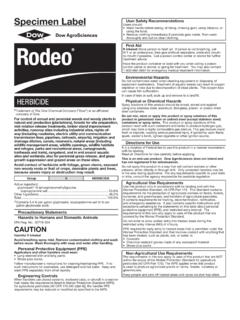
1 Specimen Label User Safety Recommendations Users should: Wash hands before eating, drinking, chewing gum, using tobacco, or using the toilet. Remove clothing immediately if pesticide gets inside. Then wash thoroughly and put on clean clothing. Remove PPE immediately after handling this product. Wash the outside of gloves before removing. As soon as possible, wash thoroughly and change into clean clothing. First Aid If on skin or clothing: Take off contaminated clothing. Rinse skin immediately with plenty of water for 15-20 minutes. Call a poison control center or doctor for treatment advice. If in eyes: Hold eye open and rinse slowly and gently with water for 15- 20 minutes. Remove contact lenses, if present, after the rst 5 minutes, then continue rinsing eye.
2 Call a poison control center or doctor for treatment advice. If swallowed: Call a poison control center or doctor immediately for treatment advice. Have person sip a glass of water if able to swallow. Do not induce vomiting unless told to do so by a poison control center or doctor. Do not give anything by mouth to an unconscious person. Have the product container or Label with you when calling a poison For the control of annual and perennial broadleaf weeds and control center or doctor, or going for treatment. You may also contact 1-800-992-5994 for emergency medical treatment information. kikuyugrass in ornamental turf. Active Ingredient: Environmental Hazards triclopyr: 3,5,6-trichloro-2- This pesticide is toxic to sh. Do not apply directly to water, to areas pyridinyloxyacetic acid, where surface water is present, or to intertidal areas below the mean butoxyethyl ester.
3 High water mark. Do not contaminate water when cleaning equipment or Other Ingredients .. disposing of equipment washwaters. Total .. This chemical has properties and characteristics associated with Acid Equivalent: triclopyr - 4 lb/gal chemicals detected in groundwater. The use of this chemical in areas where soils are permeable, particularly where the water table is shallow, Precautionary Statements may result in groundwater contamination. Hazards to Humans and Domestic Animals Directions for Use EPA Reg. No. 62719-566. It is a violation of Federal law to use this product in a manner inconsistent with its labeling. CAUTION Read all Directions for Use carefully before applying. Causes Moderate Eye Irritation Harmful If Swallowed Prolonged Do not apply this product in a way that will contact workers or other Or Frequently Repeated Skin Contact May Cause Allergic Reactions persons, either directly or through drift.
4 Only protected handlers may be In Some Individuals in the area during application. For any requirements speci c to your state or tribe, consult the agency responsible for pesticide regulation. Avoid contact with skin, eyes, or clothing. Wear gloves and protective clothing. Wash thoroughly with soap and water after handling and before eating, drinking, chewing gum, or using tobacco. Agricultural Use Requirements The requirements in this box apply to sod farm uses. Personal Protective Equipment (PPE) Use this product only in accordance with its labeling and with the Some materials that are chemical-resistant to this product are listed Worker Protection Standard, 40 CFR part 170. This standard contains below. If you want more options, follow the instructions for category E on requirements for the protection of agricultural workers on farms, forests, an EPA chemical resistance category selections chart.
5 Nurseries, and greenhouses, and handlers of agricultural pesticides. WPS Uses: Applicators and other handlers who handle this pesticide It contains requirements for training, decontamination, noti cation, for any use covered by the Worker Protection Standard (40 CFR and emergency assistance. It also contains speci c instructions Part 170) for this product, sod farm uses -- must wear: and exceptions pertaining to the statements on this Label about personal protective equipment (PPE) and restricted-entry interval. The Long-sleeved shirt and long pants requirements in this box only apply to uses of this product that are Chemical-resistant gloves (>14 mils) such as barrier laminate, nitrile covered by the Worker Protection Standard. rubber, neoprene rubber, or viton Shoes plus socks Do not enter or allow worker entry into treated areas during the restricted entry interval (REI) of 12 hours.
6 Non-WPS Uses: Applicators and other handlers who handle this pesticide for any use NOT covered by the Worker Protection Standard PPE required for early entry to treated areas that is permitted under the (40 CFR Part 170) for this product, non-sod farm uses -- must wear: Worker Protection Standard and that involves contact with anything that has been treated, such as plants, soil, or water, is: Long-sleeved shirt and long pants Coveralls Chemical-resistant gloves Chemical-resistant gloves (>14 mils) such as barrier laminate, nitrile Shoes plus socks rubber, neoprene rubber, or viton Follow the manufacturer's instructions for cleaning/maintaining PPE. If no Shoes plus socks such instructions for washables, use detergent and hot water. Keep and wash PPE separately from other laundry.
7 Engineering Controls When handlers use closed systems, enclosed cabs, or aircraft in a manner that meets the requirements listed in the Worker Protection Standard (WPS) for agricultural pesticides (40 CFR (d)(4-6)), the handler PPE requirements may be reduced or modi ed as speci ed in the WPS. Non-Agricultural Use Requirements General Use Precautions and Restrictions The requirements in this box apply to all use sites on this Label In Arizona: The state of Arizona has not approved Tur on Ester Ultra for except for sod farm uses. use on sod farms. The requirements in this box apply to uses of this product that are NOT Chemigation: Do not apply this product through any type of irrigation within the scope of the Worker Protection Standard for Agricultural system.
8 Pesticides (40 CFR Part 170). The WPS applies when this product Do not apply Tur on Ester Ultra directly to, or otherwise permit it to is used to produce agricultural plants on farms, forests, nurseries, or come into direct contact with, cotton, grapes, tobacco, vegetable crops, greenhouses. owers, fruit or orchard trees, shrubs, or other desirable broadleaf plants. Entry Restrictions for Non-WPS Uses: For applications to turf other Do not permit spray mists containing Tur on Ester Ultra to drift onto such than sod farms or turf grown for seed, do not allow entry into areas until plants. sprays have dried. To minimize turf injury, do not treat if turf is under heat or drought stress. Reapply Tur on Ester Ultra at 4-week intervals. Storage and Disposal Mow newly seeded turf 2 or 3 times before treating.
9 Do not water for Do not contaminate water, food, or feed by storage and disposal. Open 24 hours after application. Do not reseed for 3 weeks after application. dumping is prohibited. (This precaution does not apply when Bermudagrass turf is overseeded Pesticide Storage: Store above 28 F or agitate before use. with perennial ryegrass at a minimum reseeding rate of 400 lb per acre.). Pesticide Disposal: Wastes resulting from the use of this product must be disposed of on site or at an approved waste disposal facility. Local conditions may affect the use of herbicides. Consult your local specialist for advice in selecting treatments from this Label to best t local Nonre llable containers 5 gallons or less: conditions. Container Handling: Nonre llable container.
10 Do not reuse or re ll this container. Offer for recycling if available or puncture and dispose of in Do not apply to ditches currently being used to transport irrigation water. a sanitary land ll, or by incineration, or by other procedures allowed by Do not apply where runoff or irrigation water may ow onto agricultural state and local authorities. land as injury to crops may result. Triple rinse or pressure rinse container (or equivalent) promptly after Do not use on other turfgrass species, such as bahiagrass, bentgrass, emptying. Triple rinse as follows: Empty the remaining contents Bermudagrass, centipedegrass, St. Augustinegrass, or zoysiagrass into application equipment or a mix tank and drain for 10 seconds unless injury can be tolerated. after the ow begins to drip.