Transcription of Specimen Label - CDMS
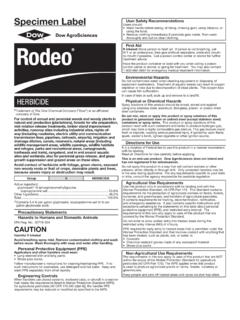
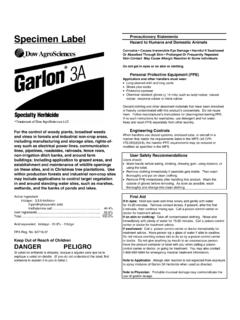
1 Specimen Label For the control of annual and perennial broadleaf weeds in established turfgrass including, but not limited to, sod farms Active Ingredients: triclopyr: 3,5,6-trichloro-2-pyridinyloxyacetic acid, triethylamine salt .. clopyralid: 3,6-dichloro-2-pyridinecarboxylic acid, triethylamine salt .. Other Ingredients .. Acid Equivalent: triclopyr - - lb/gal clopyralid - - lb/gal EPA Reg. No. 62719-92 Keep Out of Reach of Children DANGER PELIGRO Si usted no entiende la etiqueta, busque a alguien para que se la explique a usted en detalle. (If you do not understand the Label , find someone to explain it to you in detail.) Precautionary Statements Hazards to Humans and Domestic Animals Corrosive Causes Irreversible Eye Damage Harmful If Swallowed, or Inhaled Prolonged Or Frequently Repeated Skin Contact May Cause Allergic Reactions In Some Individuals Do not get in eyes or on clothing.
2 Wear protective eyewear (goggles, face shield or safety glasses). Avoid breathing spray mist. Personal Protective Equipment (PPE) Applicators and other handlers must wear: Long-sleeved shirt and long pants Shoes plus socks Protective eyewear Discard clothing and other absorbent materials that have been drenched or heavily contaminated with this product s concentrate. Do not reuse them. Follow manufacturer s instructions for cleaning/maintaining PPE. If no such instructions for washables, use detergent and hot water. Keep and wash PPE separately from other laundry. Engineering Controls When handlers use closed systems, enclosed cabs, or aircraft in a manner that meets the requirements listed in the Worker Protection Standard (WPS) for agricultural pesticides (40 CFR (d)(4-6), the handler PPE requirements may be reduced or modified as specified in the WPS. User Safety Recommendations Users should: Wash hands before eating, drinking, chewing gum, using tobacco, or using the toilet.)
3 Remove clothing immediately if pesticide gets inside. Then wash thoroughly and put on clean clothing. Remove PPE immediately after handling this product. Wash the outside of gloves before removing. As soon as possible, wash thoroughly and change into clean clothing. First Aid If in eyes: Hold eye open and rinse slowly and gently with water for 15-20 minutes. Remove contact lenses, if present, after the first 5 minutes, then continue rinsing eye. Call a poison control center or doctor for treatment advice. If swallowed: Call a poison control center or doctor immediately for treatment advice. Have person sip a glass of water if able to swallow. Do not induce vomiting unless told to do so by a poison control center or doctor. Do not give anything by mouth to an unconscious person. If inhaled: Move person to fresh air. If person is not breathing, call 911 or an ambulance, then give artificial respiration, preferably mouth- to-mouth if possible.
4 Call a poison control center or doctor for further treatment advice. Have the product container or Label with you when calling a poison control center or doctor, or going for treatment. You may also contact 1-800-992-5994 for emergency medical treatment information. Note to Physician: Probable mucosal damage may contraindicate the use of gastric lavage. Environmental Hazards Do not apply directly to water, or to areas where surface water is present or to intertidal areas below the mean high water mark. Do not contaminate water when cleaning equipment or disposing of equipment washwaters. Triclopyr has properties and characteristics associated with chemicals detected in groundwater. The use of triclopyr in areas where soils are permeable, particularly where the water table is shallow, may result in groundwater contamination. 2 Specimen Label Revised 06-20-08 Clopyralid is a chemical which can travel (seep or leach) through soil and under certain conditions contaminate groundwater which may be used for irrigation or drinking purposes.
5 Users are advised not to apply clopyralid where soils have a rapid to very rapid permeability throughout the profile (such as loamy sand to sand) and the water table of an underlying aquifer is shallow, or to soils containing sinkholes over limestone bedrock, severely fractured surfaces, and substrates which would allow direct introduction into an aquifer. Your local agricultural agencies can provide further information on the type of soil in your area and the location of groundwater. Notice: Read the entire Label . Use only according to Label directions. Before using this product, read Warranty Disclaimer, Inherent Risks of Use, and Limitation of Remedies elsewhere on this Label . If terms are unacceptable, return at once unopened. In case of emergency endangering health or the environment involving this product, call 1-800-992-5994. If you wish to obtain additional product information, visit our web site at Agricultural Chemical: Do not ship or store with food, feeds, drugs or clothing.
6 Directions for Use It is a violation of Federal law to use this product in a manner inconsistent with its labeling. Read all Directions for Use carefully before applying. Agricultural Use Requirements Use this product only in accordance with its labeling and with the Worker Protection Standard, 40 CFR Part 170. This standard contains requirements for the protection of agricultural workers on farms, forests, nurseries, and greenhouses, and handlers of agricultural pesticides. It contains requirements for training, decontamination, notification, and emergency assistance. It also contains specific instructions and exceptions pertaining to the statements on the Label about personal protective equipment, restricted-entry interval, and notification to workers (as applicable). The requirements in this box apply to uses of this product that are covered by the Worker Protection Standard. Do not enter or allow worker entry into treated areas during the restricted entry interval (REI) of 48 hours.
7 For early entry into treated areas that is permitted under the Worker Protection Standard and that involves contact with anything that has been treated, such as plants, soil, or water, wear: Coveralls Chemical-resistant gloves Shoes plus socks Protective eyewear Non-Agricultural Use Requirements The requirements in this box apply to uses of this product that are NOT within the scope of the Worker Protection Standard for agricultural pesticides (40 CFR Part 170). The WPS applies when this product is used to produce agricultural plants on farms, forests, nurseries, or greenhouses. Entry Restrictions for Non-WPS Uses: Do not enter or allow others to enter the treated area until sprays have dried. Storage and Disposal Do not contaminate water, food or feed by storage and disposal. Pesticide Storage: Store above 28 F or agitate before use. Pesticide Disposal: Pesticide wastes are acutely hazardous. Improper disposal of excess pesticide, spray mixture, or rinsate is a violation of federal law.
8 If these wastes cannot be disposed of by use according to Label instructions, contact your state pesticide or environmental control agency, or the hazardous waste representative at the nearest EPA regional office for guidance. Nonrefillable containers 5 gallons or less: Container Reuse: Nonrefillable container. Do not reuse or refill this container. Offer for recycling if available. Triple rinse or pressure rinse container (or equivalent) promptly after emptying. Triple rinse as follows: Empty the remaining contents into application equipment or a mix tank and drain for 10 seconds after the flow begins to drip. Fill the container 1/4 full with water and recap. Shake for 10 seconds. Pour rinsate into application equipment or a mix tank or store rinsate for later use or disposal. Drain for 10 seconds after the flow begins to drip. Repeat this procedure two more times. Pressure rinse as follows: Empty the remaining contents into application equipment or a mix tank and continue to drain for 10 seconds after the flow begins to drip.
9 Hold container upside down over application equipment or mix tank or collect rinsate for later use or disposal. Insert pressure rinsing nozzle in the side of the container, and rinse at about 40 psi for at least 30 seconds. Drain for 10 seconds after the flow begins to drip. Refillable containers 5 gallons or larger: Container Reuse: Refillable container. Refill this container with pesticide only. Do not reuse this container for any other purpose. Cleaning the container before final disposal is the responsibility of the person disposing of the container. Cleaning before refilling is the responsibility of the refiller. To clean the container before final disposal, empty the remaining contents from this container into application equipment or a mix tank. Fill the container about 10% full with water and, if possible, spray all sides while adding water. If practical, agitate vigorously or recirculate water with the pump for two minutes.
10 Pour or pump rinsate into application equipment or rinsate collection system. Repeat this rinsing procedure two more times. Nonrefillable containers 5 gallons or larger: Container Reuse: Nonrefillable container. Do not reuse or refill this container. Offer for recycling if available. Triple rinse or pressure rinse container (or equivalent) promptly after emptying. Triple rinse as follows: Empty the remaining contents into application equipment or a mix tank. Fill the container 1/4 full with water. Replace and tighten closures. Tip container on its side and roll it back and forth, ensuring at least one complete revolution, for 30 seconds. Stand the container on its end and tip it back and forth several times. Turn the container over onto its other end and tip it back and forth several times. Empty the rinsate into application equipment or a mix tank or store rinsate for later use or disposal. Repeat this procedure two more times.