Transcription of Spelling rules from Spelling Lessons - The Phonics …
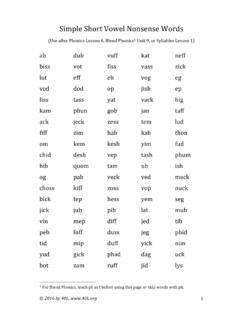
1 Copyright 2012 by 40L, (DRAFT) Spelling rules from Spelling Lessons Spelling lesson 1 Syllables and words ending in a consonant will have their short sound: at in on up, en (as in en- ter); man met lip hop tug Short (1- syllable) words ending in a K sound are usually spelled with a ck: lack peck sick rock truck Short (1- syllable) words ending in a L, F, or S sound usually have doubled letters: fall well mill doll pull; gaff tiff doff muff; mass hiss less toss fuss Words usually divide between two consonants (ck & doubled letters count as 1 consonant): (remember the rule that syllables ending in a vowel are short) nap- kin rab- bit ad- mit well- ness son- net bob- cat Words ending in hissing sounds add es in the plural, all others just add s.
2 Keeps farms fishes boxes Words usually divide between consonant blends: hand- craft lip- stick dust- pan The letter groups sh, th, wh, ng, and nk count as one letter for syllable division, and will stay together when dividing words. Words ending in a CH sound are often spelled tch: watch etch itch thatch Unaccented syllables are often mushed to the schwa sound of uh (shown in the dictionary as an upside- down e.) This happens especially often with words the vowels o or a. The letter c is pronounced as an s before e, i, and y, but with a k sound before all other letters. (Before the vowels a, o, and u and before all consonants.) The letter c is often followed by a silent e whose purpose is to keep the sound of the c soft, as its s sound is called.
3 C as s before e, i, or y: cell, city, cyber, ace, dice, mice c as s with a silent e to keep the soft sound: prince, fleece The letter g is pronounced as a j before e, i, and y, but with a g sound before all other letters. (Before the vowels a, o, and u and before all consonants.) English words will not end with a j. The letter g is often followed by a silent e whose purpose is to keep the sound of the g soft, as its j sound is called. A letter d is added before the ge to keep the vowel short (2 consonants, short vowel: 1 consonant, long vowel.) A few common words such as girl and get have a hard g where a soft g j sound would be expected.
4 Copyright 2012 by 40L, (DRAFT) g as j before e, i, or y: gem, ginger, gypsy g as g before e, i, or y as an exception- - a few common words: get, girl Longer words ending in a k sound are usually spelled with a single c: music, celiac, republic Short words ending in a k sound are usually spelled with a ck: duck, pick, lack With another consonant sound before the k sound, spelled with a k: dark, think, perk Spelling lesson 2 Words and syllables ending in a vowel will have their long sound: be hi go mu my; ma- ker me- ter si- ding mo- tor cu- pid (Words ending in an a are exceptions, they will say ah, ma, pa.)
5 Syllables ending in the letter a will have their long a sound, as in ma- ker and pa- per. ) Words with a vowel followed by a consonant followed by a letter e will have their long sound. (Silent e rule.) late Pete nine home cube Words usually divide before 1 consonant (mi- ner, o- bey, to- ma- to) Exception: Latin words divide after consonant (lim- it, met- al) Long a sound is spelled with an ai within the word and an ay at the end: mail, paid; say stay The long a sound can also be spelled ei within a word and ey at the end: vein, weigh; they, grey (Native English words will not end in an i, so the i changes to a y at the end.
6 U, eu, ui, ue, and ew can be pronounced either yoo or oo depending on the letter that comes before the vowel. Words that start with a ch, d, j, l, r, or s will say oo, t can say either sound except for a few words which can only be pronounced oo. Words starting with all other letters will say yoo. oo: due, chew, june, lute, rue, Sue, blue, brew yoo: butane, cube, feud, mew The long u sound (yoo or oo) is spelled with ui within the word and ue at the end: fruit, ruin; blue, true (Native English words will not end in an i, so the i changes to an e at the end.) Divide between 2 words (sail- boat, lip- stick, bee- hive, way- laid) Copyright 2012 by 40L, (DRAFT) Words in English will not end in v, so words with ve at the end may be either short or long: give, live, have; save, hive (Live can be pronounced either long or short depending on its usage.)
7 Long o is spelled oa within the word and oe or ow at the end: boat goat loaf; toe Joe; row slow Some short words with o and i will have a long sound, they used to have a silent e at the end of the word. This often happens when these o and i words have the letters l, t, or d in them. wild child old told both post host kind find mind roll colt Spelling lesson 3 The sound of au is spelled with au within the word, aw at the end (aw can also be used within the word): faun, autumn; lawn, hawk; raw, claw The sound of ou as in out or how is spelled with a ou within the word and ow within the word or at the end of the word.
8 It will not end spelled with a ou. out south; howl; now plow (Words of native English origin will not end in u, so the u changes to a w at the end.) Words beginning with wa usually have an ah sound as in water instead of the expected short a sound: want water watch The sound of oi is spelled with oi within the word and oy at the end: oil, coin; boy, troy (Words of native English origin will not end in i, so the i changes to a y at the end.) or will usually say er after a w and at the end of a word (or normally says or as in for): word world work; doctor actor janitor The letter team gh usually says g, and the letter team gn usually says n: ghost, spaghetti; gnat sign The letters wh normally are a letter team that makes the sound of w (or, in some regions, its unvoiced consonant pair sound of wh) However, before o, it often makes the sound of h: when where which.
9 Who whose whole The letter h is often silent at the beginning of words: honor, herb Copyright 2012 by 40L, (DRAFT) g as j with a silent e to keep the soft sound: age huge g as j with a silent e to keep the soft sound and a d to keep the vowel short (2 consonants, short vowel): badge, ridge, edge, dodge, grudge The letter team kn is pronounced with the k silent: knight, knee The letter team wr is pronounced with the w silent: write, wrong The letter team mb is pronounced with the b silent: lamb climb comb The letters b and t are sometimes silent: debt, often Spelling lesson 4 Divide after prefixes (pre- fix, be- fore) Divide before suffixes (hap- i- ness, faith- ful, sleep- ing) Common prefixes: re- dis- over- un- mis- out- be- co- de- pre- fore- inter- sub- trans- Common suffixes: - tion - ize - ate - en - ity - er - ness - ism - ment - ant - ship - ive - ful - less Most words ending in the cede sound are spelled cede (precede.)
10 There is only 1 word that is spelled sede (supersede.) Only 3 words are spelled ceed (exceed, proceed, succeed.) - el and le Most words end in le. You will divide 1 letter before le (ap- ple) - el often follows the letters s, z, or v. It will divide directly before el (lev- el) - ive words in English will not end in v. It normally has a short sound, the e is merely to keep the v from ending the word. Making plurals: 1. After hissing sounds, add es 2. After non- hissing sounds, just add - s Words ending in an o can add either - s or - es. F/V consonant pairs Some words will change from f to v when becoming plural, some just add an s to their f.