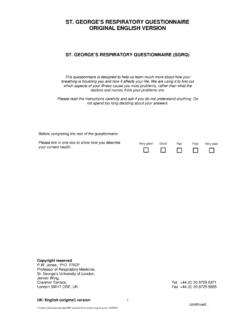
Transcription of ST GEORGE’S RESPIRATORY QUESTIONNAIRE …
1 ST george S RESPIRATORY QUESTIONNAIREMANUALP rofessor Paul JonesDivision of Cardiac and Vascular ScienceSt george s, University of LondonLondon SW17 0 REUKPaul W. JonesYvonne FordeTel +44 (0) 208 725 5371 Fax +44(0) 208 725 5955 Version Guide to the of the scoring scores in healthy from previous of scoring of available A GUIDE TO THE SGRQWhat is the St george s RESPIRATORY QUESTIONNAIRE ?The SGRQ is designed to measure health impairment in patients with asthma and COPD. Itis also valid for use in bronchiectasis and has been used successfully in patients withkyphoscoliosisand sarcoidosis.
2 There is a report of its validation in a small study of adultswith cysticfibrosis (Archivos de BronconeumologiaVolume 43, Issue 4, April 2007, pages205-211).It is in two parts. Part I produces the Symptoms score, and Part 2 the Activity andImpacts scores. A Total score is also 1(Questions 1 to 8)covers the patients recollection of their symptoms over apreceding period that may range 1 month to 1 year. It is not designed to be an accurateepidemiological tool, its purpose is to assess the patient s perception of their recentrespiratory problems. The original version was validated using a 12-month recall recently a 1 month recall version (appropriately worded) has been validated.
3 This hasslightly weaker psychometric properties than the 12-month version and produces amarginally lower Symptoms score and Total score. A 3-month recall period has been usedvery satisfactorily. In summary, the 3-month and 1-yearversions provide the best properties,with no specific advantages to either. The 1-month version should only be used when thetime frame of the study 2(Questions 9 to 16)addresses the patients current state ( how they are thesedays). The Activity score just measures disturbances to patients daily physical activity. TheImpacts score covers a wide range of disturbances of psycho-social function.
4 Validationstudies showed that this component relates in part to RESPIRATORY symptoms, butit alsocorrelates quite strongly with exercise performance (6-minute walking test), breathlessnessin daily life (MRC breathlessness score) and disturbances of mood (anxiety and depression).The Impacts score is, therefore, the broadest component of thequestionnaires, covering thewhole range of disturbances that RESPIRATORY patients experience in their STRUCTURE OF SGRQPart 1 (Questions 1-8)addresses the frequency of RESPIRATORY symptoms. It is not designedto be a preciseepidemiological tool, but to assess the patient s perception of their recentrespiratory 2(Sections 9-16)addressesthe patient s current state ( how they are these days).
5 The Activity score measures disturbances to daily physical activity. The Impacts scorecovers a range of disturbances of psycho-socialfunction. Validation studies forthe originalSGRQ showed thatthis component relates in partto RESPIRATORY symptoms, but it alsocorrelates quite strongly with exercise performance (6-minute walking test), breathlessnessin daily life (MRC breathlessness score) and disturbances of mood (anxiety and depression).The Impacts score is, therefore, the broadest component of the questionnaires, covering thewhole range of disturbances that respiratorypatients experience in their : the general scale on the front page is not part of the SGRQ or SGRQ-C, but someinvestigators find it useful as an additional global ADMINISTRATIONThe QUESTIONNAIRE should be completed in a quiet area,free from distraction and the patientshould ideally be sitting at a desk or table.
6 Explain to the patient why theyare completing it,and how important it isfor cliniciansand researchersto understand how their illness affectsthem and their dailylife. Ask him or herto complete the QUESTIONNAIRE as honestly as theycan and stress that there are no right or wrong answers, simply the answer that they feel3bestapplies to that they must answereveryquestion and that someone will beclose at hand to answer any queriesabout how to complete the designedforsupervised self-administration. This means that the patients shouldcomplete the QUESTIONNAIRE themselves,but someone shouldbe available to give advice ifrequired.
7 It is designed to elicit the patient s opinion of his/her health,notsomeone else sopinion of it, so family, friends or members of staff should not influence the patient sresponses. If the spouse or partner has accompanied the patient they should be asked towait in a separate area. Similarly, do not allow patients to take the SGRQ-Chome to becompleted since you cannot be sure that it will be completed without the help of family orfriends. A recent study of the use of surrogates to complete the QUESTIONNAIRE has shownsmall but significant differences in scoresobtained from the patients themselves (Santiveri etalRespiratory Medicine (2007) 101, 439 445)Once the patient has finished, it is very important that you check the QUESTIONNAIRE to makesure a response has been given to every question.
8 If they have missed an item return ittothe patient for completion,before they administrationof the SGRQ hasbeen validated (Anie et al J Clin Epidemiol1996;49:653-6.), as has computer based presentation (Meguro and Jones, unpublished), butpostal administration has should I do about queries regarding completion of the QUESTIONNAIRE ?If a patient asks for help with a question, do not provide an answer for them. The pointof thequestionnaire is to get an understanding of how the patient views his or her illness. It isappropriate to clarify a question but not to provide an answer.
9 Questions may be read aloudif patients have difficulty with reading, but the responses mustbe theirs alone. If a patientgives an answer you disagree with it is not appropriate to challenge their response or toquery it. It is their view of their condition we are interested in no matter how strange theresponse!The following are notes whichmay help you explain to patients what is Part 1 of the QUESTIONNAIRE , emphasise to patients that you are interested in howmuch chest trouble they have had over the last year. The exact period is not are looking for an impression or perception of and COPD can vary day-to day.
10 In Part 2, we want to know about the patient scurrent state (these days). severe or very unpleasant attack of chest trouble (Part 1, Question 5) is any attackthat could be described that wayin the patient s own judgement. Not severe as definedby medical Question 7 emphasise that you are interested in the number ofgooddays that theyhave 10 regarding employment can cause patients some problems. We areinterested in how a patient s chest trouble affects their current working lifeorhow itaffected life when theywereworking. For example, if a patient took early retirementbecause of their chest condition, the response would be 10a My chest trouble mademe stop work , if a patient s retirement was unrelated to their chest trouble, theirresponse would be 10c My chest trouble does not affect my work.