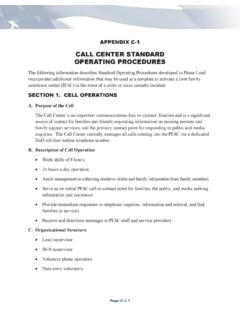
Transcription of standard oPeratinG ProCedure - Travel
1 standard oPeratinG ProCedure102103 ConsularnotifiCation and aCCessConsularnotifiCation and aCCessstandard oPeratinG ProCedure102103 ConsularnotifiCation and aCCessConsularnotifiCation and aCCessThe obligations of consular notification and access are not codified in any federal statute. Implementing legislation is not necessary because executive, law enforcement, and judicial authorities can implement these obligations through their existing powers on the basis of the relevant international agreements and written guidance such as this manual. Implementation may also be facilitated through issuance of internal directives, orders, or similar instructions by appropriate federal, state, and local officials to their subordinates.
2 For example, many local police departments incorporate instructions on consular notification into their internal manuals. The Department of State strongly encourages all law enforcement agencies to develop standard oPeratinG procedures for complying with consular notification and access requirements. Such procedures help your agency avoid costly litigation and diplomatic complaints. Moreover, a written directive governing procedures for assuring compliance with consular notification and access requirements is now required for accreditation by the Commission on Accreditation for Law Enforcement Agencies (CALEA).138 The model standard oPeratinG ProCedure (SOP) below is intended for law enforcement agencies to use as a template . Please add or remove language to best fit your agency s needs.
3 The Department of State does not intend this model SOP to be a complete or comprehensive restatement of the United states international legal obligations under the VCCR or any bilateral agreement. Instead, the model SOP provides one set of suggested procedures that, if followed, will in most cases ensure that your department or agency complies with the law on consular notification and access. going through the procedures precisely as outlined in the model SOP is not necessarily the only means by which your agency can ensure compliance with this body of law. For a more complete description of the legal regime governing consular notification and access, including many of its nuances, you should read Parts One through Four of this and comments about the model SOP can be emailed to A version of the model SOP reflecting any updates that may have occurred subsequent to this manual s publication is available for download at See CALEA standards for Law Enforcement Agencies (5th ed.)
4 2006), standard , available at oPeratinG ProCedure104105 ConsularnotifiCation and aCCessConsularnotifiCation and aCCessstandard oPeratinG ProCedure104105 ConsularnotifiCation and aCCessConsularnotifiCation and aCCessArrests/detentions/deAths/serious INJURIES OF FOREIGN NATIONALS statement of purposeThe purpose of this standard oPeratinG ProCedure is to provide written policies and procedures on the arrest, detention, death, or serious injury of foreign PolicyB. DefinitionsC. Consular Notification ProceduresD. Facility Access/Visitation Privileges of Consular OfficialsE. Documentation/RecordkeepingF. Death, Serious Injury, or Serious Illness of a Foreign Nationalg. References_____A. POLICYIt is the policy of [NAME OF LAW ENFORCEMENT AGENCY] to comply with all United states treaty obligations on consular notification and access.
5 B. DEFINITIONSA rrest or detention: Any arrest, detention, or 1. other commitment to custody which results in a foreign national being incarcerated for more than a few hours triggers consular notification requirements. A brief traffic stop or an arrest resulting in a citation for a misdemeanor and release at the scene does not trigger such requirements. On the other hand, requiring a foreign national to accompany a law enforcement officer to a place of detention may trigger the consular notification requirements, particularly if the detention lasts for a number of hours or overnight. The longer a detention continues, the more likely it is that consular notification requirements are national: Any person who is not a 2. citizen; same as alien.
6 Aliens who are lawful permanent residents in the United states and who have a resident alien registration card ( green card ) are foreign nationals. So are undocumented or illegal officer or consul: A foreign 3. official authorized by the Department of State to provide assistance to the foreign government s citizens in the United states . Different from counsel, which is an attorney authorized to provide legal advice. Consuls are not authorized to practice : A foreign official at the country s 4. embassy in Washington, , assigned to represent the country. Diplomats may also perform consular functions, and should be treated the same as a consular officer. Mandatory notification: Consular 5. notification procedures that apply when you arrest or detain a foreign national from any of the 57 countries that have agreed to special rules with the United states .
7 For such a foreign national, you must notify the consular officer regardless of whether the national requests or wants you to do so. The mandatory list of these 57 countries is at Upon request notification: Consular 6. notification procedures that apply when you arrest or detain a foreign national from any country not on the mandatory list of 57 oPeratinG ProCedure104105 ConsularnotifiCation and aCCessConsularnotifiCation and aCCessstandard oPeratinG ProCedure104105 ConsularnotifiCation and aCCessConsularnotifiCation and aCCessC. CONSULAR NOTIFICATION PROCEDURESO bligation triggered at time of booking. 1. The notification process will begin at the time the arrested foreign national is booked into the detention facility.
8 The booking officer who processes the foreign national is responsible for implementing the notification the foreign national s country. In 2. the absence of other information, assume this is the country on whose passport the foreign national travels. Absent citizenship documentation or other evidence to the contrary, accept the foreign national s own statement as to his or her whether or not this country is a 3. mandatory notification ( list ) country. If the foreign national s country is not on the list of mandatory notification countries, he or she is from an upon request For foreign nationals whose country is on the list of mandatory notification countries:i. Notify the nearest consulate of the foreign national s country via fax immediately or as soon as reasonably possible, and in no case longer than the end of the booking shift.
9 Notify the consulate even if the foreign national does not want notification. Contact information for consulates is at Never tell the consular officer that the foreign national has requested asylum. If the consular officer insists on information the foreign national does not want disclosed, contact your supervisor or the Department of State at (202) Inform the foreign national that you notified his or her consulate. you may use the sample statement, available in several languages, at Make a note of the completed notification in the case file and keep the fax and fax confirmation For foreign nationals whose country is not on the list of mandatory notification countries:i. As soon after the arrest as reasonably possible but no later than booking, inform the foreign national that he or she may have his or her consular officers notified of the arrest or detention.
10 You may use the sample statement, available in several languages, at Make a note of the foreign national s decision in the case If the foreign national requests notification, notify the nearest consulate of the foreign national s country as soon as reasonably possible but no later than 72 hours after arrest. Contact information for consulates is at Never tell the consular officer that the foreign national has requested asylum. If the consular officer insists on information the foreign national does not want disclosed, contact your supervisor or the Department of State at (202) Make a note of the completed notification in the case file and keep the fax and fax confirmation oPeratinG ProCedure106107 ConsularnotifiCation and aCCessConsularnotifiCation and aCCessstandard oPeratinG ProCedure106107 ConsularnotifiCation and aCCessConsularnotifiCation and aCCessD.