Transcription of STANDARDS AND DATASETS FOR REPORTING CANCERS
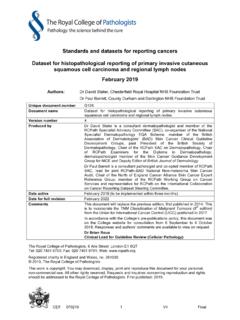
1 STANDARDS and DATASETS for REPORTING CANCERS dataset for histopathological REPORTING of primary cutaneous basal cell carcinoma February 2019. Authors: Dr David Slater, Chesterfield Royal Hospital NHS Foundation Trust Dr Paul Barrett, County Durham and Darlington NHS Foundation Trust Unique document number G123. Document name dataset for histopathological REPORTING of primary cutaneous basal cell carcinoma Version number 4. Produced by Dr David Slater is a consultant dermatopathologist and member of the RCPath Specialist Advisory Committee (SAC), co-organiser of the National Specialist Dermatopathology EQA Scheme, member of the British Association of Dermatologists' (BAD) Skin cancer Clinical Guideline Development Groups, past President of the British Society of Dermatopathology, Chair of the RCPath SAC on Dermatopathology, Chair of RCPath Examiners for the Diploma in Dermatopathology, dermatopathologist member of the Skin cancer Guidance Development Group for NICE and Deputy Editor of British Journal of Dermatology.
2 Dr Paul Barrett is a consultant pathologist and co-opted member of the RCPath SAC, lead for joint RCPath BAD National Non-melanoma Skin cancer Audit, Chair of the North of England cancer Alliance Skin cancer Expert Reference Group, member of the RCPath Working Group on cancer Services and representative for RCPath on the International Collaboration on cancer REPORTING dataset Steering Committee. Date active February 2019 (to be implemented within three months). Date for full revision February 2022. Comments This document will replace the 3rd edition of the dataset for the histological REPORTING of basal cell carcinoma. This is to incorporate the TNM Classification of Malignant Tumours (8th edition) from the Union for International cancer Control (UICC) published in 2017.
3 In accordance with the College's pre-publications policy, this document was on the College website for consultation from 6 September to 4 October 2018. Responses and authors' comments are available to view on request. Dr Brian Rous Clinical Lead for Guideline Review (Cellular Pathology). The Royal College of Pathologists, 6 Alie Street, London E1 8QT. Tel: 020 7451 6700; Fax: 020 7451 6701; Web: Registered charity in England and Wales, no. 261035. 2019, The Royal College of Pathologists This work is copyright. You may download, display, print and reproduce this document for your personal, non- commercial use. All other rights reserved. Requests and inquiries concerning reproduction and rights should be addressed to the Royal College of Pathologists.
4 First published: 2019. CEff 070219 1 V4 Final Contents Foreword .. 3. 1 Introduction .. 4. 2 Clinical information required on the specimen request form .. 9. 3 Preparation of specimens before dissection .. 9. 4 Specimen handling, dissection and block selection .. 10. 5 Core data items .. 11. 6 Non-core data items .. 20. 7 Diagnostic staging and coding .. 24. 8 REPORTING of small biopsy specimens .. 26. 9 REPORTING of frozen 26. 10 Cytological diagnosis .. 26. 11 Specific aspects of individual tumours not covered elsewhere .. 26. 12 Criteria for audit .. 27. 13 Acknowledgements .. 28. 14 References .. 29. Appendix A UICC TNM 8 pathological staging of primary cutaneous carcinoma .. 31. Appendix B Basal cell carcinoma SNOMED coding.
5 34. Appendix C (Draft) UK National Histopathology Request Form for skin biopsies .. 35. Appendix D REPORTING proforma for cutaneous basal cell carcinoma removed with therapeutic intent .. 36. Appendix E REPORTING proforma for cutaneous basal cell carcinoma removed with therapeutic intent in list format .. 38. Appendix F Table of high-risk pathological features for clinical management .. 42. Appendix G Summary table Explanation of levels of evidence .. 43. Appendix H AGREE II compliance monitoring sheet .. 44. NICE has accredited the process used by the Royal College of Pathologists to produce its cancer DATASETS . Accreditation is valid for five years from 25 July 2017. More information on accreditation can be viewed at CEff 070219 2 V4 Final Foreword The cancer DATASETS published by the Royal College of Pathologists (RCPath) are a combination of textual guidance, educational information and REPORTING proformas.
6 The DATASETS enable pathologists to grade and stage CANCERS in an accurate, consistent manner in compliance with international STANDARDS and provide prognostic information, thereby allowing clinicians to provide a high standard of care for patients and appropriate management for specific clinical circumstances. This guideline has been developed to cover most common circumstances. However, we recognise that guidelines cannot anticipate every pathological specimen type and clinical scenario. Occasional variation from the practice recommended in this guideline may therefore be required to report a specimen in a way that maximises benefit to the patient. Each dataset contains core data items (see Appendices D and E) that are mandated for inclusion in the cancer Outcomes and Services dataset (COSD previously the National cancer dataset ) in England.
7 Core data items are items that are supported by robust published evidence and are required for cancer staging, optimal patient management and prognosis. Core data items meet the requirements of professional STANDARDS as defined by the Information STANDARDS Board for Health and Social Care (ISB), and it is recommended that at least 95% of reports on cancer resections should record a full set of core data items. Other non-core data items are described. These may be included to provide a comprehensive report or to meet local clinical or research requirements. All data items should be clearly defined to allow the unambiguous recording of data. The following organisations were consulted during its preparation and approved the dataset : British Association of Dermatologists (BAD; member of RCPath Specialty Advisory Committee on Dermatopathology).
8 British Society for Dermatopathology (BSD; member of RCPath Specialty Advisory Committee on Dermatopathology). participating members of the National Specialist Dermatopathology External Quality Assessment (NSDEQA) scheme (member of the RCPath Speciality Advisory Committee on Dermatopathology). This dataset has been constructed taking into account the strong evidence that is contained in, and forms the basis for, the following national and international publications. All publications have widespread national and/or international peer acceptance and reflect the current accepted professional STANDARDS and practice in skin cancer : Union for International cancer Control (UICC) 1. American Joint Committee on cancer (AJCC)2.
9 World Health Organization (WHO) Classification of Skin Tumours 3. National Institute for Health and Clinical Excellence (NICE) Guidance and Quality STANDARDS on skin cancer and melanoma4 6. NHS Evidence7. Clinical guidelines published by the BAD and other professional bodies 8. Public Health England (PHE) cancer Outcomes and Services dataset (COSD)9. NHS England Quality Surveillance Programme (QSP; formerly the National cancer Peer Review Program)10. National Comprehensive cancer Network (NCCN) 11. Armed Forces Institute of Pathology (AFIP) Atlas of Tumour Pathology (noting AFIP. disestablished in 2011 and now under American Registry of Pathology [ARP] Press).12. CEff 070219 3 V4 Final Evidence for the revised dataset was obtained from updates to international tumour grading, staging and classification systems and by electronically searching medical literature databases for relevant research evidence, systematic reviews and national or international publications on uterine sarcomas.
10 The level of evidence for the recommendations has been summarised (Appendix G). Unless otherwise stated, the level of evidence corresponds to Good practice point (GPP): Recommended best practice based on the clinical experience of the authors of the writing group'. The sections of this dataset that indicate compliance with each of the AGREE II STANDARDS are indicated in Appendix H. No major organisational changes have been identified that would hinder the implementation of the dataset , which is fully integrated with the COSD, and there are no new major financial or work implications arising from the implementation, compared to the 2002 dataset . A formal revision cycle for all cancer DATASETS takes place on a three-yearly basis.