Transcription of Standards: Medical Devices
1 Taylor, A. Page 1 Standards: Medical Devices Medical Devices are subject to strict general controls and procedural regulations. The development and use of standards is vital to ensuring the safety and efficacy of Medical Devices . Numerous regulatory agencies and standards organizations collaborate to establish the accepted standards for Medical equipment. Standard setting activities include the development of performance characteristics, characterization and testing methodologies, manufacturing practices, product standards, scientific protocols, compliance criteria, ingredient specifications, labeling, or other technical or policy criteria.
2 The regulatory agencies and standards organizations integral to establishing the standards and monitoring compliance with those standards include, but are not limited to, the Food and Drug Administration (FDA), particularly the FDA s Center for Devices and Radiological Health (CDRH), Joint Commission on Accreditation of Health Care Organizations (JC), Clinical Laboratory Improvement Amendments (CLIA), College of American Pathologists (CAP), and the International Organization of Standardization (ISO), International Electrotechnical Commission (IEC), and ASTM International, formally known as the American Society for Testing and Materials (ASTM).
3 The type of device determines the agency (or agencies) to whose regulation it is subject. You will need to do some research to determine which regulatory agency is responsible for your type of device, as well as which standards are applicable. Recall from your previous courses in BIOE that Medical Devices , as defined by the FDA, can range from simple tongue depressors to complex programmable pacemakers with micro chip technology and laser surgical Devices . In addition, Medical Devices include in vitro diagnostic products, such as general purpose lab equipment, reagents, and test kits.
4 Also, certain electronic radiation emitting products with Medical application and claims meet the definition of Medical device. (Examples include diagnostic ultrasound products, x ray machines and Medical lasers.) Knowledge of, and conformance to, standards recognized by the FDA is key if you want your device to be approved for sale in the The FDA department responsible for regulating Medical Devices and radiation emitting products, the CDRH, believes that conformance with recognized consensus standards can support a reasonable assurance of safety and/or effectiveness for many applicable aspects of Medical Devices .
5 Therefore, information submitted on conformance with such standards should have a direct bearing on safety and effectiveness determinations made during the review of IDEs, HDEs, PMAs, and PDPs. In a 510(k) application, information on conformance with recognized consensus standards may help establish the substantial equivalence of a new device to a legally marketed predicate device. (recall your BIOEN 215 notes on the FDA approval process) Important Tip: A database containing the FDA s recognized consensus standards from 25 standards organizations can be searched so you can find the relevant standards for your product: You can narrow your research by the Standards Organization you wish to investigate, such as the three described in pages 2 3 of this handout.
6 What types of standards are relevant to your Capstone project and why? You must include this information in the Introduction section of your Capstone report. What pertains to you work? (or may be relevant in the future if this project was continued think long term development and long term applications of the knowledge and/or design you ve generated.) Taylor, A. Page 2 Examples and brief descriptions of standards organizations which develop and publish standards for Medical products: International Organization for Standardization (ISO): a non governmental organization that develops and publishes international standards on a wide range of subject, including Medical equipment.
7 For the consumer, ISO International Standards ensure that products and services are safe, reliable and of good quality. For business, they are strategic tools that reduce costs by minimizing waste and errors, and increasing productivity. These standards are very relevant for Medical Devices and encompass virtually every aspect of device design and implementation from device inspection requirements to guidelines for Medical device labels. o For example, ISO 13485 establishes the requirements for a quality management system for both the design and manufacture of Medical Devices .
8 Covers aspects including risk management, design control during product development, and verification and validation systems. o For more information: International Electrotechnical Commission (IEC): a non governmental organization that prepares and publishes International Standards for all electrical, electronic and related technologies. Utilizes over 10,000 experts from industry, commerce, government, test and research labs, and academia and consumer groups. When appropriate, IEC cooperates with ISO to ensure that International Standards are congruent.
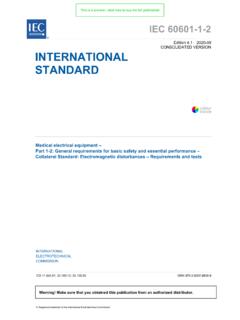
9 O For example, IEC 60601 is a series of technical standards for the safety and effectiveness of Medical electrical equipment. First published in 1977 and regularly updated and restructured, it consists of a general standard, collateral standards, and particular standards. The newest revision of requirements will be implemented in the by the FDA starting June 2013. Collateral standards (numbered 60601 1 X) define the requirements for certain aspects of safety and performance, Electromagnetic Compatibility (IEC 60601 1 2) or Protection for diagnostic use of X rays (IEC 60601 1 3).
10 In recent years, consideration of the environmental impact of the device has also been added. This standard asks manufacturers of Medical Devices to consider the environmental impacts of their Devices throughout the product's entire life cycle and to minimize these where possible. The standard also requires that the manufacturer provide information to the user on how to use the product in the most environmentally sensitive way. Particular standards (numbered 60601 2 X) define the requirements for specific products, MR scanners or Electroencephalograms.