Transcription of State of Connecticut
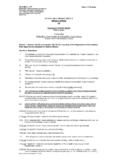
1 State of Connecticut Office of Policy and Management Policy Title: Policy for the Management of State information technology Projects Policy ID: IT-SDLC-17-04. Version: Date Date Issued: 12/13/2017 12/13/2017. Effective: Last Review: 12/13/2017 Next Review: 12/13/2019. Scope: Executive Branch Agencies Authority: 4d-8a Purpose Scope Authority Applicability Importance of Effective project Management Policy Statements Compliance Definitions Purpose The Office of Policy and Management (OPM) has established this policy to provide State agencies with the necessary guidance, principles and expectations of agencies for the effective management of projects requiring significant technology work or procurement. The purpose of this policy is to bring consistency to practices and controls used in the planning and execution of projects, regardless of funding sources, and promote better direction, delivery, and control of technology project timelines, costs and quality.
2 Scope This policy applies to all State of Connecticut Executive Branch agencies with a department head as defined in 4-5. Agencies shall determine, on a case-by-case basis, how this policy applies to vendors involved in projects. This policy does not apply to the Judicial or Legislative Branches of government, State institutions of higher education or Quasi-Public agencies as defined in 1-120. However, these branches or Quasi-Public agencies may consider adopting any or all parts of this policy. Authority In accordance with 4d-8a , OPM is responsible for developing and implementing an integrated set of policies governing the use of information and telecommunications systems for State executive branch agencies. State of Connecticut -1- Policy for the Management of State Office of Policy and Management information technology Projects Applicability This policy applies to a Qualifying project as defined below.
3 Nothing precludes agencies from following this policy for non-qualifying projects, and in fact agencies are strongly encouraged to do so where appropriate. Agency heads or their designees are encouraged to develop internal agency policies that supplement this policy for both qualifying and non-qualifying projects. Importance of Effective project Management project management is a discipline of planning, organizing, securing, managing, leading, and controlling resources to achieve a specific business objective through a project . Projects are often complicated endeavors, involving multiple business goals, external delivery deadlines, limited funding and/or resources, competition from other priorities, and so on. Proper management of a project provides many key benefits, including: Clarity and agreement on the essential requirements, goals and scope of the project , as well as the pool of available resources, Alignment and commitment of resources across project participants and stakeholders, Identification and sequencing of project tasks and dependencies, leading to a realistic estimated timeframe for delivery, A vehicle through which the business owner, project participants and stakeholders can raise and manage project issues and risks, Focused leadership and oversight, Relative assurance that projects can be delivered on time and within budget.
4 Regardless of the scope of any business activity, effective project management helps ensure that agencies are using taxpayer resources responsibly, and that the agencies are positioned for success. Therefore, OPM strongly recommends that agencies consider the need for project management for any activity that may not be considered a qualifying project as defined by this policy. Policy Statements 1. A qualifying project must include a process evaluation and analysis ( Lean, Six Sigma, BPM, etc.) which removes unnecessary steps/work from the business process(es) centrally related to the solution delivered by the project . The resulting process(es) must be streamlined to deliver the most value possible to the end- user/customer. 2. All agencies must follow an industry standard and proven project management methodology, framework and processes that will help to ensure the successful delivery of projects.
5 Examples include PMBOK, Agile and Lean. 3. Projects must have a project manager assigned. The project manager must have the right level of skills, experience and dedication to help ensure successful delivery of the project . State of Connecticut -2- Policy for the Management of State Office of Policy and Management information technology Projects 4. A qualifying project must implement a project Governance framework , which at a minimum establishes the roles, responsibilities, and decision rights of an Executive Sponsor, project Steering Committee, IT Manager, and Qualified project Manager. 5. Projects must have a written project Management plan that addresses and documents the following items: a. The project goals must be clearly defined in consultation with the executive sponsor, project team, end-users and other stakeholders.
6 B. Business implementation activities to assess organizational preparedness, training and rollout. c. There must be an integrated plan that outlines the action required in order to reach the goals. d. There must be a schedule establishing the timeline to achieve the goals, phases and milestones of the project . e. There must be a budget plan defining cost and sources of funds required for the project . f. A project Staffing Plan g. A project Issue/Risk Management document and plan needs to be established including the identification of a set of conditions under which the project will be ended. h. A project Communication plan needs to be established. i. A project Test Plan. j. A project Training Plan addressing both user and technical components. k. A Production Support plan 6. information and semiannual status reports for a qualifying project must be provided to OPM in a format prescribed or accepted by OPM.
7 7. Exemptions from the current policy statement may be granted by the Secretary of OPM through formal appeal by the head of the agency. 8. Agencies should be mindful of their obligations under 4e-16 when evaluating the cost-effectiveness of State staff versus contractors. Compliance The head of the agency is responsible for ensuring compliance with this policy and may appoint a responsible designee from within their agency for policy oversight and administration. Compliance with this policy is subject to audit by the Auditor of Public Accounts. Definitions Agency Any agency with a department head, as defined in 4-5. State of Connecticut -3- Policy for the Management of State Office of Policy and Management information technology Projects Agency Lean An individual selected by the Agency Head/Commissioner to work on Coordinator behalf of their agency to promote a culture of continuous improvement.
8 Activities include, but are not limited to, encourage Lean thinking whenever possible; plan for, schedule, and coordinate Lean activity; coach and mentor colleagues in the application of Lean tools; and assist agency executive leadership in creating a successful problem-solving environment. Executive Sponsor A commissioner designee who provides resources and support for the project and who is accountable for enabling success in the project . IT Manager A person holding the job title of information technology Manager (1, 2, 3, or 4), Agency information technology Manager, or equivalent, who has been designated by the commissioner to serve as the IT. Manager for the project . Process Evaluation An in-depth analysis of a business process that is overseen by the Agency Lean Coordinator and led by a trained facilitator or improvement coach.
9 project A temporary endeavor undertaken to create a unique product, service or result. project Budget A document that provides a breakdown of the estimated costs of a project by type of expenditure, anticipated timeframe, and funding source. project Charter A document that provides summary information about a project , including its objectives, stakeholders, risks, and governance. project Governance The alignment of project objectives with the strategy of the larger framework organization by the project sponsor and project team. A project 's governance is defined by and is required to fit within the larger context of the organization sponsoring it but is separate from organizational governance. project Steering A group that is responsible for monitoring and evaluating the Committee progress and integrity of a project , for handling escalations and potential deviations, for representing stakeholder interests in the project , and for ensuring commitments to the project by participating agencies and relevant business units.
10 Qualified project A person who has a demonstrated track record utilizing the chosen Manager project management approach successfully on a number of projects and who is responsible for coordinating work effort on the project and ensuring objectives and deliverables are met. State of Connecticut -4- Policy for the Management of State Office of Policy and Management information technology Projects Qualifying project A project which affects multiple agencies or whose overall cost is expected to exceed $1 million. Overall cost should include estimated contractor costs, new equipment and licensing costs, and soft dollar costs for State employee time, but exclude post-implementation (operation/maintenance) costs. A qualifying project must have received an affirmative funding commitment from all funding sources prior to establishment of a project .