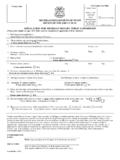
Transcription of State Transitional Professional A Career Change …
1 State Transitional Professional A Career Change Process for State Employees in or Eligible for Professional occupations Who is eligible? Classified employees with status, who wish to make a Change to a new Professional Career and either (a) meet the education requirement for the new classification, or (b) possess the alternate education and experience identified on the job specification. An employee classified in the Senior Executive Management Assistant Service (SEMAS) with the equivalent of six months full-time experience as a SEMA or an employee who attained status in a SEMAS-designated position qualifies for Professional classifications in which the minimum education allows for a bachelor s degree in any major and no specific required experience.
2 An employee not possessing a bachelor s degree who attained status in a Professional classification qualifies for Professional classifications in which the minimum education requires a bachelor s degree in any major and no specific required experience. What is the purpose of this process? The State Transitional Professional process can be used to facilitate Career movement by allowing employees to switch from one Professional classification to another without losing pay or employment preference rights. How does the State Transitional Professional process help employees? The State Transitional Professional process can help employees Change Professional careers at an accelerated pace, without losing pay or employment preference rights.
3 For example, an employee could switch careers from a Departmental Analyst 12 to a Human Resources Analyst 12. Without the State Transitional Professional process, the employee would have to demote to an entry-level Human Resources Analyst position. It would then typically take three years for the employee to return to their former level as a Human Resources Analyst 12 one year at the entry (9) level, one year at the advanced (10) level, and one year at the journey (P11) level. With the State Transitional Professional process, however, a Departmental Analyst 12 employee can enter the new field as a State Transitional Professional . Upon satisfactory completion of 18 months of full-time service, the employee could be reallocated to the Human Resources Analyst 12.
4 Throughout the transition process to a Departmental Analyst 12, they would have maintained their employment preference rights and rate of pay, if the latter did not exceed the maximum of the State Transitional Professional s pay range. How does this process work? The employee must possess the minimum educational, licensure, certification, or registration requirements for the new classification. An employee classified in the Senior Executive Management Assistant Service (SEMAS) with six months full-time experience as a SEMA or an employee who attained status in a SEMAS-designated position qualifies for Professional classifications in which the minimum education allows for a bachelor s degree in any major and no specific required experience.
5 The employee applies for a new Professional classification and is appointed to a position in the State Transitional Professional classification at their current pay level. After completing satisfactory service, the employee may be reclassified to the new Professional classification as follows: More on the State Transitional Professional Process .. (Regulation ) Revised 4/1/11 o An employee appointed to a Professional 10-level (intermediate) position designated as Transitional from a Professional 10-12-level; SEMA 11-15 level; or a Professional specialist or managerial 12-15-level job classification may have the Transitional designation removed after successful completion of the equivalent of six months of full-time experience in the Transitional period.
6 O An employee appointed to a Professional P-11 level (experienced) position, 12-level (advanced) position, 13-15-level specialist position designation as Transitional from an equivalent or higher Professional P11 or 12-level or a Professional specialist or managerial 12-15-level job classification may have the Transitional designation removed after successful completion of the equivalent of six months of full-time experience in the Transitional period. o An employee appointed to a Professional P11-level (experienced) position designated as Transitional from a SEMA 11-15 level job classification may have the Transitional designation removed after successful completion of the equivalent of six months of full-time experience in the Transitional period.
7 O An employee appointed to a Professional 12-level (advanced) position or a Professional 13-level specialist position designated as Transitional from a SEMA 15-level job classification may have the Transitional designation removed after successful completion of the equivalent of six months of full-time experience in the Transitional period. o An employee appointed to a Professional position designated as Transitional from a non- Professional job classification may have the Transitional designation removed after successful completion of the experience requirements for the classification. If the removal of the Transitional designation would result in a pay decrease, the employee remains in the Transitional period for another year.
8 What happens to pay? Upon appointment, the employee maintains their current rate of pay if it is less than or equal to the maximum of the State Transitional Professional pay range or less than the maximum of the classification level to which the employee will be reclassified upon completion of the transition period. If the employee is paid more than the maximum of the State Transitional Professional pay range or more than the maximum of the classification level to which the employee will be reclassified, the employee is paid the lesser of the two rates. What would happen during a RIF? In a Reduction in Force (RIF), an employee entering the State Transitional Professional classification from a classification with a higher employment preference level would maintain their employment preference rights from their former classification and level.
9 Questions? If you have questions about this information, or would like to schedule an appointment with one of our Lansing or Detroit Office Career planning staff, call Civil Service Commission, Career Services: Lansing Office Detroit Regional Office (517) 241-6674 (313) 456-4400 (800) 788-1766 (313) 456-4409 (TDD) (517) 335-0191 (TTY)