Transcription of Steam Trap Performance Assessment - Gleason …
1 The Department of Energy requests that no alterations be made without permission in any reproduction of this report. Abstract Various types of Performance Assessment equipment can be used as part of a proactive Steam trap maintenance program to significantly reduce energy losses in Steam distribution systems. Approximately 20% of the Steam leaving a central boiler plant is lost via leaking traps in typical space heating systems without proactive maintenance Relatively simple equipment and programs can easily cut losses in half. Intermediate equipment and programs can cut losses in half again. The best equipment and programs can reduce losses to less than 1%.2 The potential impact in the Federal sector is enormous. In the Army alone, the annual savings associated with implementing intermediate Steam trap Performance Assessment equipment and programs are estimated to be about $20 million. Based on investment costs of only $8 million, the average payback period is less than half a year.
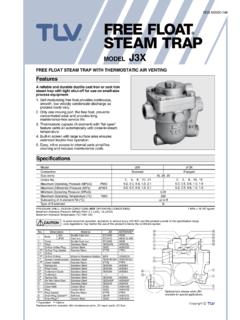
2 The total present value of savings over a 25-year period was estimated to be about $200 million. Department of Defense (DoD) and Federal sector impacts are probably about three and four times as great, respectively, as the Army impacts. Steam trap Performance Assessment has traditionally been based on three basic methods: sight, sound, and temperature. This Federal Technology Alert focuses on ultrasonic sound measurement equipment and equipment utilizing a fourth method based on conductivity. A sight glass specifically designed for Steam trap Performance Assessment is also included. (Photo courtesy of TLV Corporation) Steam Trap Performance Assessment Advanced technologies for evaluating the Performance of Steam traps Page 1 of 25 Federal Technology Alert - Steam Trap Performance Assessment7/26/2004 first two sections present background material that describes the basic types of Steam traps and Performance Assessment methods.
3 The next section describes the technologies included in this Federal Technology Alert in more detail. Subsequent sections describe how to use the technologies and the experiences of Federal sector users. Details regarding development of the Army impacts noted above and the results of a specific program initiated at three Veterans Administration hospitals are also documented. Finally, Appendix A provides detailed information on manufacturers and their products, and Appendix B gives Federal life-cycle costing procedures. About the Technology | Federal Sector Potential | Application | Technology Performance Case Study | The Technology in Perspective | Manufacturers For Further Information | References | Appendixes | Contacts | Disclaimer About the Technology The focus of this Federal Technology Alert (FTA) is on advanced technologies for evaluating the Performance or working condition of Steam traps. However, prior to discussing techniques and equipment for evaluating Steam traps, a brief overview of Steam trap functions, designs, and operating characteristics is provided.
4 At least a rudimentary understanding of Steam trap principles is necessary to understand how the various evaluation approaches work and why some are more likely to produce a better evaluation than others. Those not familiar with Steam traps are also referred to several references listed at the end of this FTA that provide a more detailed discussion. Steam Trap Overview Steam traps are automatic valves used in every Steam system to remove condensate, air, and other non-condensable gases while preventing or minimizing the passing of Steam . If condensate is allowed to collect, it reduces the flow capacity of Steam lines and the thermal capacity of heat transfer equipment. In addition, excess condensate can lead to "water hammer," with potentially destructive and dangerous results. Air that remains after system startup reduces Steam pressure and temperature and may also reduce the thermal capacity of heat transfer equipment. Non-condensable gases, such as oxygen and carbon dioxide, cause corrosion.
5 Finally, Steam that passes through the trap provides no heating service. This effectively reduces the heating capacity of the Steam system or increases the amount of Steam that must be generated to meet the heating demand. The objective of the Steam trap is not an easy task and condensate pressures and flow rates vary significantly at various points in a Steam distribution system. As a result, many different types of Steam traps have been developed. Steam traps are commonly classified by the physical process causing them to open and close. The three major categories of Steam traps are 1) mechanical, 2) thermostatic, and 3) thermodynamic. In addition, some Steam traps combine characteristics of more than one of these basic categories. The operation of a mechanical Steam trap is driven by the difference in density between condensate and Steam . The denser condensate rests on the bottom of any vessel containing the two fluids. As additional condensate is generated, its level in the vessel will rise.
6 This action is transmitted to a valve via either a "free float" or a float and connecting levers in a mechanical Steam trap. One common type of mechanical Steam trap is the inverted bucket trap, shown in Figure 1. Steam entering the submerged bucket causes it Page 2 of 25 Federal Technology Alert - Steam Trap Performance Assessment7/26/2004 rise upward and seal the valve against the valve seat. As the Steam condenses inside the bucket or if condensate is predominately entering the bucket, the weight of the bucket will cause it to sink and pull the valve away from the valve seat. Any air or other non-condensable gases entering the bucket will cause it to float and the valve to close. Thus, the top of the bucket has a small hole to allow non-condensable gases to escape. The hole must be relatively small to avoid excessive Steam loss. As the name implies, the operation of a thermostatic Steam trap is driven by the difference in temperature between Steam and sub-cooled condensate.
7 Valve actuation is achieved via expansion and contraction of a bimetallic element or a liquid-filled bellows. Bimetallic and bellows thermostatic traps are shown in Figures 2 and 3. Although both types of thermostatic traps close when exposure to Steam expands the bimetallic element or bellows, there are important differences in design and operating characteristics. Upstream pressure works to open the valve in a bimetallic trap, while expansion of the bimetallic element works in the opposite direction. Note that changes in the downstream pressure will affect the temperature at which the valve opens or closes. In addition, the nonlinear relationship between Steam pressure and temperature requires careful design of the bimetallic element for proper response at different operating pressures. Upstream and downstream pressures have the opposite effect in a bellows trap; an increase in upstream pressure tends to close the valve and vice versa.
8 While higher temperatures still work to close the valve, the relationship between temperature and bellows expansion can be made to vary significantly by changing the fluid inside the bellows. Using water within the bellows results in nearly identical expansion as Steam temperature and pressure increase, because pressure inside and outside the bellows is nearly balanced. Figure 1. Inverted bucket Steam trap. (Illustration courtesy of Yarway Corporation) Figure 2. Bimetallic Steam trap. (Illustration courtesy of Yarway Corporation) Page 3 of 25 Federal Technology Alert - Steam Trap Performance Assessment7/26/2004 contrast to the inverted bucket trap, both types of thermostatic traps allow rapid purging of air at startup. The inverted bucket trap relies on fluid density differences to actuate its valve. Therefore, it cannot distinguish between air and Steam and must purge air (and some Steam ) through a small hole. A thermostatic trap, on the other hand, relies on temperature differences to actuate its valve.
9 Until warmed by Steam , its valve will remain wide open, allowing the air to easily leave. After the trap warms up, its valve will close, and no continuous loss of Steam through a purge hole occurs. Recognition of this deficiency with inverted bucket traps or other simple mechanical traps led to the development of float and thermostatic traps. The condensate release valve is driven by the level of condensate inside the trap, while an air release valve is driven by the temperature of the trap. A float and thermostatic trap is shown in Figure 4. Thermodynamic trap valves are driven by differences in the pressure applied by Steam and condensate, with the presence of Steam or condensate within the trap being affected by the design of the trap and its impact on local flow velocity and pressure. Disc, piston, and lever designs are three types of thermodynamic traps with similar operating principles; a disc trap is shown in Figure 5. When subcooled condensate enters the trap, the increase in pressure lifts the disc off its valve seat and allows the condensate to flow into the chamber and out of the trap.
10 The narrow inlet port results in a localized increase in velocity and decrease in pressure as the condensate flows through the trap, following the 1st law of thermodynamics and the Bernoulli equation. As the condensate entering the trap increases in temperature it will eventually flash to Steam because of the localized pressure drop just described. This increases the velocity and decreases the pressure even further, causing the disc to snap closed against the seating surface. The moderate pressure of the flash Steam on top of the disc acts on the entire disc surface, creating a greater force than the higher pressure Steam and condensate at the inlet, which acts on a much smaller portion of the opposite side of the disc. Eventually, the disc chamber will cool, the flash Figure 3. Bellows Steam trap. (Illustration courtesy of Yarway Corporation) Figure 4. Float and thermostatic Steam trap. (Illustration courtesy of Yarway Corporation) Page 4 of 25 Federal Technology Alert - Steam Trap Performance Assessment7/26/2004 will condense, and inlet condensate will again have adequate pressure to lift the disc and repeat the cycle.