Transcription of steam trapping - an overview - Spirax Sarco
1 steam trapping overview * The benefits of effective steam trappingSpirax Sarco are focused on helping our customers achieve process efficiency, increased production output and energy savings, and we know the importance of effective steam trap management in achieving this. A healthy steam trap population allows condensate to be removed from the steam system effectively which means it can be re-used. We call this condensate recovery and it saves energy and cost in a number of different ways: Reduced fuel costs Normally, condensate will contain around 25% of the usable energy of the steam from which it came. Returning this to the boiler feedtank can save thousands of pounds per year in energy saving Condensate returned to the feedtank reduces the need for boiler blowdown, which is used to reduce the concentration of dissolved solids in the boiler. This therefore reduces the energy lost from the boiler during the blowdown water charges Returning and re-using condensate reduces the requirement for fresh replacement chemical treatment costs Re-using as much condensate as possible minimises the need for costly chemicals to treat raw effluent costs In many countries there are restrictions on releasing effluent at elevated temperatures so it must be cooled if discharged which incurs extra Sarco are always on hand to advise you about the best ways to manage your steam system and to help ensure you continue to reap these more information about our steam trapping solutions, or any of our other solutions and services please visit steam trapsMaintaining optimum process performanceThermodynamic steam traps are the best choice for steam mains drainage due to their simplicity, long life and robust construction.
2 With a large condensate capacity for their size, the all stainless steel construction of our thermodynamic traps offer a high degree of resistance to corrosive steam trapsUtilising heat energy in condensateFor applications where it would be desirable to make use of the heat in the condensate such as sterilisation, a thermostatic steam trap is an ideal solution as it will not open until the condensate temperature drops below saturated steam temperature. This allows the heat in the condensate to be utilised before it is drained off which in turn reduces flash steam losses and can help to reduce energy introduction to steam trapsMechanical steam trapsMaintaining optimum process performanceMechanical steam traps are ideal for use on process applications where condensate must be removed as soon as it forms, to safeguard against temperature fluctuation which would lead to issues such as product spoilage and inadequate heating.
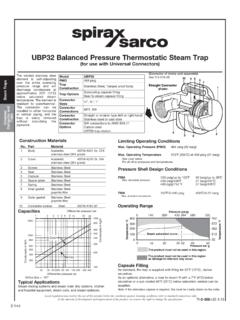
3 Our mechanical steam trap range is adaptable to all applications where instantaneous removal of condensate is steam application has its own steam trap requirements. Selecting the right steam trap for your application could have a significant, positive impact on your process, potentially improving efficiency, reducing energy costs and giving you a safer working example: condensate must be removed promptly from a plant where maximum heat transfer is sought at all times. The presence of excess condensate in an item of heat transfer equipment will reduce its efficiency, preventing it from achieving its maximum rated output and may also reduce its service ; in other applications, it may be required to hold back the condensate to extract some of its heat and thus save on steam . Furthermore, by discharging condensate well below steam temperature, flash steam losses can be reduced or avoided Sarco offers a complete range of steam traps to ensure you canselect the perfect trap for your trappingSteam trap operationThermodynamicMechanicalThermost aticSteamtrap typesThermodynamicBall float Inverted bucketBalanced pressureBimetallicMain features Robust design giving excellent resistance to waterhammer and vibration Inexpensive Positive discharge with tight shut-off Discharge condensate close to steam saturation temperature High capacity Excellent air venting capabilities Continuous discharge of condensate for maximum heat transfer Will not back-up with condensate High capacity Robust design Near continuous discharge of condensate Minimal back-up of condensate Utilises sensible heat in the condensate, reducing flash steam losses.
4 Which saves energy Excellent air venting properties for quick start-upTypical applicationsMains drainage and all tracing process applications with light loads such as small presses and cylindersTemperature / pressure controlled applications with fluctuating loadsTemperature / pressure controlled applications with fluctuating loads Where condensate back-up can be tolerated or is required in order to remove excess enthalpy, non-critical tracingSizeDN8 DN25( 1 )DN15 DN100( " 4")DN15 DN50( " 2")DN8 DN25( " 1")DN8 DN100( " 4")Maximum body ratingPN250PN100 and ASME Class 600 ASME 900PN40 and ASME Class 300PN420 and ASME Class 2500 Maximum operating pressure250 bar g80 bar g110 bar g32 bar g150 bar gSpirax Sarco s steam trap rangethermodynamic steam trapsHow a thermodynamic steam trap works 1. On start-up, incoming pressure raises the disc and cooled condensate, and air is immediately Hot condensate flowing through the trap releases flash steam .
5 High velocity creates a low pressure area under the disc and draws it towards the seat. 3. At the same time there is a pressure build-up of flash steam in the chamber above the disc which forces it down against the pressure of the incoming condensate until it seats on the inner ring and closes the inlet. The disc also seats on the outer ring and traps pressure in the Pressure in the chamber is decreased by condensation of the flash steam and the disc is raised. The cycle is then and benefits: Positive condensate discharge with clean tight shut-off Discharges condensate at very close to steam temperature that ensures maximum plant efficiency Just one moving part , a disc, ensures reliable operation and minimal maintenance without having to remove from the line Compact and light weight, reducing installation costs Hardened disc and seat for long life One trap covers a wide range of operating pressures making selection and replacement simple Insulating cover for low ambient temperature or wet environments Thermodynamic traps can be used on high pressure and superheated steam and are not affected by waterhammer or vibration.
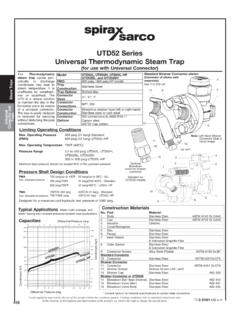
6 Thermodynamic steam traps7 MaterialMaximum operating pressureConnectionSizesRecommended installationDN8 "DN10"DN15 "DN20 "DN251"Carbon steel42 bar gSocket weldTD42S2 TD42S2 LCHorizontal46 bar gScrewedSocket weldFlangedTDC46 MHorizontalStainless steel10 bar gScrewedTD10 Horizontal30 bar gSwivelUTD30L UTD30H(universal connection)Universal32 bar gFlangedTD32F TD32 FLCH orizontal42 bar gButt weldTD3-3TD3-3TD3-3 LCTD3-3 HorizontalScrewedTD 259TD52 MTD42 LCTD42L TD52 MTD42TD42 LCTD42 HTD42L TD52 MTD52 MLCTD42TD42 HTD42 LTD52 MTD42 HTD42 LTD52 MHorizontal46 bar gSwivelUTDS46 MUniversal46 bar gScrewedSocket weldFlangedTDS46 MHorizontalAlloy steel62 bar gScrewed Socket weld FlangedTD62M TD62 LMHorizontal250 bar gSocket weld Butt weld FlangedTD120 MHorizontalStainless steel (Clean steam )10 bar gScrewedBTD52 LHorizontalClamp Tube endBTD52 LHorizontalThermodynamic steam traps - product steam trapsBall float mechanical steam trapsBall float (FT) mechanical steam traps have an integral air vent as standard and the options of a manually adjustable needle valve (SLR - steam lock release mechanism) and drain cock tapping, the FT range is adaptable to all applications where ball float traps are recommended and instantaneous removal of condensate is a ball float steam trap works1.
7 On start-up a thermostatic air vent allows air to bypass the main valve (1) which would otherwise be unable to escape (a condition known as air-binding ).2. As soon as condensate reaches the trap, the float israised and the lever mechanism opens the main condensate closes the air vent but continues to flowthrough the main valve. 3. When steam arrives the float drops and closes off the main valve, which remains at all times below the water level, ensuring that live steam cannot be As the steam condenses, the float rises allowing condensate to be and benefits: Immediate condensate discharge with clean, tight shut-off. No backup of condensate ensures maximum plant efficiency Works efficiently on both heavy and light loads with no passage of live steam Not affected by wide and sudden fluctuations of pressure or flowrate Stainless steel internals that can tolerate corrosive condensate Integral air vent to ensure rapid warm-up of plant Robust construction to guarantee long life against waterhammer and steam SizesInstallationDN15 "DN20 "DN251"DN321 "DN401 "DN502"DN803"DN1004"Cast iron13 bar gFlangedFT43FT43 FT53FT43 HorizontalFT43 VFT43V FT53 VVertical down14 bar gScrewedFT14 HorizontalSG iron14 bar gScrewedFT14 HorizontalFT14 VVertical downFlangedFT14 Horizontal21 bar gScrewedFT14 HCFT14 Horizontal32 bar gFlangedFT47 FT57FT47 FT57 HorizontalFlangedFT47 VFT47 VVertical downENP coatedSG iron coverandstainless bar gScrewedFTGS14 HorizontalFlangedFTGS14 Horizontal17 bar gScrewedFTGS14
8 HCHorizontalCarbon steel23 bar gFlangedFTC23 Horizontal32 bar gScrewed Socket weldFTC32FT450*HorizontalFTC32 VVertical downFlangedFTC32 F T4 4 FT54F T4 4 FT54F T4 4 FT54F T4 4 FT450*HorizontalFTC32V F T4 4V FT54VF T4 4V FT54VF T4 4V FT54 VVertical down80 bar gSocket weld FlangedFTC80 HorizontalScrewed Socket weld FlangedFTC62 HorizontalStainless steel23 bar g FlangedFTS23 Horizontal19 bar gScrewed Socket weld FlangedFTS14 HorizontalFTS14 VVertical bar gFlangedFT46FT46 Horizontal32 bar bar gScrewed Socket weld FlangedFTS62 HorizontalStainless steel (Clean steam ) bar downBall float steam traps - product range* not PED approvedMechanical steam trapsInverted bucket mechanical steam traps Our inverted bucket steam traps employ a well-proven principle which relies on the difference in density between steam (a vapour) and condensate (a liquid). They have a robust design and incorporate a simple density sensitive bucket and lever steam trapsHow an inverted bucket steam trap works1.
9 As condensate reaches the trap it forms a watersealinside the body. The weight of the bucket keeps the valveoff its seat. Condensate can then flow around the bottomof the bucket and out of the trap. 2. When steam enters the underside of the bucket it givesit buoyancy and the bucket rises. This positions the levermechanism such that the main valve snaps shut due toflow The bucket will lose its buoyancy as the enclosedsteam condenses due to radiation losses and steamescapes through the vent hole. Once this happens theweight of the bucket will pull the valve off its seat and thecycle is then Any air reaching the trap will also give the bucket buoyancy and close the valve preventing condensate flow. Thesmall vent hole positioned at the top of the bucket will lead air into the top of the trap. Because the vent hole at the top ofthe bucket is small in diameter it will vent air very slowly. Where the venting of air may be a particular problem, this canbe overcome simply by fitting an external air vent in and benefits: Near continuous condensate discharge with tight shut-off.
10 Minimal back-up of condensate ensures maximum plant efficiency Deep water-seal to protect against the possibility of steam loss Suitable for superheat conditions when fitted with internal inlet check valve Simple and robust construction to guarantee long life against waterhammer and vibration Stainless steel internals are attached to the cover for ease of maintenance Integral strainer (HM, HM34 and SCA models only) Optional blowdown valve (only for HM and HM34). "DN20 "DN251"DN401 "DN502"DN803"Cast iron13 bar gScrewed FlangedS SFHorizontal14 bar gScrewed FlangedHMHorizontal22 bar gScrewed Flanged200 VerticalCarbon steel32 bar gScrewed Socket weld FlangedHM34 Horizontal41 bar gScrewed Socket weld FlangedSCAH orizontal116 bar gScrewed Socket weld FlangedIBV Series C IBV Series C-LDF2 VerticalStainless steel30 bar gScrewed Socket weld FlangedSIB30 SIB30 HHorizontalSwivelUIB30 UIB30 HUniversal60 bar gScrewedFlangedSIB45 Horizontal63 bar gSwivelUIB46 UniversalAlloy steel123 bar gScrewed Socket weld FlangedIBV Series ZVerticalInverted bucket steam traps - product rangeThermostatic steam trapsHow a balanced pressure thermostatic steam trap works 1.