Transcription of steelwise - AISC
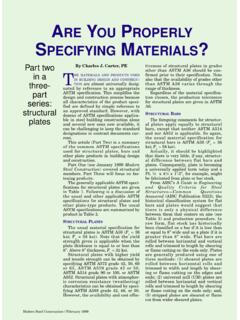
1 APRIL 2018WE WOULD HOPE THAT your answer to the important question masquerading as the title of this month s steelwise is a resounding Yes! We recognize that your answer might be a less confident Yes, an I think so, an I m not sure, a Maybe or even a Please help! Wherever you are on the spectrum, rest assured we re here to help clarify any we know, ASTM specifications undergo periodic revi-sions and new ones come into existence. The design and con-struction process is simplified greatly through the reference of appropriate ASTM specifications because they allow you to de-fine all the relevant characteristics of a specified product.
2 How-ever, with dozens of ASTM specifications applicable to steel construction alone, it can be a challenge to keep the standard designations used in contracts current. Here, we ll provide a summary of the most common ASTM specifications used in steel building design and construction, including standards for structural shapes, plate products, fas-tening products and more. This information is based on similar information in AISC s 15th Edition Steel Construction Manual. Another useful AISC publication is Selected ASTM Standards for Steel Construction, which provides a compilation of more than 60 steel-related ASTM standards.
3 Both publications are avail-able at ASTM standards typically include a section on ordering requirements listing the variables in each standard that should be specified in a complete order or specification for the material. This is routine for fabricator purchasing departments at local fabrication ShapesLet s start with structural shapes, which are summarized inTable The preferred material specification for W-shapes is ASTM A992 (Fy = 50 ksi, Fu = 65 ksi). The avail-ability and cost-effectiveness of W-shapes in grades other than ASTM A992 should be confirmed prior to their specification.
4 W-shapes of limited sizes with higher yield and tensile strength can be obtained by specifying ASTM A529 Grade 55, ASTM A572 Grades 55, 60 or 65 or ASTM A913 Grades 60, 65 or 70. W-shapes with atmospheric corrosion resistance (weather-ing characteristics) can be obtained by specifying ASTM A588. These and other material specifications applicable to W-shapes are shown in Table and S-Shapes. The preferred material speci-fication for these shapes is in transition. ASTM A36 (Fy = 36 ksi, Fu = 58 ksi) is now only slightly more common than 50-ksi grades like ASTM A529 Grade 50, ASTM A572 Grade 50, or ASTM A992; each of these 50-ksi grades has Fy = 50 ksi and Fu = 65 ksi for these shapes.
5 The availability and cost-effec-tiveness of M-shapes and S-shapes in grades other than those listed should be confirmed prior to their specification. M-shapes and S-shapes with a higher yield and tensile strength can be obtained by specifying ASTM A529 Grade 55, ASTM A572 Grades 55, 60 and 65 or ASTM A913 Grades 60, 65 or 70. Atmospheric corrosion resistance (weathering charac-teristics) can be obtained by specifying ASTM A588 Grade 50. These and other material specifications applicable to M-shapes and S-shapes are shown in Table The preceding comments for M-shapes and S-shapes apply equally to channels.
6 However, note that channels are now most commonly available as ASTM A992 (Fy = 50 ksi, Fu = 65 ksi). Be sure to confirm material avail-ability with your The preferred material specification for HP shapes is ASTM A572 Grade 50 (Fy = 50 ksi, Fu = 65 ksi); the availability and cost effectiveness of other grades should be con-firmed prior to specification. HP-shapes with atmospheric cor-rosion resistance (weathering characteristics) can be obtained by specifying ASTM A588 Grade 50.
7 These and other material specifications applicable to HP-shapes are shown in Table The preceding comments for M-shapes and S-shapes apply equally to YOU PROPERLY SPECIFYING MATERIALS?steelwiseAs material specifications change and improve, so too can your steel-framed Tavarez is a staff engineer in AISC s Steel Solutions JONATHAN TAVAREZ Modern STEEL CONSTRUCTION structural Tees. structural tees are split from W-, M- and S-shapes to make WT-, MT- and ST-shapes, respectively. For the preferred material specifica-tions, as well as other suitable material specifications for structural tees, refer to the preceding sections on W-, M- or S-shapes, as (and Square) HSS.
8 The preferred material specification for rectangu-lar hollow structural sections (HSS) is ASTM A500 Grade C (Fy = 50 ksi, Fu = 62 ksi). Two material standards new to the 15th Edi-tion Manual for HSS are A1065 and A1085. A1085 Grade A (Fy = 50 ksi, Fu = 65 ksi) pro-vides tighter wall thickness and corner radii tolerances. Additional benefits include a maximum yield stress of 70 ksi and a de-fined standard for Charpy V-notch material toughness. The availability and cost-effec-tiveness of rectangular HSS in grades other than ASTM A500 Grade C should be con-firmed prior to their specification.
9 Because A500 Grade C meets the requirements of Grade B, it is likely that you will receive Grade C regardless of what you specify. It is therefore best to specify Grade C from the beginning and take advantage of the in-creased design strength. Rectangular HSS with atmospheric resistance (weathering characteristics) can be obtained by speci-fying ASTM A847 or A1065 Grade 50W. These and other material specifications applicable to rectangular HSS are shown in Table 2-4.
10 Note that A1085 Grade A is hoped to supersede A500 relatively HSS. The preferred material specification for round HSS is ASTM A500 Grade C (Fy = 46 ksi, Fu = 62 ksi). Note that A1085 Grade A (Fy = 50 ksi, Fu = 65 ksi) may also be specified for round HSS mem-bers for tighter wall thickness and again, is hoped to supersede A500 relatively soon. The availability and cost-effectiveness of round HSS in grades other than ASTM A500 Grade C should be confirmed prior to specification.