Transcription of Step 8 Considering Validity and Discussing Limitations
1 Step 8: Considering Validity and Discussing Limitations Written and Compiled by Amanda J. Rockinson-Szapkiw and Anita Knight Introduction It is important to think about threats to Validity prior to planning all of the details of your study so that you can be proactive in designing a study that controls for threats to Validity . Then, in the limitation section of your research plan, identify your threats to both internal and external Validity and discuss controls. Begin by thinking about your student and identifying a list of threats to internal and external Validity . Think about weaknesses of the study, the design ( , lack of randomization, bias), the analysis, the instruments, and the sample ( gender, age, ethnicity, geographical location). Once you identify the Limitations , label them. In your manuscript. Identify the type of threat and describe it in terms of your present study.
2 Discuss how the limitation could potentially influence the study. Discuss the steps taken to limit the threat, if applicable. For example, if you were studying college students and non-ignorable nonresponse was an issue, you may say (Szapkiw, 2009, ): Results do not account for students at universities who chose not to participate due to multi-institutional research polices that prohibited participation or universities or who chose not to participate for other reasons. Since this study used survey data, responses made by students who did not respond to the survey or who dropped out of the online courses were not accounted for. This subjected the study to unit nonresponse and the issue of non-ignorable nonresponse. Within the realm of non-ignorable nonresponse issues, item nonresponse was not a problem in this study; however, the problem of unit nonresponse needs to be noted as a limitation when applying and making inferences based on part one of this study (King, Honaker, Joseph, & Shever, 1998).
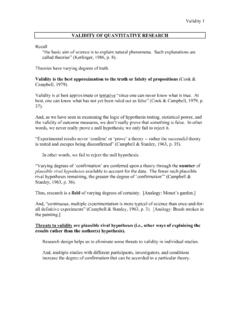
3 Since the data analysis did not use statistical controls to address the issue of non-ignorable nonresponse, findings cannot be applied to the students who did not respond. Thus, care should be taken not to make invalid inferences based on the results (Hausman & Wise, 1979). Topical Discussion Define Validity Validity , in reference to research, refers to the accuracy of the research results. There are 4 types of Validity (Cook & Campbell, 1979; Kazdin, 2003): 1. internal Validity 2. external Validity 3. Construct Validity 4. Statistical conclusion Validity internal Validity internal Validity has been defined as the confidence one can have in inferring a causal relationship among variables while simultaneously eliminating rival hypotheses (Hepner, Kivilghan, & Wampold, 1999). It refers to the extent that a researcher has control over extraneous variables and can say that the intervention accounted for the results.
4 Threats to internal Validity can be thought of as rival hypotheses or alternative explanations for the effect within a sample. To evaluate whether a study has internal Validity , and the degree of the internal Validity the study possesses the researcher must ask the following questions, Is the change in the independent variable responsible for the differences observed in the dependent variable? And, To what degree can alternative explanations of changes in the dependent variable be ruled out? As a researcher asks this question, the researcher is evaluating the internal Validity of the study at hand. However, since this question may not be answered directly, researchers can conclusively respond to the question, by ruling out alternative explanations for the changes in the dependent variable (Hepner, Kivilghan, & Wampold, 1999). And, threats to internal Validity , these confounding or extraneous variables, need to be controlled.
5 Several procedures may be undertaken to control for internal Validity . These include the following (Hepner, Kivilghan, & Wampold): a) randomly assigning participants to groups, b) randomly selecting participants, c) determination of measurement times, and d) manipulation of the independent variable. Let s take a look at specific threats to internal Validity and how they can each be controlled for either statistically or by design. Table 1 identifies threats to internal Validity . Each threat is labeled, defined, and illustrated. Possible actions a researcher can take to control for the threats are also identified. Table 1. Threats to internal Validity (Cook & Campbell, 1979; Kazdin, 2003) Type of Threat Definition Illustration Possible Control History An event outside of the experiment that affects the dependent variable During the course of a diversity tolerance treatment aimed at improving tolerance of undergraduate students, the university has a multicultural awareness week with numerous events.
6 This event hosted by the university may affect the tolerance attitudes of the participants, especially if a survey is used as surveys are particularly subject to this influence Reduction of time between the pretest & posttest Control Group Maturation Change or growth over time ( older, stronger, In a treatment for depression, the process of "spontaneous remission" is wrongly attributed to a treatment effect. Reduction of time between the pretest & smarter, fatigued, well etc.) Studies that involve adolescents and children are extremely sensitive to this threat. posttest Control Group Randomization/ True experimental design Testing Presence of the pretest or posttest ( familiarity with the test may cause improvement) A group of adolescents take the Beck Depression Inventory (BDI) before and after treatment.
7 Familiarity with the instrument in the post testing influences performance eon the instrument. Parallel test form True experimental design to eliminate pretest Solomon 4-group design Instrumentation Changes in the instrument or the environment in which the measurement is being given A graduate student in a counseling program is interested in exploring the similarities and differences in matters of motivation in parenting between mothers and fathers. She plans to collect data from 150 parents taking a class using an instrument she developed based on her experience. She plans to review the parents responses to open-ended questions and to detect any generalities or trends without any system for data analysis. Standardized testing manual; trained implementers and observers ; inter-rater reliability Valid and reliable instrument Objective observation instruments Minimized experimenter interaction with the participants Statistical regression The tendency for extreme score to regress toward the mean A therapeutic intervention based in Beck s work was developed to decrease depression.
8 If the intervention is implemented with 25% of the most depressed clients (determined by scores on the BDI) receiving services at a treatment center, The BDI scores will be assured improvement from pre to posttest by statistical regression alone. Control group Random Assignment Selection bias Differences between groups prior to implementation of the experiment. This is often present in research that uses intact groups or self-selection to groups. Two classes are exposed to different counseling skills teaching methods and both classes post tested on their skills. If the class A scores better than class B, the difference could be attributed to the fact that class A had better counseling skills prior to the teaching intervention. Random Assignment Homogeneity of groups Statistical control ( pretest, covariates) Matching Attrition/ Mortality Loss of participants Clients who sign up to participate in a study drop out before the completion of the study.
9 Shorten duration of research Compare dropouts & non dropouts Diffusion of treatment The treatment is accidentally dispersed to both groups. This may occur for many reasons including the control and experimental group becoming aware of both treatments . A teacher who is teaching the control group is trained in the methods the experimental group is receiving and integrates the method with the control group by nature of her training. Minimize or Eliminate) contact between groups Use systematic procedures for interventions Reaction to controls Due to awareness about participation in the study, participants behave different. This can include the compensatory equalization of treatment, in which one treatment is seen as more desirable than the other by the implementer, and, thus, the implementation is biased. This also Two classes are exposed to different counseling skills teaching methods and both classes post tested on their skills.
10 Class B the comparison group sees Class A receiving special treatment and feels resentful. This resentment affects their performance on the post test. Minimize or Eliminate) contact between groups Use systematic procedures for interventions includes resentful demoralization of the control group, in which the control group perceives less benefit and this perception influences the outcomes. *These threats are not mutually exclusive. Many overlap and are considered in combination with one another. Additionally, it is important to note that these threats only pertain to experimental studies and not correlational studies. Correlational studies, particularly predictive correlation studies have a unique set of threats to Validity . Also, this is not a comprehensive list. internal Validity is concerned with what is, and external Validity is concerned with how the findings can be applied.