Transcription of step V Administering Vaccines - Immunization …
1 Ou have your vaccination supplies, and youhave properly stored your vaccine inventory. As you start to assess your patients vaccinationstatus and history, the gaps in their records remindyou why your practice is now incorporating vacci-nation services. It s time to administer vaccine . Chances are, many of your patients are behind ontheir vaccinations and they are grateful that you arehelping them get up to date. Even if you are newatadministering Vaccines , don t be intimidated this will soon be second nature to you. Determine who can administer Vaccines (either independently or under standingorders)Every state has regulations that specify who canadminister Vaccines . All states allow physicians,nurse practitioners, and physician assistants to bothassess the need for and to admin-ister Vaccines . All states allow RNsand LPNs to administer states allow medical assis-tants (MAs) to give injections afterproper training and with supervi-sion.
2 All states allow pharmaciststo assess the need for and admin-ister one or more Vaccines if theyhave been properly trained andcertified. However, you ll need tocheck to see if there are restrictionson the particular vaccine (s) theymay administer in your state or ifvaccines can be administeredunder standing orders. For moreVaccinatingAdults:A Step-by-Step guide Immunization action coalition : Administering VaccinesYStep-by-Step: vaccine Administration Tasks Determine who can administer Vaccines (either independ-ently or under standing orders) Always provide a vaccine Information Statement (VIS) Administer the vaccine properly Use the proper site for injection Prepare the vaccine (and diluent, if needed) Use the proper needle gauge and length Administer injections by the correct route intramuscular(IM) or subcutaneous (Subcut) Know how to deliver nasal spray vaccine (when recommended) Administer all needed Vaccines at the same visit Safely dispose of the needle and syringe and nasal sprayer Avoid vaccine administration errors Prepare and watch for an allergic reaction (anaphylaxis) aftervaccination Always report anaphylaxis and other adverse events aftervaccination to VAERS Prepare and watch for syncope (fainting)
3 Communicate about appointments for subsequent doses Understand proper spacing of dosesYou ll need to check to see if there are restrictionson the particular vaccine (s)they may administer inyour state or if Vaccines canbe administered understanding ordersinformation about standing orders and who is eli-gible to provide vaccination services using them,which might include RNs, pharmacists, and MAs,see the Immunization action coalition s (IAC)UsingStanding Orders for Administering Vaccines : WhatYou Should Knowat You also should check with your statemedical licensing board for the regulations in yourpractice location. Another great resource is IAC s10 Steps to Implementing Standing Orders for Immunization in Your Practice Settingavailable of the local regulations, proper vaccineadministration technique is a skill that requirespractice. If you have not administered injectable ornasal spray Vaccines recently, you should refreshyour skills.
4 In addition to watching a vaccine admin-istration video (one example is discussed later inthis chapter), you should consider contacting yourlocal health department. Staff there may be able to provide hands-on training with this importantprocedure, or they can head you in the right directionfor provide a vaccine Information Statement (VIS)Since 1994, healthcare providers who administerany vaccine covered bythe NationalChildhoodVaccineInjury Act(Section 2125 of the Public Health Service Act [ 300aa-26]) are required to provide a copy ofthe relevant federal vaccine Information Statement(VIS) beforeadministering most Vaccines to a person of any age, including adults. VISs are avail-able for all Vaccines licensed in the United States,and many are available in multiple languages onthe IAC website at A listingof the most current versions for each VIS also maybe found on this website. Patients must be offered a copy (which can be an electronic copy) of the VIS to take home with them, though the recipientmay decline.
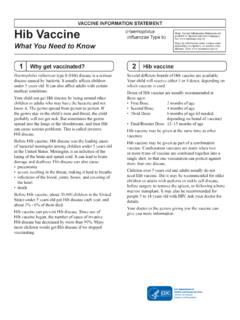
5 (You can learn more about this federalrequirement in Step 6 Documentation and RelatedIssues.) You probably will want to give patients evenmore information aboutthe disease that the vac-cine prevents, as well as answer any questionsthey may have. Administer the vaccine properlyRemember if you don t administer the vaccineproperly, you might as well not give it at all. You vegone to a lot of trouble to keep your Vaccines viable, and your patients need this a waste it would be for the vaccine not to beadministered properly! One common mistake is that too short a needle isused a subcutaneous Subcut needle rather thanan intramuscular IM needle. When this happens,the vaccine can be injected into fat instead of into muscle. You may hear that some Vaccines willVaccinating Adults: A Step-by-Step guide Immunization action coalition : Administering Depar tment of Health and Human Ser vices Centers for Disease Control and Prevention vaccine INFORMATION STATEMENTMany vaccine Information Statements are available in Spanish and other languages.
6 See de informaci n sobre vacunas est n disponibles en espa ol y en muchos otros idiomas. Visite ,Q XHQ]D )OX 9 DFFLQH ,QDFWLYDWHG RU 5 HFRPELQDQW What you need to know 1 :K\ JHW YDFFLQDWHG",Q XHQ]D X LV D FRQWDJLRXV GLVHDVH WKDW VSUHDGV around the United States every year, usually between October and May.)OX LV FDXVHG E\ LQ XHQ]D YLUXVHV DQG LV VSUHDG PDLQO\ by coughing, sneezing, and close contact.$Q\RQH FDQ JHW X )OX VWULNHV VXGGHQO\ DQG FDQ ODVW several days. Symptoms vary by age, but can include: fever/chills sore throat muscle aches fatigue cough headache runny or stuffy noseFlu can also lead to pneumonia and blood infections, and cause diarrhea and seizures in children. If you have a PHGLFDO FRQGLWLRQ VXFK DV KHDUW RU OXQJ GLVHDVH X FDQ PDNH LW ZRUVH Flu is more dangerous for some people. Infants and young children, people 65 years of age and older, pregnant women, and people with certain health FRQGLWLRQV RU D ZHDNHQHG LPPXQH V\VWHP DUH DW JUHDWHVW ULVN Each year thousands of people in the United States die IURP X, and many more are vaccine can: NHHS \RX IURP JHWWLQJ X PDNH X OHVV VHYHUH LI \RX GR JHW LW DQG NHHS \RX IURP VSUHDGLQJ X WR \RXU IDPLO\ DQG other people.
7 ,QDFWLYDWHG DQG UHFRPELQDQW X YDFFLQHV$ GRVH RI X YDFFLQH LV UHFRPPHQGHG HYHU\ X VHDVRQ Children 6 months through 8 years of age may need two GRVHV GXULQJ WKH VDPH X VHDVRQ (YHU\RQH HOVH QHHGV RQO\ RQH GRVH HDFK X VHDVRQ 6 RPH LQDFWLYDWHG X YDFFLQHV FRQWDLQ D YHU\ VPDOO amount of a mercury-based preservative called thimerosal. Studies have not shown thimerosal in YDFFLQHV WR EH KDUPIXO EXW X YDFFLQHV WKDW GR QRW contain thimerosal are LV QR OLYH X YLUXV LQ X VKRWV They cannot cause WKH X 7 KHUH DUH PDQ\ X YLUXVHV DQG WKH\ DUH DOZD\V FKDQJLQJ (DFK \HDU D QHZ X YDFFLQH LV PDGH WR SURWHFW DJDLQVW WKUHH RU IRXU YLUXVHV WKDW DUH OLNHO\ WR FDXVH GLVHDVH LQ WKH XSFRPLQJ X VHDVRQ %XW HYHQ ZKHQ WKH vaccine doesn t exactly match these viruses, it may still provide some vaccine cannot prevent: X WKDW LV FDXVHG E\ D YLUXV QRW FRYHUHG E\ WKH YDFFLQH or LOOQHVVHV WKDW ORRN OLNH X EXW DUH QRW ,W WDNHV DERXW ZHHNV IRU SURWHFWLRQ WR GHYHORS DIWHU YDFFLQDWLRQ DQG SURWHFWLRQ ODVWV WKURXJK WKH X VHDVRQ 6 RPH SHRSOH VKRXOG QRW JHW WKLV YDFFLQHTell the person who is giving you the vaccine .))
8 ,I \RX KDYH DQ\ VHYHUH OLIH WKUHDWHQLQJ DOOHUJLHV If you ever had a life-threatening allergic reaction DIWHU D GRVH RI X YDFFLQH RU KDYH D VHYHUH DOOHUJ\ WR any part of this vaccine , you may be advised not to JHW YDFFLQDWHG 0 RVW EXW QRW DOO W\SHV RI X YDFFLQH contain a small amount of egg protein. If you ever had Guillain-Barr Syndrome (also FDOOHG *%6 6 RPH SHRSOH ZLWK D KLVWRU\ RI *%6 VKRXOG QRW JHW WKLV vaccine . This should be discussed with your doctor. ,I \RX DUH QRW IHHOLQJ ZHOO ,W LV XVXDOO\ RND\ WR JHW X YDFFLQH ZKHQ \RX KDYH D PLOG LOOQHVV EXW \RX PLJKW EH DVNHG WR FRPH EDFN when you feel are available for all vaccineslicensed in the United States, andmany are available in multiplelanguages on the IAC website if you don tadminister the vaccineproperly, you might as well not give it at still work if given via the wrong route andwill merely cause greater temporary local discom-fort.)
9 While that may be true for some, for others,such as hepatitis B, HPV, influenza, and rabies Vaccines , the correct route is essential to obtainingan adequate immune response. We will not be discussing oral Vaccines in the only oral vaccine currently licensed for routineuse in the is rotavirus, which is only adminis-tered to infants. In addition, one influenza vaccine (FluzoneIntradermal, Sanofi Pasteur) is specificallylicensed for intra-dermal (into theskin) injection. Thisvaccine is adminis-tered with a speciallydesigned micro-needle and syringeinto the deltoid area. If you stock this type of influ -enza vaccine (it currently is approved only for people18 through 64 years of age), you should thoroughlyacquaint yourself with how to use the injection system by reading the instructions in the productinformation. No other vaccine should ever beadministered by the intradermal route. (Note thata tuberculin skin test, or PPD, which is administeredintradermally, is a diagnostic test NOT a vaccine .)
10 IAC s Administering Vaccines to Adults: Dose, Route, Site,and Needle Size, available , provides a conciseguide to help you ensure youare Administering vaccinesproperly. In addition, after youread this chapter, watch theCalifornia Department of Pub-lic Health s DVD titled Immunization Techniques: BestPractices with Infants, Children, and Adults. The DVD isavailable for a nominal chargeat , or the video may be streamedat Unlike thisGuide, which is limited to adultimmunization issues, the videoalso covers infant and child injections. Watchingthis video will give you an idea of the differences,as well as the similarities, involved and will remindyou that it really is simpler to vaccinate adults. Use the proper site for injectionFor adult vaccinations, all you need to give an injec-tion is the patient s deltoid muscle in the upperarm, although the muscle in the thigh can be usedif necessary. (For infant vaccinations, the thigh isgenerally used as an injection site.)