Transcription of STEPS for Teachers - Ophelia Project
1 2010. The Ophelia Project . All Rights Reserved. 1 STEPS for Teachers 2010. The Ophelia Project . All Rights Reserved. 2 Table of Contents Table of Contents .. 2 Introduction .. 3 Overview .. 3 step One: SEE Aggressive Behaviors .. 5 step Two: TEACH the Language of Peer Aggression .. 7 step Three: EMPHASIZE Positive Normative Beliefs .. 9 step Four: PRACTICE Pro-social Skills .. 11 step Five: SHARE What You Know .. 14 2010. The Ophelia Project . All Rights Reserved. 3 Introduction The Ophelia Project has established a mission to create a socially healthy environment through awareness, education, advocacy, and systems change.
2 We believe that everyone deserves a safe, healthy setting for personal and professional growth. Whether it s a child in a classroom or a worker in his or her office, everyone should expect a secure environment, free from emotional torment. We believe that each individual can contribute to creating these safe social climates, in the home, in the school, throughout their communities, and within the workplace. What is a safe social climate? It s an environment where people are protected, respected, encouraged, and held accountable for their actions. It also fosters inclusion, healthy relationships, and civility.
3 In a safe social climate, every individual has the opportunity to reach their full potential. The Five Critical STEPS for Addressing Peer Aggression serves as a tool for anyone seeking to establish a safe social climate within schools. However, once familiar with the STEPS , it is easy to extrapolate them to other environments such as the home, sports, work environments, and any other environment where people come together. Students who are preoccupied with managing negative social interactions are not available to learn. A middle school student who sits at home crying because her friends have excluded her from their weekend shopping trip is not able to concentrate on her homework.
4 A boy who takes a circuitous route from Math class to English class each day to avoid being in the hallway with aggressive classmates is always late for class. The nervous teenager who spends hours each night on the Internet monitoring her Facebook wall has little time or energy left to work on her history paper. Teachers know that when students are on edge during class, little work gets done. They describe off days when something is in the air and no one is on task. Many times this something is peer aggression. Teachers often find themselves dealing with aggression in a reactive manner without having all the information or strategies that they need.
5 Becoming pro-active is critical. Rather than reacting to incidents of peer aggression after they occur, students, Teachers , and school administrators must work together to create a school culture that values cooperation, friendship, and a true appreciation of diversity. The Five Critical STEPS in the following pages describes a comprehensive approach to identifying peer aggression: seeing the behaviors, naming the behaviors, stating positive normative beliefs, fostering pro-social skills, and finally developing practical prevention and intervention strategies.
6 2010. The Ophelia Project . All Rights Reserved. 4 Overview How often have you heard the expression you have to look before you can see ? As educators, we often miss incidents of social aggression because we are not aware of what is occurring in our classrooms, school buildings and communities. We have to look carefully and thoughtfully for negative social behaviors before we can truly see what is happening and begin to address it. The following STEPS are a way to start: 1. SEE Aggressive Behaviors a. Expand your thinking to include all forms of overt and covert aggression b.
7 Challenge your own normative beliefs c. Consider your past experiences d. Become a careful observer 2. TEACH the Language of Peer Aggression a. Teach students the language of feelings and peer aggression b. Describe the behavior that you are observing and call it aggression 3. EMPHASIZE Positive Normative Beliefs a. Write down the norms and display them in your classroom b. Hold your students accountable for demonstrating these norms c. Express your behavioral expectations to students clearly and frequently d. Model these norms in the way you structure and conduct your classes 4.
8 PRACTICE Pro-Social Skills a. Teach pro-social skills to enhance empathy, emotional intelligence, relationship building, and conflict resolution b. Develop intervention strategies to deal with peer aggression when it occurs c. Support and encourage the bystanders to speak out in appropriate ways d. Take advantage of teachable moments to reinforce the norms and integrate them into your lesson plans e. Reinforce the new behaviors in your day-to-day interactions with students, colleagues, and parents f. Integrate the concepts into your on-going curriculum Teach students alternative positive strategies for dealing with conflict and friendship issues 5.
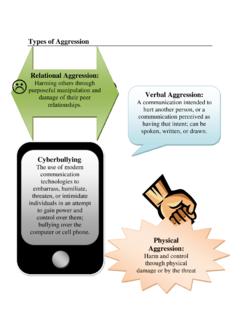
9 SHARE What You Know a. Creating school-wide policies and procedures to address Peer Aggression b. Making common school areas safer social environments c. Empowering the bystander to make a difference. 2010. The Ophelia Project . All Rights Reserved. 5 step One: SEE Aggressive Behaviors While the first step may appear to be the easiest, it is the most critical. We are often tempted to jump ahead and try to solve problems once we recognize them, but careful observation and reflection are often the keys to lasting changes. What is aggression? Overt aggression is defined as bullying that is done out in the open.
10 The bully physically or verbally attacks the classmate who is usually not part of his social circle ( is not a friend) Overt aggression is often easier to identify and includes: Most forms of physical aggression including threats Name calling based on race, religion, gender or sexual orientation Verbal abuse including put-downs and sexual harassment Taunting Covert aggression, commonly referred to as Relational Aggression, often occurs within the social circle and is more common among girls. It is more subtle, under the radar screen , and requires careful observation.