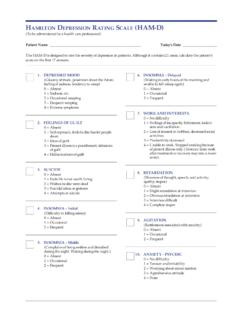
Transcription of STRUCTURED INTERVIEW GUIDE FOR THE HAMILTON …
1 SIGHD-IDSC Page 1 of 16 f:\institut\cultadap\project\3320\study3 320\final_versions\sighd-idsc\ STRUCTURED INTERVIEW GUIDE FOR THE HAMILTON depression RATING SCALE (SIGH-D) Janet Williams, This INTERVIEW GUIDE is based on the HAMILTON depression Rating Scale ( HAMILTON , Max: A rating scale for depression . J Neurol Neurosurg Psychiat 23:56-61, 1960). The anchor point descriptions, with very minor modifications, have been taken from the ECDEU Assessment Manual (Guy, William, ECDEU Assessment Manual for Psychopharmacology, Revised 1976, DHEW Publication No. (ADM) 76-338). A reliability study of the SIGH-D has been reported (Williams JBW: A STRUCTURED INTERVIEW GUIDE for the HAMILTON depression Rating Scale. Archives of General Psychiatry 45:742-747, 1988). Copyright 1988, 1992, 1996. All rights reserved. Permission is granted for reproduction for use by researchers and clinicians.
2 For correspondence: Dr. Williams, New York State Psychiatric Institute, Unit 60, 1051 Riverside Drive, New York, New York 10032 INVENTORY OF DEPRESSIVE SYMPTOMATOLOGY CLINICIAN RATED (IDS-C) Rush, , Gullion, , Basco, , Jarrett, and Trivedi, The Inventory of Depressive Symptomatology (IDS): Psychometric properties. Psychological Medicine, 26:477-486, 1996. INSTRUCTIONS TO INTERVIEWERS: The first question for each item (in bold print) should be asked exactly as written. Follow-up questions are provided for further exploration or additional clarification of symptoms. The specified questions should be asked until you have enough information to rate the item confidently. You may also have to add your own follow-up questions to obtain necessary information. If the answer to a specified question is already known, it is sufficient to confirm the information with the subject ( , "You said ), make the rating, and continue.
3 The final score for each item should reflect an assessment and balancing of the severity and frequency of the symptom. Note that patients with chronic symptoms may not be able to identify a period of normalcy or may report that "depressed" is their usual state. However, depression should not be rated as "normal" ( , a rating of "0") in these cases. SIGHD-IDSC Page 2 of 16 f:\institut\cultadap\project\3320\study3 320\final_versions\sighd-idsc\ STRUCTURED INTERVIEW GUIDE FOR THE HAMILTON depression SCALE (SIGH-D)* and INVENTORY OF DEPRESSIVE SYMPTOMATOLOGY (IDS-C) (SIGHD-IDS) Instruments Combined by Kenneth A. Kobak, Janet Williams, and A. John Rush OVERVIEW: I d like to ask you some questions about the past week. How have you been feeling since last (DAY OF WEEK)? IF OUTPATIENT: Have you been working? IF NOT: Why not? What s your mood been like this past week (compared to when you feel OK)?
4 Have you been feeling down or depressed? Sad? Hopeless? Helpless? Worthless? - IF YES: Can you describe what this feeling has been like for you? How bad is the feeling? Have you been crying at all? How have you been feeling about the future? (optimistic/pessimistic) Do you feel better with encouragement/reassurance from others? Do you feel things will get better, improve, work out? IF DEPRESSED: In the past week, when something good, even small things have happened, did your mood brighten up? How long did this brightened mood last? Were there things that occurred that should have brightened your mood but did not? In the last week, how often have you felt (OWN EQUIVALENT)? Every day? All day? HAMD ITEM IDS-C ITEM 1. Depressed Mood (sadness, hopeless, helpless, worthless): 0 - Absent. 1 - Indicated only on questioning (occasional, mild depression ) 2 - Spontaneously reported verbally (persistent, mild to moderate depression ) 3 - Communicated non-verbally, , facial expression, posture, voice, tendency to weep (persistent, moderate to severe depression ) 4 - VIRTUALLY ONLY those feeling states reported in spontaneous verbal and non-verbal communication (persistent, very severe depression , with extreme hopelessness or tearfulness) 5.
5 Mood (Sad): 0 - Does not feel sad 1 - Feel sad less than half the time 2 - Feels sad more than half the time 3 - Feels intensely sad virtually all of the time 8. Reactivity of Mood: 0 - Mood brightens to normal level and lasts several hours when good events occur 1 - Mood brightens but does not feel like normal self when good events occur 2 - Mood brightens only somewhat with few selected, extremely desired events 3 - Mood does not brighten at all, even when very good or desired events occur 17. Outlook (Future): 0 - Views future with usual optimism 1 - Occasionally has pessimistic outlook that can be dispelled by others or events 2 - Largely pessimistic for the near future. 3 - Sees no hope for self/situation anytime in the future IF SCORED 1-4 ABOVE, ASK: How long have you been feeling this way? SIGHD-IDSC Page 3 of 16 f:\institut\cultadap\project\3320\study3 320\final_versions\sighd-idsc\ In the past week, have you noticed your depressed mood feeling worse at any particular time of the day-such as in the morning or evening?
6 (IF YES), is this related to any particular event(s)? How much worse do you feel-a little bit or a lot? Even on weekends? HAMD ITEM IDS-C ITEM NONE 9. Mood Variation: 0 - Notes no regular relationship between mood and time of day 1 - Mood often relates to time of day due to environmental circumstances 2 - For most of week, mood appears more related to time of day than to events 3 - Mood is clearly, predictably, better or worse at a fixed time each day If response is 1, 2 or 3: 9A. Is mood typically worse in MORNING, AFTERNOON, or NIGHT (CIRCLE ONE) 9B. Is mood variation attributed to environment by the patient? YES or NO (CIRCLE ONE) Have you experienced grief or loss in your life, like the death of a close friend or relative (or pet, lost an important job)? Do you remember how you felt? How is the sad or down mood you have experienced this week similar to how you felt then?
7 (IF NO), How is it different? HAMD ITEM IDS-C ITEM NONE 10. Quality of Mood: 0 - Mood is virtually identical to feelings associated with bereavement or is undisturbed 1 - Mood is largely like sadness in bereavement, although it may lack explanation, be associated with more anxiety, or be much more intense 2 - Less than half the time, mood is qualitatively distinct from grief and therefore difficult to explain to others 3 - Mood is qualitatively distinct from grief nearly all of the time SIGHD-IDSC Page 4 of 16 f:\institut\cultadap\project\3320\study3 320\final_versions\sighd-idsc\ Have you been putting yourself down this past week, feeling you ve done things wrong, or let others down? IF YES: What have your thoughts been? Has this been more than is normal for you? In the past week, how have you felt about yourself? Have you noticed your self-esteem has been down in the past week?
8 How would you rate your worth as a person compared to others? Have you been feeling guilty about anything that you ve done or not done? What about things that happened a long time ago? Do you feel like you're being punished? Have you thought that you ve brought (THIS depression ) on yourself in some way? (Have you been hearing voices or seeing visions in the last week? IF YES: Tell me about them.) HAMD ITEM IDS-C ITEM 2. Feelings Of Guilt: 0 - Absent. 1 - Self-reproach, feels he/she has let people down (or guilt over decreased productivity only) 2 - Ideas of guilt or rumination over past errors or sinful deeds ( feelings of guilt, remorse, or shame) 3 - Present illness is a punishment. Delusions of guilt. (severe, pervasive feelings of guilt) 4 - Hears accusatory or denunciatory voices and/or experiences threatening visual hallucinations 16. Outlook (Self): 0 - Sees self as equally worthwhile and deserving as others 1 - Is more self-blaming than usual 2 - Largely believes that he/she causes problems for others 3 - Ruminates over major and minor defects in self This past week, have you had thoughts that life is not worth living?
9 What about thinking you d be better off dead or wishing you were dead? Have you had thoughts of hurting or killing yourself? IF YES: What have you thought about? How often do these thoughts come? How long do they stay? Have you thought of a plan in the last week? Have you done anything to try to hurt yourself or taken any steps toward ending your life? HAMD ITEM IDS-C ITEM 3. Suicide: 0 - Absent. 1 - Feels life is not worth living 2 - Wishes he/she were dead or any thoughts of possible death to self 3 - Suicidal ideas or gesture 4 - Attempts at suicide 18. Suicidal Ideation: 0 - Does not think of suicide or death 1 - Feels life is empty or is not worth living 2 - Thinks of suicide/death several times a week for several minutes 3 - Thinks of suicide/death several times a day in depth, or has made specific plans, or attempted suicide SIGHD-IDSC Page 5 of 16 f:\institut\cultadap\project\3320\study3 320\final_versions\sighd-idsc\ Now let s talk about your sleep.
10 What were your usual hours of going to sleep and waking up, before this began? When have you been falling asleep and waking up over the past week? Have you had any trouble falling asleep at the beginning of the night? (Right after you go to bed, how long has it been taking you to fall asleep?) How many nights this week have you had trouble falling asleep? HAMD ITEM IDS-C ITEM 4. Insomnia Early (Initial Insomnia): 0 - No difficulty falling asleep 1 - Complains of occasional difficulty falling asleep ( , hour or more, 2-3 nights) 2 - Complains of nightly difficulty falling asleep ( , hour or more, 4 or more nights) 1. Sleep Onset Insomnia: 0 - Never takes longer than 30 minutes to fall asleep. 1 - Takes at least 30 minutes to fall asleep, less than half the time 2 - Takes at least 30 minutes to fall asleep, more than half the time 3 - Takes more than 60 minutes to fall asleep, more than half the time During the past week, have you been waking up in the middle of the night?