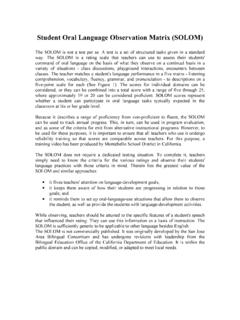
Transcription of Student Oral Language Observation Matrix (SOLOM)
1 Student Oral Language Observation Matrix (SOLOM). The SOLOM is not a test per se. A test is a set of structured tasks given in a standard way. The SOLOM is a rating scale that teachers can use to assess their students'. command of oral Language on the basis of what they observe on a continual basis in a variety of situations - class discussions, playground interactions, encounters between classes. The teacher matches a Student 's Language performance in a five mains - listening comprehension, vocabulary, fluency, grammar, and pronunciation - to descriptions on a five-point scale for each (See Figure 1). The scores for individual domains can be considered, or they can be combined into a total score with a range of five through 25, where approximately 19 or 20 can be considered proficient.
2 SOLOM scores represent whether a Student can participate in oral Language tasks typically expected in the classroom at his or her grade level. Because it describes a range of proficiency from non-proficient to fluent, the SOLOM. can be used to track annual progress. This, in turn, can be used in program evaluation, and as some of the criteria for exit from alternative instructional programs. However, to be used for these purposes, it is important to ensure that all teachers who use it undergo reliability training so that scores are comparable across teachers. For this purpose, a training video has been produced by Montebello School District in California. The SOLOM does not require a dedicated testing situation. To complete it, teachers simply need to know the criteria for the various ratings and observe their students'.
3 Language practices with those criteria in mind. Therein lies the greatest value of the SOLOM and similar approaches: it fixes teachers' attention on Language -development goals;. it keeps them aware of how their students are progressing in relation to those goals; and it reminds them to set up oral- Language -use situations that allow them to observe the Student , as well as provide the students with Language -development activities. While observing, teachers should be attuned to the specific features of a Student 's speech that influenced their rating. They can use this information as a basis of instruction. The SOLOM is sufficiently generic to be applicable to other Language besides English. The SOLOM is not commercially published. It was originally developed by the San Jose Area Bilingual Consortium and has undergone revisions with leadership from the Bilingual Education Office of the California Department of Education.
4 It is within the public domain and can be copied, modified, or adapted to meet local needs. Directions for Administering the SOLOM: Based on your Observation of the Student , indicate with an "X" across the category which best describes the Student 's abilities. The SOLOM should only be administered by persons who themselves score at level "4" or above in all categories in the Language being assessed. Students scoring at level "1" in all categories can be said to have no proficiency in the Language . SOLOM Teacher Observation Student Oral Language Observation Matrix Student 's Name: Grade: Date: Language Observed: Administered By (signature): 1 2 3 4 5. A. Comprehension Cannot be said to understand Has great difficulty following Understands most of what is Understands nearly everything Understands everyday even simple conversation.
5 What is said. Can comprehend said at slower-than-normal at normal speech. Although conversation only social conversation speed with repetitions. occasional repetition may be and normal classroom spoken slowly and with necessary. discussions. frequent repetitions. B. Fluency Speech so halting and Usually hesitant: often forced Speech in everyday Speech in everyday Speech in everyday fragmentary as to make into silence by Language conversation and classroom conversation and classroom conversation and classroom conversation virtually limitations. discussion frequently discussions generally fluent, discussions fluent and impossible. disrupted by the Student 's with occasional lapses while effortless; approximating that search for the correct manner the Student searches for the of a native speaker.
6 Of expression correct manner of expression. C. Vocabulary Vocabulary limitations so Misuse of words and very Student frequently uses wrong Student occasionally uses Use of vocabulary and idioms extreme as to make limited: comprehension quite words: conversation inappropriate terms and/or approximate that of a native conversation virtually difficult. somewhat limited because of must rephrase ideas because speaker. impossible. inadequate vocabulary. of lexical inadequacies. D. Pronunciation Pronunciation problems so Very hard to understand Pronunciation problems Always intelligible, although Pronunciation and intonation severe as to make speech because of pronunciation necessitate concentration on the listener is conscious of a approximate that of a native virtually unintelligible.
7 Problems. Must frequently the part of the listener and definite accent and occasional speaker. repeat in order to make occasionally lead to inappropriate intonation him/herself understood. misunderstanding. patterns. E. Grammar Errors in grammar and word Grammar and word order Makes frequent errors of Occasionally makes Grammar and word order order so severe as to make errors make comprehension grammar and word order that grammatical and/or word approximate that of a native speech virtually unintelligible. difficult. Must often rephrase occasionally obscure meaning. order errors that do not speaker. and/or restrict him/herself to obscure meaning. basic patterns.