Transcription of Student Outcomes and Performance Indicators
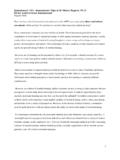
1 Revised 04/21/10 G. Rogers Student Outcomes and Performance Indicators Performance Indicators are a means to focus on specific expectations of a program. They facilitate the curriculum delivery strategies, and assessment procedures. There is an important first step that must come before the development of Performance Indicators , and that is deciding on Student Outcomes . These are usually communicated to students in the program description, and are stated in terms that inform the students about the general purpose of the program and expectations of the faculty. The primary difference between Student Outcomes and Performance Indicators is that Student Outcomes are intended to provide general information about the focus of Student learning and are broadly stated of the outcome , not measurable, while Performance Indicators are concrete measurable performances students must meet as Indicators of achievement.
2 Performance Indicators are developed from program Outcomes . Sample Student Outcomes : o students will work effectively as a member of a team. o students can apply the principles of math and science to a technical problem. o students will have an appreciation for the need to be lifelong learners. o students will have effective communication skills. Performance Indicators indicate what concrete actions the Student should be able to perform as a result of participation in the program. Once program Outcomes have been identified, the knowledge and skills necessary for the mastery of these Outcomes should be listed.
3 This will allow the desired behavior of the students to be described, and will eliminate ambiguity concerning demonstration of expected competencies. Performance Indicators are made up of at least two main elements; action verb and content (referent). The expected behavior must be specified by name, using an observable action verb such as demonstrate, interpret, discriminate, or define. Sample Performance Indicators : o students will know a professional code of ethics. (knowledge) o students will be able to describe the problem solving process. (comprehension) o students will solve research problems through the application of scientific methods.
4 (application) Cunningham, G. K. (1986). Educational and psychological measurement. New York: MacMillan Publishing. McBeath, R. J., Ed. (1992). Instructing and evaluating in higher education: A guidebook for planning learning Outcomes . Englewood Cliffs, NJ: Educational Technology Publications. 5 Revised 04/21/10 G. Rogers COGNITIVE learning is demonstrated by knowledge recall and the intellectual skills: comprehending information, organizing ideas, analyzing and synthesizing data, applying knowledge, choosing among alternatives in problem-solving, and evaluating ideas or actions.
5 Level Illustrative Verbs Definition Example Knowledge arrange, define, describe, duplicate, identify, label, list, match, memorize, name, order, outline, recognize, relate, recall, repeat, reproduce, select, state remembering previously learned information memory of specific facts, terminology, rules, sequences, procedures, classifications, categories, criteria, methodology, principles, theories, and structure Comprehension classify, convert, defend, describe, discuss, distinguish, estimate, explain, express, extend, generalize, give examples, identify, indicate, infer, locate, paraphrase, predict, recognize, rewrite, report, restate, review, select, summarize, translate grasping the meaning of information stating problem in own words, translating a chemical formula, understanding a flow chart, translating words and phrases from a foreign language Application apply, change, choose, compute, demonstrate, discover, dramatize, employ, illustrate, interpret, manipulate, modify, operate, practice, predict, prepare, produce, relate, schedule, show, sketch, solve, use.
6 Write applying knowledge to actual situations taking principles learned in math and applying them to figuring the volume of a cylinder in an internal combustion engine Analysis analyze, appraise, break down, calculate, categorize, compare, contrast, criticize, diagram, differentiate, discriminate, distinguish, examine, experiment, identify, illustrate, infer, model, outline, point out, question, relate, select, separate, subdivide, test breaking down objects or ideas into simpler parts and seeing how the parts relate and are organized discussing how fluids and liquids differ, detecting logical fallacies in a Student 's explanation of Newton's 1st law of motion Synthesis arrange, assemble, categorize, collect, combine, comply, compose, construct, create, design, develop, devise, design, explain, formulate, generate, integrate, manage, modify, organize, plan, prepare, propose, rearrange, reconstruct, relate, reorganize, revise, rewrite, set up, summarize, synthesize, tell, write rearranging component ideas into a new whole writing a comprehensive report on a problem-solving exercise, planning a program or panel discussion, writing a comprehensive term paper Evaluation appraise.
7 Argue, assess, attach, choose, compare, conclude, contrast, defend, describe, discriminate, estimate, evaluate, explain, judge, justify, interpret, relate, predict, rate, select, summarize, support, value making judgments based on internal evidence or external criteria evaluating alternative solutions to a problem, detecting inconsistencies in the speech of a Student government representative Gronlund, N. E. (1981). Measurement and evaluation in teaching, 4th ed. New York, Macmillan Publishing. McBeath, R. J., (Ed.). (1992). Instructing and evaluating in higher education: A guidebook for planning learning Outcomes .
8 Englewood Cliffs, NJ: Educational Technology Revised 04/21/10 G. Rogers AFFECTIVE learning is demonstrated by behaviors indicating attitudes of awareness, interest, attention, concern, and responsibility, ability to listen and respond in interactions with others, and ability to demonstrate those attitudinal characteristics or values which are appropriate to the test situation and the field of study. Level Illustrative Verbs Definition Example Receiving asks, chooses, describes, follows, gives, holds, identifies, locates, names, points to, selects, sits erect, replies, uses willingness to receive or attend listening to discussions of controversial issues with an open mind, respecting the rights of others Responding answers, assists, complies, conforms, discusses, greets, helps, labels, performs, practices, presents, reads, recites, reports, selects, tells, writes active participation indicating positive response or acceptance of an idea or policy completing homework assignments.
9 Participating in team problem-solving activities Valuing completes, describes, differentiates, explains, follows, forms, initiates, invites, joins, justifies, proposes, reads, reports, selects, shares, studies, works expressing a belief or attitude about the value or worth of something accepting the idea that integrated curricula is a good way to learn, participating in a campus blood drive Organization adheres, alters, arranges, combines, compares, completes, defends, explains, generalizes, identifies, integrates, modifies, orders, organizes, prepares, relates, synthesizes organizing various values into an internalized system recognizing own abilities, limitations, and values and developing realistic aspirations Characterization by a value or value complex acts, discriminates, displays, influences, listens, modifies, performs, practices, proposes, qualifies, questions, revises, serves, solves, uses, verifies the value system becomes a way of life a person's lifestyle influences reactions to many different kinds of situations Gronlund, N.
10 E. (1981). Measurement and evaluation in teaching, 4th ed. New York, Macmillan Publishing. McBeath, R. J., (Ed.). (1992). Instructing and evaluating in higher education: A guidebook for planning learning Outcomes . Englewood Cliffs, NJ: Educational Technology Publications. 7 Revised 04/21/10 G. Rogers PSYCHOMOTOR learning is demonstrated by physical skills: coordination, dexterity, manipulation, grace, strength, speed; actions which demonstrate the fine motor skills such as use of precision instruments or tools, or actions which evidence gross motor skills such as the use of the body in dance or athletic Performance .











![Gender Equality and Women's Empowerment in India [OD57]](/cache/preview/0/7/f/d/9/7/1/6/thumb-07fd97166dd92c7359501888c42037d3.jpg)