Transcription of SUBJECT MATTER JURISDICTION
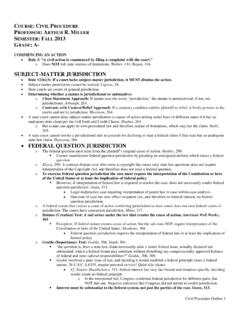
1 CIVIL PROCEDURE. ARTHUR R. MILLER. FALL 2013. GRADE: A. RULE 3: A civil action is commenced by filing a complaint with the court . SUBJECT MATTER JURISDICTION . Rule 12(b)(1) and (h)(3): if the court determines at any time that it lacks SUBJECT MATTER JURISDICTION , the court must dismiss the action o Capron: SUBJECT MATTER JURISDICTION can NEVER be waived o Lacks: state courts are courts of general JURISDICTION IS A STATUTE IS JURISDICTIONAL OR SUBSTANTIVE? o Clear-statement approach: if statute contains the word JURISDICTION then it's jurisdictional, Arbaugh o Statute of limitations is jurisdictional because the word JURISDICTION is in the statute, Sand o Context-relief approach: if statutory provision entitles plaintiff to relief, then it's probably substantive, not jurisdictional, Morrison CONCURRENT JURISDICTION . o Hughes: state court cannot close doors to a cause of action arising under laws of another state per Full Faith and Credit But states can apply their own procedural laws (Wells).
2 O Howlett: per the Supremacy Clause, a state cannot refuse to hear a claim arising under federal law when that defense would not bar an analogous state law claim o Haywood: per the Supremacy Clause, a state cannot invoke a non-neutral jurisdictional rule to decline to hear a federal claim if there is an analogous state law claim DIVERSITY OF CITIZENSHIP JURISDICTION ( 1332). o Strawbridge: rule of complete diversity 3 Statutory Exceptions to Strawbridge that only require minimal diversity 1332(d) Class Action Fairness Act 1335 Interpleader 1369 Multiparty, Multiform JURISDICTION (mass accident statute). o Need at least 75 deaths o Citizenship of Persons ( 1332 (a)(1)): must be BOTH US citizens and domiciliaries of a state MAS V. PERRY: for diversity JURISDICTION , citizenship means US citizen and domiciliary of a state Domicile is one's true home and persists until one 1) moves to another place, with 2) intention to remain there o Zuckerberg: going to college does not change domicile o Center of gravity test: documents, taxes, etc.
3 O Alienage JURISDICTION ( 1332(a)(2-4)). Traffic Stream: citizenship is determined using US law, not foreign law Sadat: in cases of dual citizenship, only US citizenship is considered, and thus alienage JURISDICTION cannot be invoked If no state domicile (but US citizenship), no diversity JURISDICTION Rubinstein: stateless person cannot invoke alienage JURISDICTION Hiulin: cannot have alien v. alien unless US citizens with complete diversity on both sides CA + UK v. NV + France = okay CA v. NV + UK = okay CA + UK v. France = not okay CA v. France = okay UK v. France = not okay, even if either or both are domiciled in a US state o But a foreign citizen, domiciled in a state, cannot sue or be sued in federal court by a US. citizen domiciled in that same state (don't want two people living in the same state suing each other in federal court ). o Manufacturing Federal JURISDICTION ( 1359). Kramer and Grassi: cannot use assignment to create or destroy diversity to gain federal JURISDICTION Rose: cannot tack on nominal non-diverse parties to destroy diversity JURISDICTION 1.
4 O Citizenship of Corporations ( 1332 (c)(1)): place of incorporation & principal place of business To determine principal place of business: NERVE CENTER test (Hertz). Federally chartered banks are citizens where MAIN office is located (Wachovia) and maybe principal place of business as well (circuit split). o Citizenship of Unincorporated Associations: sum total of the citizenship of all the associations' members Hoagland: drew a bright line rule between corporations and unincorporated associations 1332 (d)(10) treated differently under CAFA. o Citizenship in Representative Actions ( 1332(c)(2)). Citizenship of the representative of a decedent, infant, or an incompetent is the same as that of the represented (excludes derivative suits and class actions). Historic rule that tested citizenship in terms of the representative, not the represented, still applies to derivative suits and class actions not governed by CAFA. o Amount in Controversy ( 1332(a)): must exceed $75,000 (Freeland).
5 St. Paul Mercury: party invoking diversity JURISDICTION bears burden of showing amount in controversy Plaintiff's sum controls if claim is made in good faith unless it is a legal certainty that the claim is really for less than the requisite amount o Joinder of Parties and Claims: Rules of Aggregation Everett: Plaintiff an aggregate multiple claims against single defendant, even when not arising from same incident at all (Rule 18). TROY BANK, Eagle Star, Durant: multiple plaintiffs v. defendant Can only aggregate claims if the claim is common and indivisible, seeking to enforce a single title or right such that if one plaintiff failed to collect, the other would collect a larger share ( estates). o *Judicial exceptions to diversity of citizenship: domestic relations and probates FEDERAL QUESTION JURISDICTION ( 1331). o *Requires the interpretation of federal law or at least the implication of federal policy. o Osborn: Federal ingredient test o MOTTLEY: federal question must arise from the plaintiff's original cause of action Cannot manufacture federal question JURISDICTION by pleading an anticipated defense that raises a federal question ( artful pleading ).
6 O Eliscu: A contract dispute regarding who owns a copyright only raises state questions about contract law and thus does not implicate the interpretation of 1338's patent provisions o HOW TO OBTAIN FEDERAL ARISING UNDER JURISDICTION . 1. CREATION TEST. American Well-Works: Creation test, suit arises under the law that creates the cause of action Vast majority of federal question JURISDICTION arises under this test o *Exception Shoshone Not all causes of action created by federal law necessarily confer federal question JURISDICTION 2. STATE/FEDERAL LAW HYBRIDS . SMITH V. KANSAS CITY: implication of an important federal policy can confer federal JURISDICTION even in a purely created state-law cause of action o MO declaring federal bonds ultra vires questions the constitutionality of congressional act to issue bonds ( VERY important) and would destabilize bonds, raise national interest rates MOORE: a state cause of action that incorporates a federal statute does not necessarily confer federal question JURISDICTION if no important federal policy is implicated o KY interpreting Federal Safety Appliance Act to see if there was a violation of safety standards would not have any impact outside of KY, no federal policy implicated MERRELL DOW.
7 State tort claim implicating federal labeling statute did not confer federal question JURISDICTION because the federal interest at stake was not substantial enough o Implication that no private right of action means no federal question JURISDICTION GRABLE: state law must raise a FEDERAL issue, disputed and SUBSTANTIAL, and exercising federal JURISDICTION would not upset BALANCE OF FEDERALISM (IMPORTANCE TEST). o A federal right of action is NOT always required in order to have federal question JURISDICTION (Merrell Dow did not overrule Smith). Sole issue in this case was the interpretation of a federal tax statute (in-hand or mail service?) with potentially wide-reaching administrative effects and it would not upset federalism due its rarity (quiet title action). EMPIRE: cf. Grable because this case was very fact-driven, not law-driven 2. o court read negative inference into Congress' silence on cause of action, since the act in question conferred JURISDICTION on other parts of the statute Federal interest is just not substantial enough, unlike Grable GUNN: substantiality inquiry under Grable must look to the importance of the issue to the federal system as a whole not just to the parties litigating the case o A legal malpractice claim that requires extensive interpretation of the exclusively federal patent statute ( 1338) but does not affect federal patent law one iota Mims: a federal statute conferring JURISDICTION on states does not oust federal JURISDICTION o Federal and state have concurrent JURISDICTION SUPPLEMENTAL JURISDICTION ( 1367).
8 O GIBBS: federal courts MAY exercise supplemental JURISDICTION over a substantial jurisdictionally sufficient claim and a jurisdictionally insufficient claim if: 1. Both claims must arise from a common nucleus of operative fact . 2. Must be such that he would expect to try them all in one judicial proceeding These two elements make it such that the entire action before the court comprises one constitutional case (tying back to Art. III, 2). *Aldinger and Finley both refused to extend Gibbs's approach of pendent-claim JURISDICTION to pendent-party JURISDICTION (EXPLICITLY overruled in 1367). o (a) In any civil action where court has ORIGINAL JURISDICTION , it shall also have supplemental JURISDICTION over all other claims from the same case or controversy (CNoOF). Includes pendent party AND pendent claim o (b) In diversity actions ONLY, supplemental JURISDICTION shall NOT extend to the following categories if it would destroy violate 1332 (destroy complete diversity, but not amount-in-controversy).
9 Claims by plaintiffs against persons made parties [defendants] under Rule 14, 19, 20, 24. KROGER: codified in 1367(b). o Plaintiff cannot bring a Rule 14(a) claim against a non-diverse third-party UNLESS third-party fires first with a 13(a) claim, then plaintiff can fire back with another 13(a) claim ALLAPATTAH: if one plaintiff meets the amount in controversy, then additional plaintiffs' claims arising from the same nucleus of operative fact, even if below the requisite amount, can be permissively joined under Rule 20 and the court can exercise supplemental JURISDICTION over them per . 1367 (b). o Since Rule 20 as applied to plaintiffs is not excluded in (b). Claims by persons proposed to be joined as plaintiffs under Rule 19. Claims by persons seeking to intervene as plaintiffs under Rule 24. o (c) Reasons to decline to exercise supplemental JURISDICTION (originally stated in Gibbs). Claim raises novel or complex issue of state law Supplemental claim substantially predominates over jurisdictionally sufficient claim All jurisdictionally sufficient claims have been dismissed Exceptional circumstances Executive Software: 1367(c)'s discretionary reasons for when a federal court can decline to exercise supplemental JURISDICTION in either federal question or diversity cases o Catchall of exceptional circumstances should be construed relatively narrowly REMOVAL JURISDICITON ( 1441, 1446).
10 O (a) Only defendant(s) can remove in both federal question and diversity cases if the federal court has original JURISDICTION over the civil action Shamrock: plaintiff cannot remove, defendant cannot remove based on a federal affirmative defense or a federal counterclaim (per Mottley). Bright: plaintiff cannot block removal by hiding federal nature of claim ( artful pleading ). *ALL defendants against whom the same claim is asserted under 1441(a) must consent to removal (Davis, 1446(2)(A)). *ALL defendants in a diversity case need to consent to removal ( 1446(2)(A)). *Consent of all defendants in same case or controversy (within supplemental JURISDICTION ) is needed for removal o (b) (2) Only out-of-state defendants can remove, but cannot remove if there are any in-state defendants involved Lively: circuit split on whether plaintiff can waive the any in-state defendant blocks removal rule, unclear if it's a jurisdictional or procedural bar 3.