Transcription of Subtracting with Multi-Digit Numbers
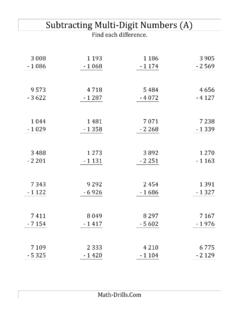
1 Page 1 of 11 MCC@WCCUSD 12/01/11 Subtracting with Multi-Digit Numbers Adaptable for 2nd, 3rd, 4th, and 5th grades* *Please note that this lesson will be most effective after students have been taught a conceptual foundation in subtraction using Base-10 Blocks and the Build It Draw It Write It model. Objective: Students will be able to solve subtraction problems, including Subtracting across zeroes, using a variety of methods, including open number lines, decomposition, and the traditional algorithm. Direct Instruction/ Teacher Model/ I Do Write on board: 1000 647 Many of you take a look at a problem like this and get scared. Today we re going to look at this problem and show you three different ways that you could solve it. By the end of the lesson, Subtracting larger Numbers even if they have a lot of zeros in them will no longer scare you. Open number Line The first way that we are going to solve this problem is using an open number line.
2 Our first step when using an open number line is to draw a blank number line. We then place a tick mark at one end and another at the other end. The two Numbers we are working with are 1000 and 647, so those are the Numbers that we need to place. Which is the smaller of those Numbers ? [647] Do we place that on the left or the right side of our number line? [On the left.] Tell your partner why. [Because on a number line, Numbers get smaller as we go to left and larger as we go to the right.] Then we ll place 1000 on the right. Now if the problem that we are solving is 1000 647, we are looking for the difference between these two Numbers . And the difference between them in this case is the distance between them on this number line. In order to find that difference, we are not going to jump straight from 647 to 1000; we are going to make smaller jumps, ones that we can do in our heads. That means that we are going to try to make easy 10 s or easy 100 s Numbers that we can work with easily using mental math.
3 Emphasize with the students that when using an open number line, we are not concerned with proportions. Also, know that there are many ways to subtract on an open number line, so there is no one way that is the right way. 647 1000 Page 2 of 11 MCC@WCCUSD 12/01/11 I know that to get from 647 to 650 is making a jump of 3. From 650, I know that jumping 50 more will get me to 700. I can jump another 100 to 800, then another 100 to 900, and then another 100 to 1000. I also could have gone straight from 700 to 1000 because I know that s a jump of 300. From looking at my open number line, I can see that the difference between 1000 and 647 is 3 + 50 + 100 + 100 + 100, or 353. Other possibilities for the same number line: 647 1000 650 900 800 700 3 50 100 100 100 647 1000 650 700 3 50 300 647 1000 657 700 697 677 10 3 300 667 687 10 10 10 10 Page 3 of 11 MCC@WCCUSD 12/01/11 Decomposition When we re faced with a problem that scares us, one thing we can do is look for a way to break it down into problems that are easier for us to solve.
4 That s where decomposition comes in. If trying to subtract 647 from 1000 is hard for me, I m going to find a way to subtract 647 from something that isn t as hard for me. 1000 647 = 999 1 647 352 1 353+ =+= Traditional Algorithm We should still be able to solve this using the traditional algorithm. One reason to save this one for last is that since we have now solved our problem twice, we can check our answer right away to confirm if we used the traditional algorithm correctly. 9 9 10 10 10 1000 647353 Once you have determined that you arrived at the same answer all three ways, then you can use the inverse operation to check your answer: 353 647 1000+= I can decompose 1000 into 999 + 1. Then I subtract the 647 from 999. Then I cannot forget to recompose the 1. In the ones place, I have 0 minus 7. Since that will give me a negative number , I will try to regroup from the tens place.
5 In the tens place, I have a 0 and therefore no tens from which to regroup. I will try to regroup from the hundreds place. In the hundreds place, I have a 0 and therefore no hundreds from which to regroup. I will try to regroup from the thousands place. In the thousands place, I have 1 thousand which I will regroup into 10 hundreds. That will leave me with 0 thousands and 10 hundreds. But I still don t have ones with which to subtract. So now that I have 10 hundreds, I will regroup one of them into 10 tens. That will leave me with 9 hundreds and 10 tens. But I still don t have ones with which to subtract. So now that I have 10 tens, I will regroup one of them into 10 ones. That will leave me with 9 tens and 10 ones. Now I can subtract 7 ones from 10, which gives me 3 ones. I can subtract 4 tens from 9, which gives me 5 tens. I can subtract 6 hundreds from 9, which gives me 3 hundreds. And I have no thousands. The difference is 353.
6 Page 4 of 11 MCC@WCCUSD 12/01/11 Guided Instruction/ We Do Example: 3005 1879 Open number Line Write an open number line with two end marks on it. Tell your partner which number is going to be written on which side of the number line. [1879 on the left, 3005 on the right] We re going to start at 1879 and make logical jumps until I get to 3005. Have the students give you suggestions for the size of the jumps. Below is one way to solve the problem. How will we find the difference between 3005 and 1879? [We will add up all of our jumps.] 1201001000 51126+ Decomposition 3005 1879 = 2999 1 5 1879 1120 1 5 1126++ =++= 1879 3005 1880 3000 2000 1900 1 20 100 1000 5 I can decompose 3005 into 5 + 2999 + 1. Then I cannot forget to recompose the 5 and the 1. Then I subtract the 1879 from 2999. Page 5 of 11 MCC@WCCUSD 12/01/11 We know that there are different ways to decompose. What is another way in which you could you decompose 3005 to help you solve this problem?
7 [2999 + 6] Page 6 of 11 MCC@WCCUSD 12/01/11 Traditional Algorithm 9 9 2 10 10 15 3005 18791126 Once you have determined that you arrived at the same answer all three ways, then you can use the inverse operation to check your answer: 1126 1879 3005+= In the ones place, I have 5 minus 9. Since that will give me a negative number , I will try to regroup from the tens place. In the tens place, I have a 0 and therefore no tens from which to regroup. I will try to regroup from the hundreds place. In the hundreds place, I have a 0 and therefore no hundreds from which to regroup. I will try to regroup from the thousands place. In the thousands place, I have 3 thousands from which I will take 1 and regroup it into 10 hundreds. That will leave me with 2 thousands and 10 hundreds. But I still don t have ones with which to subtract. So now that I have 10 hundreds, I will regroup one of them into 10 tens.
8 That will leave me with 9 hundreds and 10 tens. But I still don t have ones with which to subtract. So now that I have 10 tens, I will regroup one of them into 10 ones. That will leave me with 9 tens and 10 ones to add to my existing 5 ones. That leaves me with 15 ones. Now I can subtract 9 ones from 15, which gives me 6 ones. I can subtract 7 tens from 9, which gives me 2 tens. I can subtract 8 hundreds from 9, which gives me 1 hundred. I can subtract 1 thousand from 2, which gives me 1 thousand. The difference is 1126. Page 7 of 11 MCC@WCCUSD 12/01/11 You Try *There are many different possibilities for the solutions with open number lines and with decomposition. These are simply one example. 4100 1975 2510001000 1002125+ 4100 1975 = 3999 1 100 1975 2024 1 100 2125++ =++= 10 9 3 0 10 10 4100 19752125 1975 2000 4100 4000 3000 25 1000 100 1000 Page 8 of 11 MCC@WCCUSD 12/01/11 You Try (continued)
9 9000 3782 810200 50005218+ 9000 3782 = 8999 1 3782 5217 1 5218+ =+= 9 9 8 10 10 10 9000 37825218 3782 3790 9000 4000 3800 8 10 5000 200 Page 9 of 11 MCC@WCCUSD 12/01/11 Independent Practice/ You Do 502 - 273 720200 2229+ 502 273 = 499 1 2 273 226 1 2 229++ =++= 9 4 10 12 502 273229 273 280 502 500 300 7 20 2 200 Page 10 of 11 MCC@WCCUSD 12/01/11 5005 31561849 6000 - 428 270500 50005572+ 6000 428 = 5999 1 428 5571 1 5572+ =+= 9 9 5 10 10 10 6000 4285572 5005 3156 440800 10051849+ 5005 3156 = 4999 1 5 3156 1843 1 5 1849++ =++= 9 9 4 10 10 15 428 430 6000 1000 500 2 70 5000 500 3156 3160 5005 4000 3200 4 40 1005 800 Page 11 of 11 MCC@WCCUSD 12/01/11 9030 44684562 8201 7102 981000 11099+ 8201 7102 = 7999 1 201 7102 897 1 201 898+1+200= 1098+1= 1099 ++ =++= 9 1 10 11 8201 71021099 9030 4468 2305004000 304562+ 9 12 8 10 2 10 9030 4468 = 8999 1 30 4468 4531 1 30 4562++ =++= 7102 8201 8200 7200 98 1000 1 4468 9030 4470 9000 5000 4500 2 30 500 4000 30