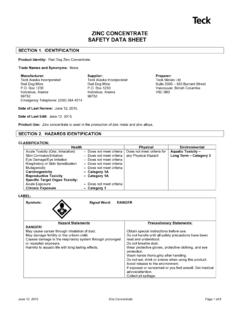
Transcription of Sulphuric Acid SDS - Teck Resources
1 Sulphuric acid . SAFETY DATA SHEET. SECTION 1. IDENTIFICATION. Product Identity: Sulphuric acid (93 percent). Trade Names and Synonyms: Oil of vitriol, electrolyte acid , battery acid , matting acid , H2SO4. Manufacturer: Supplier: Preparer: Teck Metals Ltd. Teck Metals Ltd. Teck Metals Ltd. Trail Operations Trail Operations Suite 3300 550 Burrard Street Trail, British Columbia Trail, British Columbia Vancouver, British Columbia V1R 4L8 V1R 4L8 V6C 0B3. Emergency Telephone: 250-364-4214. Date of Last Revision: May 22, 2015. Date of Last Edit: May 22, 2015. Product Use: Used in the manufacture of chlorine dioxide (a pulp and paper bleaching chemical), in the manufacture of phosphate and sulphate fertilizers, in the manufacturing of metal sulphates, as a metal pickling chemical and as a component of lead storage batteries.
2 SECTION 2. HAZARDS IDENTIFICATION. CLASSIFICATION: Health Physical Environmental Acute Toxicity (Inhalation) Category 2 Corrosive to Metals Category 1 Aquatic Toxicity . Skin Corrosion Category 1 Short Term Category 3. Eye Damage Category 1. Specific Target Organ Toxicity Acute Exposure Category 3. Chronic Exposure Category 2. May 22, 2015 Sulphuric acid Page 1 of 6. LABEL: Symbols: Signal Word: DANGER. Hazard Statements Precautionary Statements: DANGER! Causes severe skin burns and serious eye damage. Wear protective gloves, protective clothing, eye and face May cause respiratory irritation. protection.
3 May cause damage to teeth through prolonged and repeated Wash exposed skin thoroughly after handling. exposure to Sulphuric acid mists. Store and use only in a well-ventilated area. Keep Fatal if inhaled. containers tightly closed. May be corrosive to metals. In case of inadequate ventilation wear respiratory Harmful to aquatic life. protection. Do not breathe mist. Avoid release to the environment. Absorb spillage. IF IN EYES: Rinse continuously with water for several minutes. Continue rinsing and immediately call a poison centre/doctor. Specific treatment is urgent. IF ON SKIN: Take off immediately all contaminated clothing.
4 Rinse skin with water or shower. For large area burns, immediately call a poison centre/doctor. Wash contaminated clothing before reuse. IF INHALED: Remove person to fresh air and keep comfortable for breathing. IF SWALLOWED: Rinse mouth. DO NOT induce vomiting. Get medical attention if you feel unwell. Store in corrosion resistant container with a resistant inner liner. Emergency Overview: A strong mineral acid present as a colourless and odourless oily liquid when pure but may appear yellow to dark brown when impure. Extremely corrosive to all body tissues, causing rapid tissue destruction and serious chemical burns.
5 Skin or eye contact requires immediate first aid. Can decompose at high temperatures, forming toxic gases such as sulphur oxides. Non-flammable but reacts violently with water, generating large amounts of heat with potential for spattering of the acid . Can react with combustible materials to generate heat and ignition. Reacts with most metals, particularly when diluted with water, to form flammable hydrogen gas which may create an explosion hazard. It is highly toxic to aquatic organisms and plant life. Potential Health Effects: Sulphuric acid is not very volatile and workplace exposures are therefore primarily due to accidental splashes or to processes or actions that generate an acid mist.
6 It is extremely corrosive to all body tissues, causing rapid tissue destruction and serious chemical burns on contact with the skin or eyes. Skin or eye contact requires immediate first aid. Inhalation of Sulphuric acid mist or fumes may produce irritation of the nose, throat and respiratory tract. High levels of acid mist are also irritating to the skin and eyes. Chronic inhalation of acid mist may cause pitting and erosion of tooth enamel. Sulphuric acid , per se, is not listed as a carcinogen by OSHA, NTP, IARC, or the ACGIH. However, IARC, the ACGIH and the NTP have concluded there is sufficient evidence that occupational exposure to strong inorganic acid mists containing Sulphuric acid is carcinogenic or potentially carcinogenic to humans (see Toxicological Information, Section 11).
7 Potential Environmental Effects: Sulphuric acid is highly toxic to aquatic organisms and terrestrial plant life; however, it does not bioaccumulate or bioconcentrate through the food chain (see Ecological Information, Section 12). SECTION 3. COMPOSITION / INFORMATION ON INGREDIENTS. HAZARDOUS COMPONENTS CAS Registry No. CONCENTRATION (% wgt/wgt). Sulphuric acid 7664-93-9 93%. Note: See Section 8 for Occupational Exposure Guidelines. SECTION 4. FIRST AID MEASURES. Eye Contact: Symptoms: Burning, pain, blurring. Avoid direct contact. Wear chemical protective gloves, if necessary. Quickly and gently blot excess acid off face.
8 Immediately flush the contaminated eye(s) with lukewarm, gently flowing water, for at least 30 minutes, while holding the eyelid(s) open. If a contact lens is present, DO NOT delay irrigation or attempt to remove the lens. Neutral saline solution may be used as soon as it is available. DO NOT INTERRUPT FLUSHING. If necessary, continue flushing May 22, 2015 Sulphuric acid Page 2 of 6. during transport to emergency care facility. Take care not to rinse contaminated water into the unaffected eye or onto the face. Quickly transport victim to an emergency care facility. Skin Contact: Symptoms: Burning, pain, ulceration.
9 Avoid direct contact. Wear chemical protective clothing if necessary. As quickly as possible, remove contaminated clothing, shoes and leather goods ( , watchbands, belts), under shower if possible. Flush with lukewarm, gently flowing water for at least 30 minutes. DO NOT INTERRUPT FLUSHING. For acid splashes over large areas of the body transport quickly to an emergency care facility. If necessary, and if it can be done safely, continue flushing during transport to emergency care facility. Completely decontaminate clothing, shoes and leather goods before reuse or discard. Inhalation: Symptoms: Nose throat and lung irritation, coughing, wheezing.
10 Take precautions to ensure your own safety before attempting rescue ( , wear appropriate protective equipment, use the buddy system). Remove source of exposure or move person from exposure area to fresh air and keep comfortable for breathing. Call a Poison Centre/doctor or seek medical attention if you feel unwell. Ingestion: Symptoms: Burning pain in mouth and throat. Have victim rinse mouth thoroughly with water. DO NOT INDUCE. VOMITING. If vomiting occurs naturally, have person lie on their side in the recovery position. Have victim rinse mouth with water again. Quickly transport victim to an emergency care facility and bring a copy of this SDS.


![Lead Metal SDS[2] - Teck](/cache/preview/e/2/d/9/e/e/c/7/thumb-e2d9eec71c9c8be922f6a8aefa2723ab.jpg)