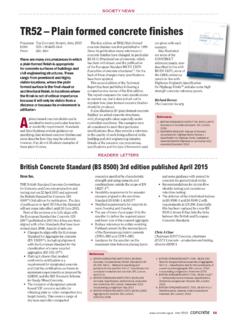
Transcription of Sustainability – technical feature
1 12 | Concrete TodayBRMCA British Ready-Mixed Concrete is a wide range of cement and cementitious materials avail-able in the UK, available as either factory-made composite cements, or equivalent combinations of CEM I (Portland cement ) and additional materials added at the concrete mixer. There is a growing demand to use these cements and additions as they will help reduce the envi-ronmental impact of concrete, may reduce cost and can be used to enhance durability. The most commonly used additional mate-rials, used either in factory-made or combination cements, are ground granulated blastfurnace slag (ggbs), fly ash, limestone and silica reactivity of the additional materials depends on their chem-ical composition and their fineness.
2 Simply stated, the greater the ratio of calcium and alumina to silica, and the finer the particle size material, the more reactive the material and so the more it can contribute to strength development. Table 1 shows a summary of the main physical characteristics of CEM I and the additional should be noted that none of these additional materials are usefully cementitious without an activator. The normal activator is provided by Portland cement or the Portland cement clinker com-ponent of a factory-made composite cement . Pozzolanic or latent hydraulic additional materials, such as fly ash, silica fume and ggbs, are those that either react with, or are activated by, alkali released by the hydration of the cement to form products that contribute to strength.
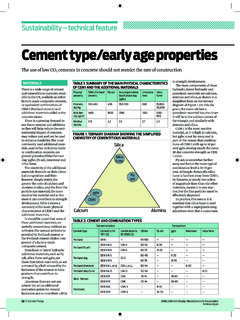
3 Limestone fines are not poz-zolanic but act as additional nucleation points for cement hydration and so contribute a little The use of low CO2 cements in concrete should not restrict the rate of constructionCement type/early age properties materialstable 1: summary of the main physical characteristics of cem i and the additional materialsto strength main components of these hydraulic, latent hydraulic and pozzolanic materials are calcium, alumina and silica, as shown in a simplified form on the ternary diagram of Figure 1. On this dia-gram, the more calcium a pozzolanic material has, the closer it will be to the calcium corner of the triangle, and similarly with alumina and silica.
4 CEM I is the most reactive material, as it is high in calcium, but ggbs is not far away and is part of the reason that combina-tions of CEM I with up to 50 per cent ggbs develop much the same 28-day concrete strength as CEM I alone. Fly ash is somewhat further away and hence the more typical combination level is 30-35 per cent. Although chemically silica fume is furthest away from CEM I, its fineness, at nearly two orders of magnitude finer than the other materials, means it is very reac-tive, but the fine particles must be effectively dispersed. In practice, this means it is essential that silica fume is used together with a superplasticising admixture such that a maximum Physical propertyCEM I (Portland cement )Fly ashGround granulated blastfurnace slag (ggbs)
5 Limestone finesSilica fumeFineness, m2/kg350-450450350-55066015,000- 35,000 Bulk den-sity, kg/m314001000120013001350-1510 Relative notationCompositionCement typeCement to EN 197-1 [1]Combination to BS 8500 [2]Clinkerfly ashggbslimestonesilica fumePortlandCEM I 95-100 Portland fly ash CEM II/A-VCIIA-V80-946-20 CEM II/B-VCIIB-V65-7921-35 Portland slagCEM II/A-SCII-S80-96 6-20 CEM II/B-S65-79 21-35 Portland limestoneCEM II/A-L or LLCIIA-L or LL80-94 6-20 Portland silica fumeCEM II/A-DCIIA-D90-94 6-10 Blast- furnace CEM III/ACIIIA35-74 36-65 CEM III/BCIIIB20-34 66-80 PozzolanicCEM IV/ACIVA-V 11-35 CEM IV/BCIVB-V 36-55 table 2: cement and combination typesSilicaCalciumAluminaSilica fumeFlyashggbsCEM Ifigure 1: ternary diagram showing the simplified chemistry of cementitious materialsSustainability technical feature 13 CONSTRUCT YEARBOOK 2009/2010of surface area is available for reaction.
6 As silica fume is so reactive it uses up the alkali released by the cement , so the percentage used is generally quite low, that is around 10 per cent. Limestone is generally used in cement to improve the fresh concrete or mortar proper-ties, where up to 15 per cent or so does not significantly reduce 28-day 2 shows the main cement and combination types, together with the standard nomenclature and the main constituents. The pozzolanic cement with siliceous fly ash as the pozzolana at 11-35 per cent, CEM IV/A-V, is included for completeness, but this is not available as a factory-made composite cement and in practice the readily available CEM II/B-V is accordance with EN 197-1 and EN 197-4 [1], cement is also categorised by strength class as well as cement type, and these categories are shown in Table 3, where there are minimum limits to early-age strength and limits for 28-day strength.
7 cement strength is based on testing a standard mortar, one part cement to three parts sand at a water/ cement of , and so there will be no direct relation-ship between cement strength and concrete strength where the mix proportions will be very is also important to note that there is no unique relationship between cement type and cement strength class. For example, in the UK:n CEM I is available as 52,5 N and 52,5 R;n CEM II/B-V is available as CEM II/B-V 42,5 N and CEM II/B-V 32,5 R;n CEM II/A L or LL is available as 32,5R, 42,5 N, 42,5 R and 52,5 N;n CEM III/A is available as CEM III/A 42,5 L but where CEM I is used in combination with higher percentages of ggbs then the appropriate equivalent strength class would be 32,5 L.
8 N CEM IV/B is available and where CEM I is used in combination with higher percentages of fly ash then the appropriate equivalent strength class would also be 32,5 should also be noted although these types and strength classes are available in the UK the local availability should be con-firmed if a particular type and strength class is required at com-mercially viable rates. Although the cement types with the lowest amount of clinker and of the lowest strength classes are likely to require more time to set, stiffen and develop strength, there is no unique relationship, as increasing the cementitious con-tent and reducing the w/c ratio of the concrete may counter the effects of the lower reactivity materials.
9 Having said this, it is useful to compare some of the earlier age properties of concrete made with Concrete Today | 13 BRMCA British Ready-Mixed Concrete The local availability should be confirmed if a particular type and strength class is required at commercially viable rates the range of cementitious materi-als using CEM I concrete as a reference, and this is shown in Table oddity in Table 4 is that the early strength of CEM I is shown as High , whereas as the table generally takes CEM I as the refer-ence perhaps the comparison should be Normal . The reason for this is that for a wide range of concrete applica-tions the strength provided by using CEM I cement is more than what is actually required.
10 For some applications such as precast concrete elements, in-situ post-tensioned concrete or cold weather concreting, the early strength development of CEM I concrete is essential, but for more normal applications then the per-formance is rightly considered high. StandardClassCompressive Strength, MPaEarly strengthStandard strength2 day7 day28 dayBS EN 197-1 (BS EN 197-4*)32,5 L* 12,0 32,5 52,532,5 N 16,032,5 R 22,5 42,5 L* 16,0 42,5 62,542,5 N 10,0 42,5 R 20,0 52,5 L* 10,0 52,5 52,5 N 20,0 52,5 R 30,0 table 3: cement strength Classes in aCCordanCe with en 197-1 and en 197-4 PropertyCement (or equivalent combination)Portland cement CEM ISilica fume cement CEM II/A-D (CIIA-D)Portland Limestone cement CEM II/A-LL or LPortland fly ash cement CEM II/B-V (CIIB-V)Blastfurnace CementsPozzolanic cement CEM IV/B-V(CIVB-V)CEM III/A (CIIIA)CEM III/B (CIIIB)