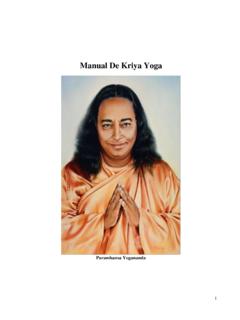
Transcription of SWAMI YOGANANDA AND THE SELF …
1 CRI, Box8500,Charlotte, NC 28271 Phone (704) 887-8200and Fax (704) 887-82991 STATEMENT DS213 SWAMI YOGANANDA AND THE self -REALIZATION FELLOWSHIPA Successful Hindu Countermission to the Westby Elliot MillerThe earliest Hindu missionaries to the West were arguably the most impressive. In 1893 SWAMI Vivekananda (1863 1902),ayoung disciple of the celebrated Hindu avatar (manifestation of God) Sri Ramakrishna (1836 1886), spoke at the World sParliament of Religions in Chicago and won an enthusiastic American following with his genteel manner and eruditepresentation. Overthe next few years, he inaugurated the first Eastern religious movement in America: the Vedanta Societies ofvarious cities, independent of one another but under the spiritual leadership of the Ramakrishna Order in India. In 1920 a secondHindu missionary effort was launched in America when a comparably charismatic neo-Vedanta SWAMI , ParamahansaYogananda, was invited to speak at the International Congress of Religious Liberals in Boston, sponsored by the UnitarianChurch.
2 After the Congress, Yoganandalectured across the country, spellbinding audiences with his immense charm andpowerful presence. In 1925 he established the headquarters for his self -Realization Fellowship (SRF) in Los Angeles on the siteof a former hotel atop Mount Washington. He was the first Eastern guru to take up permanent residence in the United States aftercreating a following : THE FORCE STRIKES BACKNeo-Vedanta arose partly as a countermissionary movement to Christianity in nineteenth-century India. Having lost a significantminority of Indians (especially among the outcast Untouchables ) to Christianity under British rule, certain adherents of theancient Advaita Vedanta school of Hinduism retooled their religion to better compete with Christianity for the souls not only ofEasterners, but of Westerners as , Advaita Vedanta, which was formulated by the Hindu philosopher Shankara (ca. 788 820), is the strictestmonist ( All is One ) philosophy in India.
3 It holds that God is an impersonal and formless Consciousness or Force, the world isan illusion (maya), and the path of devotion (Bhakti yoga ) to a personal god (Krishna, Shiva, Kali, etc.), though valid, is inferiorto the more direct and abstract approach of seeking oneness with theimpersonal Absolute (Brahman).Following the lead of Ramakrishna, who embraced the devotional elements not only of Hinduism but of Christianity and otherreligions as well, a new movement of Vedantists added a warm devotional emphasis to their cold monistic tradition and extolledChrist as one of the greatest avatars. They also opened up the previously restrictive practice of Vedanta to all regardless of caste,colour, or race 2and stressed the importance of balancing their contemplative life of worldlywithdrawal with active such distinctively Christian missionary practices as providing education and health care to the poor, they set upsuccessful missionary organizations in India ( , Vivekananda s Ramakrishna Order with its Ramakrishna Mission; YOGANANDA s Yogoda Satsanga Society, established in 1917) that were complemented by strong sister organizations in Europeand the United States.
4 Thus the Vedanta Societies and the self -Realization Fellowship were the first but farfrom the last Hindu missionary works planted in the rationale offered for such efforts was that the West though technologically advanced was spiritually impoverished,while India though technologically backward was spiritually advanced. Just as the West had brought technology to India,India was now imparting its spiritual riches to the West. Furthermore, they maintained, since Vedanta is a naturalistic philosophy,and since its adherents pursue union with the Absolute through empirical, time-tested, and rigorously systematized disciplines( yoga ), it is a scientific philosophy/religion that can bridge the growing gap between science and religion in the , Box8500,Charlotte, NC 28271 Phone (704) 887-8200and Fax (704) 887-82992 YOGANANDA S EXCELLENT ADVENTUREBorn Mukunda Lal Ghosh in northeastern Indiain 1893, YOGANANDA was a devout, college-educated, personable man.
5 He wasacquainted with many dignitaries in his native India (he even initiated Mahatma Ghandi into his kriya yoga ). After beinginitiated into the SWAMI Order, an ancient order of AdvaitaVedanta monks, YOGANANDA was sent to the West by his guru, SriYukteswar, to preach the gospel of kriya yoga (see below) and to work for the spiritual unification of East and public lectures, yoga classes, and published writings, Yoganandaattracted a sizable following, which included famedhorticulturist Luther Burbank. His best-sellingAutobiography of a Yogiis a New Age classic and, perhaps, the most readable andfascinating introduction to Hindu spirituality in the English s autobiography is replete with accounts of the mystical and miraculous, including his own ecstatic visions as well ashis encounters with legendary Hindu saints. The latter allegedly displayed such powers as levitation, materialization of asecond body, and the ability to live without such physical necessities as food and sleep.
6 Most fantastic of all is his description ofBabaji, the yogi Christ of India, who like the Immortals in the 1990sHighlandermovies and television series isbelieved to have retained the same 25-year-old appearance for hundreds or even thousands of years. Babaji allegedly initiated SriYukteswar s master, Lahiri Mahasaya, and thus got the SRF ball rolling. In the SRF visitor center, a drawing of Babaji, whichhad been sketched under YOGANANDA s supervision, accompanies photographs of Mahasaya and Yukteswar. Not surprisingly,although YOGANANDA supposedly met Babaji and his Autobiography is filled with pictures of the people (including Indian gurusand saints ) described in its pages, no known photograph of the yogi Christ yoga as Science. This emphasis on the extraordinary is accompanied by the repeated claim that yoga is a science, and thatsuch miraculous feats as these Hindu supermen performare, in fact, the natural results of a yogi s mastering the more subtlelaws of the universe and the self .
7 Indeed, YOGANANDA argued that yoga could prove to be the perfect counterbalance to the uniqueperils of our scientific age: The Western day is nearing when the inner science of self -control will be found as necessary as theouter conquest of indirect benefit of mankind s concern over atomic bombs may be an increased practical interest inthe science of yoga , a bombproof shelter truly. 4 InAutobiographyYogananda cites an observation made by Swiss psychiatrist(and New Age forefather) Carl J ng that the guru obviously took quite seriously: When a religious method recommends itself as scientific, it can be certain of its public in theWest. yoga fulfills this expectation. 5 kriya yoga , the distinctive system of yoga taught by YOGANANDA , is an advanced Raja Yoga6technique that reinforces andrevitalizes subtle currents of life energy in the body, enabling the normal activities of heart and lungs to slow down naturally. Asa result, the consciousness is drawn to higher levels of perception, gradually bringing about an inner awakening more blissful andmore deeply satisfying than any of the experiences that the mind or the senses or theordinary human emotions can give.
8 7 Among other disciplines, the kriya yogi manipulates this life energy (prana) through breath control and by mentally directing itaround his or her spinal cord. Death Had No Power ? YOGANANDA s mission to the West can be viewed only as a success. SRF claims that Yoganandapersonally initiated 100,000 students into yoga . His Autobiography has undoubtedly influenced a much greater number towardembracing Eastern mysticism. Like Vivekananda, YOGANANDA won a good measure ofacceptance and admiration from thecultural establishment. In 1927 he even received an audience with an enthusiastic President Calvin Coolidge. His 32-year missionin the United States helped pave the way for an unending cavalcade of Eastern gurus who havesince found a ripe mission field onAmerican died of heart failure in Los Angeles on 7 March 1952. SRF cites a notarized letter from the director of the LosAngeles Forest Lawn Memorial Park that affirms that YOGANANDA s body exhibited aphenomenal state of immutability.
9 At thetime of his burial 20 days after his death, there was no reason to say that his body had suffered any visible physicaldisintegration at all. 8 Thus SRF concludes that death had no power of disintegration over this incomparable devotee of God. 9 SRF AFTER YOGANANDAA fter YOGANANDA s passing, self -made business magnate J. L. Lynn (renamed Rajas Jana Kananda by YOGANANDA ) assumed thepresidency of SRF. Less than three years later Lynn also died, and SRF s leadership passed to the Reverend Mother Sri DayaMata. It was in 1931 that Daya Mata then a 17-year old Mormon girl named Faye Wright met YOGANANDA in Salt LakeCity. She says after he cured her of a blood disease that had forced her to leave high school, she became a nun in the SRF has continued as president of SRF to this , Box8500,Charlotte, NC 28271 Phone (704) 887-8200and Fax (704) 887-82993 Although three books bear her name and she regularly contributes toSelf-Realizationmagazine, Daya Mata has maintained a lowprofile, faithfully promoting YOGANANDA steachings and executing his wishes.
10 Under her leadership, SRF has expanded andcharted a steady course. SRF lacks the visibility of some of the newer Eastern movements whose colorful and controversialleaders are still living or only recently deceased ( , Maharishi Mahesh Yogi s Transcendental Meditation and the cult of thelate Bhagwan Shree Rajneesh). Nonetheless, SRF has demonstrated a staying power that most of the Eastern sects that haveappeared on the Western scene since the mid-1960s can only envy ( , Guru Maharaj Ji s Divine Light Mission, P. R. Sarkar sAnanda Marga yoga Society, and SWAMI Muktananda s Sidha meditation movement).Religious Life. Devotion is a central component of SRF religious life. The birth and, in some cases, death (mahasamadhi)anniversaries of the SRF gurus (not only YOGANANDA but also Jesus, Krishna, Babaji, Lahiri Mahasaya, and Sri Yukteswar) areadoringly observed each year ( Offerings of flowers and a donation should be brought 10). YOGANANDA is devotedly referred to as Master, his spiritual presence is believed in and sought in a manner comparable to that of Jesus for the Christian, and virtuallyeverything on which he left his mark at SRF s Mount Washington Mother Center has been turned into a shrine.