Transcription of Syllabus for B.Tech(ECE) Second Year
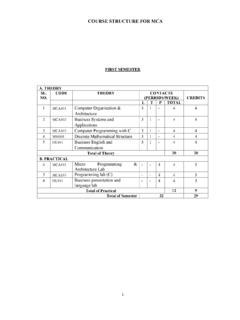
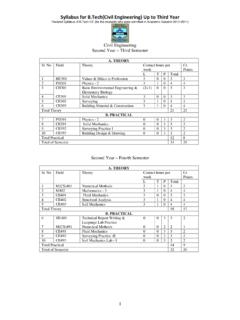
1 Syllabus for (ECE) Second Year Revised Syllabus of in ECE (To be followed from the academic session, July 2011, for the students who were admitted in Academic Session 2010-2011) 1 ECE Second YEAR: THIRD SEMESTER A. THEORY Field Theory Contact Hours/Week Cr. Points L T P Total 1 M(CS)301 Numerical Methods 2 1 0 3 2 2 M302 Mathematics!III 3 1 0 4 4 3 EC301 1. Circuit Theory & Networks 3 1 0 4 4 4 EC302 2. Solid State Device 3 0 0 3 3 5 EC303 1. Signals & Systems 2. Analog Electronic Circuits 3 3 0 1 0 0 3 4 3 4 EC304 6 Total of Theory 21 20 B. PRACTICAL 7 8 M(CS)391 EC391 Nunerical Lab Circuit Theory & Network Lab 0 0 0 0 2 3 2 3 1 2 9 EC392 Solid State Devices 0 0 3 3 2 10 11 EC393 EC394 1. Signal System Lab 2. Analog Electronic Circuits Lab 0 0 0 0 3 3 3 3 2 2 Total of Practical 14 9 Total of Semester 35 29 ECE Second YEAR: FOURTH SEMESTER A.
2 THEORY Field Theory Contact Hours/Week Cr. Points L T P Total 1 HU401 Values & Ethics in Profession 3 0 0 3 3 2 PH401 Physics!II 3 1 0 4 4 3 CH401 Basic Environmental Engineering & Elementary Biology 2+1 0 0 3 3 4 5 EC401 EC402 1. EM Theory & Transmission Lines 2. Digital Electronic & Intrgrated Circuits 3 3 1 1 0 0 4 4 4 4 Total of Theory 18 18 B. PRACTICAL 6 HU481 Technical Report Writing & Language Lab Practice 0 0 3 3 2 7 PH491 Physics!II Lab 0 0 3 3 2 8 9 EC491 EC492 1. EM Theory & Tx Lines Lab 2. Digital Electronic & Integrated Circuits Lab 0 0 0 0 3 3 3 3 2 2 Total of Practical 12 8 Total of Semester 30 26 Syllabus for (ECE) Second Year Revised Syllabus of in ECE (To be followed from the academic session, July 2011, for the students who were admitted in Academic Session 2010-2011) 2 SEMESTER 2 III Theory NUMERICAL METHODS Code : M(CS) 301 Contacts : 2L+1T Credits :2 Approximation in numerical computation: Truncation and rounding errors, Fixed and floating!
3 Point arithmetic, Propagation of errors. (4) Interpolation: Newton forward/backward interpolation, Lagrange s and Newton s divided difference Interpolation. (5) Numerical integration: Trapezoidal rule, Simpson s 1/3 rule, Expression for corresponding error terms. (3) Numerical solution of a system of linear equations: Gauss elimination method, Matrix inversion, LU Factorization method, Gauss!Seidel iterative method. (6) Numerical solution of Algebraic equation: Bisection method, Regula!
4 Falsi method, Newton!Raphson method. (4) Numerical solution of ordinary differential equation: Euler s method, Runge!Kutta methods, Predictor!Corrector methods and Finite Difference method. (6) Text Books: 1. : C Language and Numerical Methods. 2. Dutta & Jana: Introductory Numerical Analysis. 3. : Numerical Mathematical Analysis. 4. Jain, Iyengar , & Jain: Numerical Methods (Problems and Solution). References: 1. Balagurusamy: Numerical Methods, Scitech. 2. Baburam: Numerical Methods, Pearson Education. 3. N. Dutta: Computer Programming & Numerical Analysis, Universities Press.
5 4. Soumen Guha & Rajesh Srivastava: Numerical Methods, OUP. 5. Srimanta Pal: Numerical Methods, OUP. MATHEMATICS Code: M 302 Contacts: 3L +1T = 4 Credits: 4 Note 1: The entire Syllabus has been divided into four modules. Note 2: Structure of Question Paper There will be two groups in the paper: Group A: Ten questions, each of 2 marks, are to be answered out of a total of 15 questions, covering the entire Syllabus . Group B: Five questions, each carrying 10 marks, are to be answered out of (at least) 8 questions. Students should answer at least one question from each module. [At least 2 questions should be set from each of Modules II & IV. For B. Tech. 3rd Semester for GR B Streams Syllabus for (ECE) Second Year Revised Syllabus of in ECE (To be followed from the academic session, July 2011, for the students who were admitted in Academic Session 2010-2011) 3 At least 1 question should be set from each of Modules I & III.]
6 Sufficient questions should be set covering the whole Syllabus for alternatives.] Module I: Fourier Series & Fourier Transform [8L] Topic: Fourier Series: Sub2 Topics: Introduction, Periodic functions: Properties, Even & Odd functions: Properties, Special wave forms: Square wave, Half wave Rectifier, Full wave Rectifier, Saw!toothed wave, Triangular wave. (1) Euler s Formulae for Fourier Series, Fourier Series for functions of period 2 , Fourier Series for functions of period 2l, Dirichlet s conditions, Sum of Fourier series. Examples. (1) Theorem for the convergence of Fourier Series (statement only). Fourier Series of a function with its periodic extension. Half Range Fourier Series: Construction of Half range Sine Series, Construction of Half range Cosine Series.
7 Parseval s identity (statement only). Examples. (2) Topic: Fourier Transform: Sub2 Topics: Fourier Integral Theorem (statement only), Fourier Transform of a function, Fourier Sine and Cosine Integral Theorem (statement only), Fourier Cosine & Sine Transforms. Fourier, Fourier Cosine & Sine Transforms of elementary functions. (1) Properties of Fourier Transform: Linearity, Shifting, Change of scale, Modulation. Examples. Fourier Transform of Derivatives. Examples. (1) Convolution Theorem (statement only), Inverse of Fourier Transform, Examples. (2) Module II : Calculus of Complex Variable [13L] Topic: Introduction to Functions of a Complex Variable.
8 Sub2 Topics: Complex functions, Concept of Limit, Continuity and Differentiability. (1) Analytic functions, Cauchy!Riemann Equations (statement only). Sufficient condition for a function to be analytic. Harmonic function and Conjugate Harmonic function, related problems. (1) Construction of Analytic functions: Milne Thomson method, related problems. (1) Topic: Complex Integration. Sub2 Topics: Concept of simple curve, closed curve, smooth curve & contour. Some elementary properties of complex Integrals. Line integrals along a piecewise smooth curve. Examples. (2) Cauchy s theorem (statement only). Cauchy!Goursat theorem (statement only). Examples. (1) Cauchy s integral formula, Cauchy s integral formula for the derivative of an analytic function, Cauchy s integral formula for the successive derivatives of an analytic function.
9 Examples. (2) Taylor s series, Laurent s series. Examples (1) Topic: Zeros and Singularities of an Analytic Function & Residue Theorem. Sub2 Topics: Zero of an Analytic function, order of zero, Singularities of an analytic function. Isolated and non!isolated singularity, essential singularities. Poles: simple pole, pole of order m. Examples on determination of singularities and their nature. (1) Syllabus for (ECE) Second Year Revised Syllabus of in ECE (To be followed from the academic session, July 2011, for the students who were admitted in Academic Session 2010-2011) 4 Residue, Cauchy s Residue theorem (statement only), problems on finding the residue of a given function, evaluation of definite integrals: 200sin( ) , , cossin( )CxdP zdxdzxa b cQ z ++ (elementary cases, P(z) & Q(z) are polynomials of 2nd order or less).
10 (2) Topic: Introduction to Conformal Mapping. Sub2 Topics: Concept of transformation from z!plane to w!plane. Concept of Conformal Mapping. Idea of some standard transformations. Bilinear Transformation and determination of its fixed point. (1) Module III: Probability [8L] Topic: Basic Probability Theory Sub2 Topics: Classical definition and its limitations. Axiomatic definition. Some elementary deduction: i) P(O)=0, ii) 0 P(A) 1, iii) P(A )=1!P(A) etc. where the symbols have their usual meanings. Frequency interpretation of probability. (1) Addition rule for 2 events (proof) & its extension to more than 2 events (statement only). Related problems. Conditional probability & Independent events.