Transcription of Syllabus for Students studying in Class XI
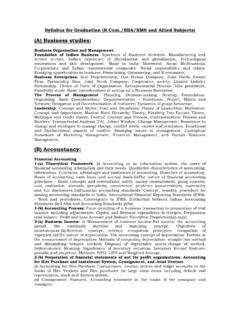
1 Syllabus for Students studying in Class XI (A) Business Studies 1. Foundations of Business- Nature and Purpose of Business, Forms of Business Organisations, Public, Private and Global Enterprises, Business Services, Emerging Modes of Business, Social Responsibility and Business Ethics, 2. Finance and Trade- Sources of Business Finance, Small Business, Internal Trade, International Business, Project Work (B) Accountancy 1. Financial Accounting-I: Theoretical Framework- Introduction of Accounting; objectives, advantages and limitations, types of accounting information; Theory Base of Accounting; Fundamental accounting assumptions, Accounting principles, Accounting Standards, Double entry system of accounting, Bases of accounting.
2 Accounting Process- Recording of Transactions; Accounting equation, rules of debit and credit, Origin of transactions, Books of original entry, Cash Book, Other books. Preparation of Bank Reconciliation Statement, Ledger and Trial Balance; Bank reconciliation statement, Ledger, Trial balance. Depreciation, Provisions and Reserves; Depreciation, Accounting treatment of depreciation, Provisions and Reserves. Accounting for Bills of Exchange; Bills of exchange and promissory note, Accounting treatment of bill transactions. Rectification of Errors. 2. Financial Accounting II: Financial Statements of Sole Proprietorship- Financial Statements, Trading and profit and loss account, Balance Sheet, Adjustments in preparation of financial statements, incomplete records, Ascertainment of profit/loss by statement of affairs method.
3 Computers in Accounting- Introduction to Computer and Accounting Information System {AIS}, Introduction to operating software, Accounting Information System (AIS), Automation of Accounting Process. (C) Economics 1. Statistics for Economics- Introduction; Meaning, scope and importance of statistics in Economics. Collection, Organization and Presentation of Data; Statistical Tools and Interpretation; Measures of Central Tendency, Measures of Dispersion, Correlation, Introduction to Index Numbers. 2. Introductory Microeconomics- Meaning of microeconomics and macroeconomics; Consumer's Equilibrium and Demand; Producer Behaviour and Supply, Forms of Market and Price Determination under perfect competition with simple applications (D) Aptitude Coding and Decoding, Arrangements, Cubes, Binary Logic, Calendars, Clocks, Directions, Blood Relations, Logical Consistency, Assumptions, Number series, Puzzles, Seating Arrangement, Non-verbal reasoning, Average, Time and Work, Time and Distance, Train questions, Partnership, Theme Detection, Probability, Data Interpretation.